
A motor vehicle report (MVR) is the official record of your driving history, kept by the agency in your state that issues driver’s licenses. It lists your license status, the traffic tickets you were convicted of, accidents, and any suspensions. If a new job or an insurance quote is asking for one, the worry is usually an old ticket. How long it follows you depends on your state and how serious it was. You can order your own copy for a small fee and see exactly what’s on it before anyone else does.
What’s on a motor vehicle report
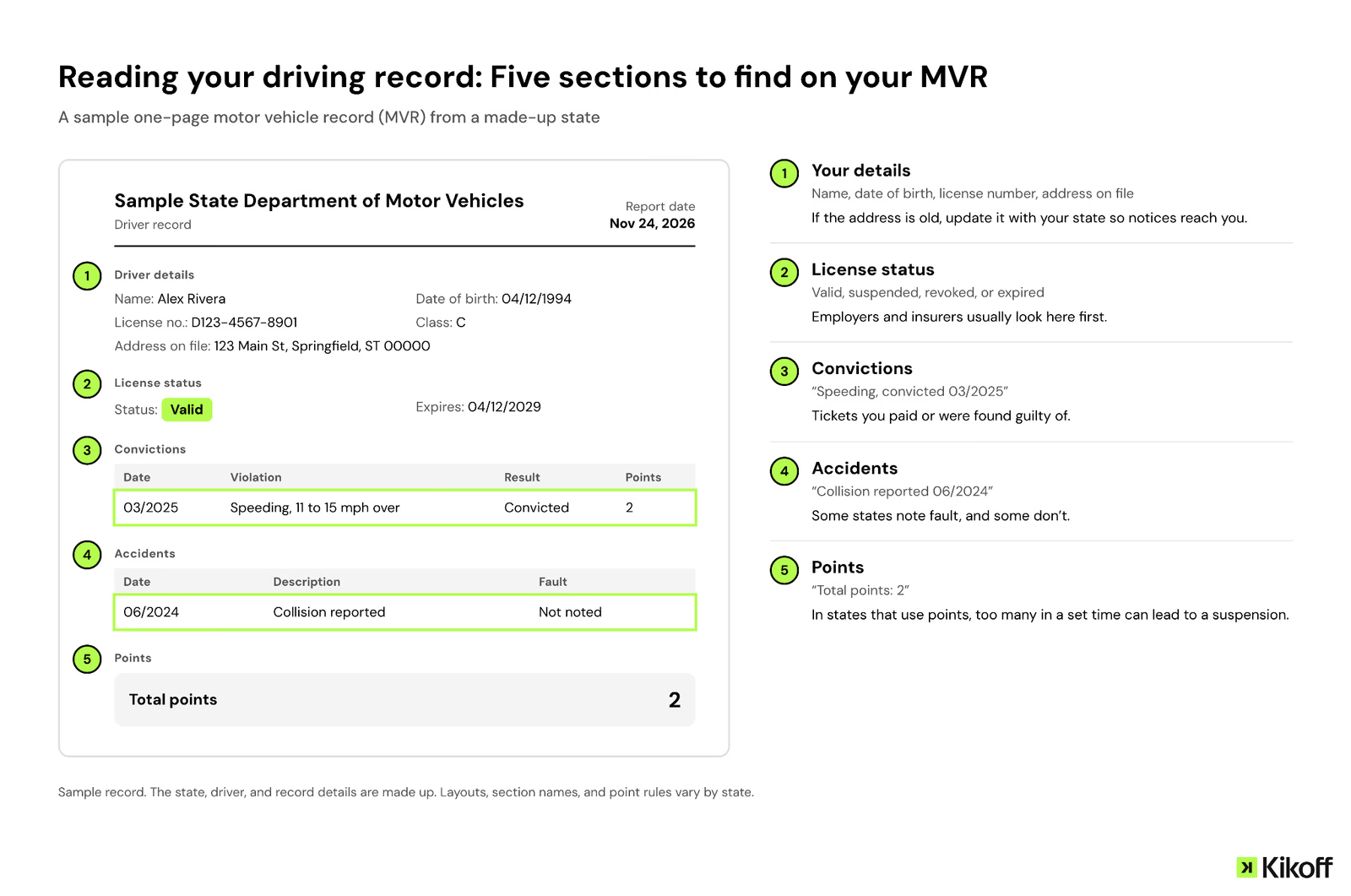
Every state formats its MVR differently, and some call it a driving record or an abstract. Most show the same basic pieces.
How long each item stays is set by your state. In California, for example, most traffic convictions show for three years, and so do collisions. DUI convictions show for 10 years.
Before you pay a ticket, ask the court whether paying it counts as a conviction on your record. In many places it does, and that’s the line insurers and employers will see.
Who can pull your MVR
Your state can’t hand the personal details on your MVR to just anyone. The Driver’s Privacy Protection Act bars state motor vehicle agencies from releasing your personal information, like your name, address, and photo, except for uses the law lists.
Many states also limit who can get the rest of your record. Those include:
- Insurers, for rating, underwriting, claims, and fraud checks
- Employers of commercial drivers, to confirm information about a commercial driver’s license
- Anyone with your written consent, such as an employer hiring for a job that involves driving
- A handful of others, such as government agencies and courts
If an employer uses a background check company to get your MVR, the Fair Credit Reporting Act adds steps. The employer has to get your written permission on a separate form, not inside the job application. If it plans to turn you down based on the report, it has to give you a copy first, so you can point out anything that’s wrong.
Commercial drivers get checked more often. Federal trucking rules require a motor carrier to request your MVR within 30 days of your start date from every state where you held a license in the past three years. After that, it has to pull it at least once every 12 months.
How to get your own MVR
Checking your own record doesn’t add anything to it or affect your insurance. It just shows you what others will see.
- Go to your state’s motor vehicle agency website. Use the official state site. Other sites may charge more for the same record.
- Pick the record type. Some states offer more than one. New York, for example, offers standard, lifetime, and commercial driver abstracts.
- Have your details ready. That’s usually your license number, date of birth, and a payment card. Some states also ask why you want the record and have you sign a form.
- Pay the fee. It varies by state. California charges $2 online and $5 by mail. New York charges $7 online and $10 by mail or in person.
- Save a copy right away. New York’s online PDF is available only for five days after you buy it.
What to do if something looks wrong
Compare the record with your own papers, such as a ticket, a court receipt, or an accident report. If it lists a ticket you beat in court, or shows one twice, contact your state’s motor vehicle agency. Ask whether it can correct the entry or whether the court has to send an update. Keep a copy of the court’s final decision as your proof.
What if an employer already saw the error? If the report came from a background check company, you can dispute the mistake with that company for free. Tell the employer in writing that you’ve filed a dispute, and send your corrected state record once you have it.
What an MVR doesn’t show
Your MVR tracks you as a driver. It doesn’t show your car loan, your payment history, or the car’s own past.
Title transfers and ownership records are handled by your state’s title office, and the rules differ by state. Buying used? Run a vehicle history report, but treat a clean one as a starting point. State reporting differs, so a report can miss problems.
According to the NAIC, insurers use credit-based insurance scores alongside factors like your driving record. In most states, that score can’t be the only reason an insurer raises your rate or turns you down, and some states limit it further. Your state’s department of insurance can tell you the rules where you live.
Bottom line
An MVR is your state’s record of you as a driver, and you can order your own for a small fee and check it before an insurer or employer does. It only covers the driving side. When you finance a car or get an insurance quote, your credit history may count too, and a clean driving record can’t add anything there. Kikoff’s Credit Account reports your on-time payments to Equifax, Experian, and TransUnion, with no credit check to sign up. Plans start at $5 a month.
Frequently Asked Questions
Article Sources
Disclaimer: The information provided in this blog post is meant for informational purposes only and does not constitute financial advice.