







A medical credit card is a credit card you can use only for health care, such as dental work, eye care, hearing aids, or a vet bill. It’s often offered right at the provider’s office, usually with a promotion like no interest if you pay the balance in full by a set date. If even a small balance is left when the promo ends, you may owe interest on the whole original amount, going back to the day of the purchase. From 2018 to 2020, people paid $1 billion in deferred interest on health care purchases made with these cards and loans, according to the Consumer Financial Protection Bureau (CFPB).
How a medical credit card works
A doctor or staff member usually signs you up, and the card company checks your credit. That check is usually a hard inquiry. If you’re approved, the card company pays your provider, and you pay the card company back. You can use the card only at providers that accept it.
Promotions come in two kinds that sound alike but treat a leftover balance very differently.
If “paid in full” means deferred interest. Before you sign, ask the office or the card company which kind of promotion you’re getting.
What deferred interest can cost
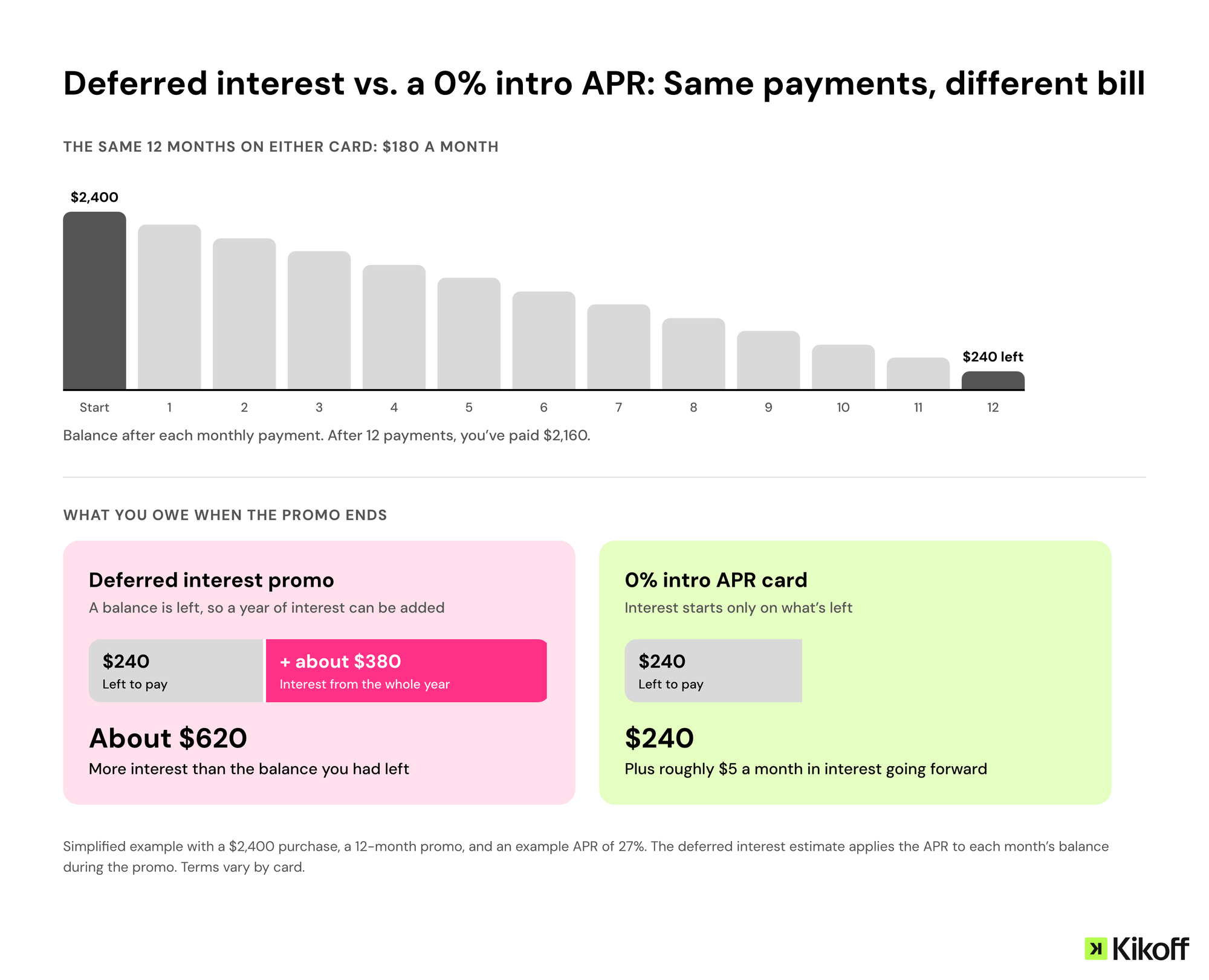
Here’s a simplified example. You put a $2,400 dental bill on a card with a 12-month deferred interest promo and an example APR of 27%. You pay $180 a month. After 12 payments, you’ve paid $2,160, and $240 is left.
Because a balance remains, the card company can add the interest that’s built up all year. In this example, that’s about $380, more than the balance you had left. With a 0% intro APR card, you’d pay interest only on the $240 going forward, roughly $5 a month at the same rate.
The interest you’ll pay depends on your daily balance and your card’s terms. The rates on medical credit cards and loans can be higher than traditional credit cards.
What federal rules require
The Credit CARD Act and Regulation Z, the federal rules for credit cards, set some limits on these promotions. They cover medical credit cards, not medical installment loans, which can be offered at the same front desk. If you’re offered a loan, read its terms on their own. For medical credit cards, the rules require:
- Clear wording. Ads for deferred interest must say “if paid in full” and state that interest will be charged from the purchase date if you don’t pay in full in time.
- The deadline on every statement. The date you must pay by has to appear on the front of each statement during the promo.
- At least six months. The card company generally can charge the built-up interest only if the promo lasted six months or longer and it told you the length of the promo and the interest rate up front. The exception is falling more than 60 days behind, which usually means missing two payments in a row. Then the card company can charge the built-up interest early, after giving you 45 days’ written notice.
- Extra payments at the end. In the last two billing cycles before the promo ends, anything you pay above the minimum must go to the promo balance first. Before that, you can ask the card company to send extra payments to the promo balance. It doesn’t have to agree.
If you already have a card, minimum payments usually won’t clear the balance in time. Find the promo end date on the front of your statement, divide the balance by the months left, and set up autopay for that amount.
How it can affect your credit
A medical credit card works like any other credit card on your credit reports. On-time payments add positive history. Late payments can show up on your credit report once you’re 30 days past due, and a high balance raises how much of your available credit you’re using.
Equifax, Experian, and TransUnion keep paid medical collections and medical collections under $500 off credit reports, and an unpaid medical collection can’t appear until a year after it goes to collections. Those protections don’t apply once a bill is on a medical credit card. If you fall behind on the card, it’s reported as a credit card account.
If a paid medical collection or one under $500 still shows up, it shouldn’t be there, and you can dispute it. Kikoff’s AI Credit Disputes can help you file.
Read more >> What Happens if You Don't Pay Your Medical Bills?
What to try before you apply
Start with the free options. You can try these in any order, and several at once.
- If your care is at a hospital, ask about financial assistance. Federal tax law requires nonprofit hospitals to have a written financial assistance policy, sometimes called charity care, that can reduce or cover your bill. Ask the billing office for an application. Even if you’ve already signed up for a medical credit card, you still have the right to apply.
- Ask for a payment plan with the provider. Many offices will split a bill into monthly payments with no card involved. Ask whether there’s interest or a fee.
- Ask about a sliding-fee discount. Community health centers that receive federal funding charge on a sliding scale based on income, and many offer dental care. Search for a health center near you.
- Ask for an itemized bill. Check it against your insurance statement before you pay or finance anything.
- Compare other credit options. A personal loan from a credit union, or a card with a true 0% intro APR, may cost less if you can’t pay before a promo ends.
Read more >> What Is Debt Forgiveness? Who Qualifies and What It Costs
If medical bills are more than you can manage, the National Foundation for Credit Counseling (NFCC) can connect you with free or low-cost debt counseling at 800-388-2227. If you were signed up for a card you didn’t understand or a promo wasn’t explained, submit a complaint to the CFPB.
Bottom line
A medical credit card costs nothing extra if you pay the full balance before the promo ends. If you can’t, deferred interest can add hundreds of dollars to the bill. If lower-cost credit, like a credit union loan or a true 0% card, wasn’t within reach this time, building credit history can help you qualify for it next time.
Kikoff’s Credit Account reports your on-time payments to Equifax, Experian, and TransUnion, with no credit check to sign up. Plans start at $5 a month.
Frequently Asked Questions
Article Sources
Disclaimer: The information provided in this blog post is meant for informational purposes only and does not constitute financial advice.