.jpg)
.jpg)



A home equity line of credit, or HELOC, is a revolving line of credit secured by your home. It lets you borrow against part of your available home equity during a set draw period, repay what you use, and potentially borrow again up to your limit.
That flexibility can be useful, but a HELOC also puts your home at risk. Most HELOCs have variable interest rates, payments can rise, and failing to repay could lead to foreclosure.
What is a HELOC?
A HELOC is an open-end line of credit that uses your home as collateral. If you already have a first mortgage, the HELOC is generally a second mortgage that you repay in addition to your existing home loan.
Unlike a home equity loan, which provides a lump sum, a HELOC gives you a borrowing limit. During the draw period, you can take out money as needed, repay it, and borrow again if the line remains available.
According to the Consumer Financial Protection Bureau (CFPB), a lender may freeze or reduce access to additional funds if your home’s value falls significantly or your financial circumstances materially worsen. A HELOC should not be treated as dependable emergency money.
Important: Your home secures the debt. If you cannot keep up with the payments, the lender could foreclose.
How much can you borrow with a HELOC?
Your available equity is your home’s current value minus the balances of loans secured by the property. Lenders also consider combined loan-to-value ratio, or CLTV. CLTV compares your existing mortgage balances plus the proposed HELOC limit with the home’s value.
For example, suppose:
- Your home is worth $300,000
- You owe $200,000 on your mortgage
- A lender allows a maximum CLTV of 80% for your application
First, multiply $300,000 by 80%, which equals $240,000. Then subtract the $200,000 mortgage balance. The resulting potential HELOC limit is $40,000.
This is only an illustration. A lender may use a different CLTV limit and may approve less based on your credit, income, debts, property value, and other underwriting requirements.
How does a HELOC work?
A HELOC generally has two phases: a draw period followed by a repayment period. The length and payment rules depend on the agreement.
The draw period
During the draw period, you can borrow up to the available credit limit, subject to the lender’s transaction rules and any freeze or reduction of the line. A draw period might last 10 years, but terms vary.
Your minimum payment depends on the agreement. Some HELOCs allow interest-only minimum payments during all or part of the draw period, while others require principal and interest. Paying only interest does not reduce the amount you borrowed.
As you draw more money, both your balance and required payment may increase. Review the agreement for minimum draw amounts, minimum outstanding balances, and transaction limits.
The repayment period
When the draw period ends, you generally can no longer take additional advances. You begin repaying the outstanding principal and interest over the schedule in your agreement, often 10 or 20 years. Some plans may require a large payment or the entire balance when repayment begins.
Monthly payments can increase substantially when principal is added, especially if you made interest-only payments during the draw period. The CFPB recommends reviewing the draw length, repayment terms, payment calculation, and rate-change disclosures before opening the account.
HELOC interest rates, payments, and fees
HELOCs usually have variable interest rates. A variable rate commonly consists of an index, such as the prime rate, plus a lender-set margin. When the index changes, your annual percentage rate and payment may change as well.
Some lenders allow you to convert part of a HELOC balance to a fixed rate. A fixed-rate conversion may make payments more predictable, but the fixed rate may be higher and a conversion fee may apply.
Depending on the plan, HELOC costs may include application, origination, appraisal, title, annual, inactivity, early-cancellation, or fixed-rate conversion fees. The CFPB lists common HELOC fees and recommends reviewing the loan documents carefully.
Compare offers using more than the introductory rate or initial payment. Review:
- The index and margin used to calculate the variable rate
- The introductory rate and when it ends
- Periodic and lifetime rate caps
- How minimum payments are calculated
- Draw and repayment lengths
- Closing, annual, transaction, and cancellation fees
- Whether a balloon payment could be required
HELOC vs. home equity loan vs. cash-out refinance
All three options can turn home equity into accessible funds, but they work differently. The CFPB identifies home equity loans and cash-out refinancing as common HELOC alternatives.
HELOC: A separate revolving line secured by your home. You borrow as needed during the draw period, and the rate is usually variable.
Home equity loan: A separate loan secured by your home. You receive a lump sum and begin repaying it on a set schedule. These loans usually have fixed rates, although terms vary.
Cash-out refinance: A new, larger mortgage replaces your current mortgage. You receive the difference in cash, subject to closing costs and lender requirements. Your entire mortgage takes on the new loan’s rate and terms.
A HELOC may fit an expense that unfolds over time. A home equity loan may be easier to budget when you know the amount needed and prefer a predictable payment. A cash-out refinance may be worth comparing when replacing the existing mortgage also makes financial sense.
Read more >> What Is a Cash-Out Refinance?
Pros and cons of a HELOC
A HELOC’s flexibility can be valuable, but it should be weighed against the risk of securing debt with your home.
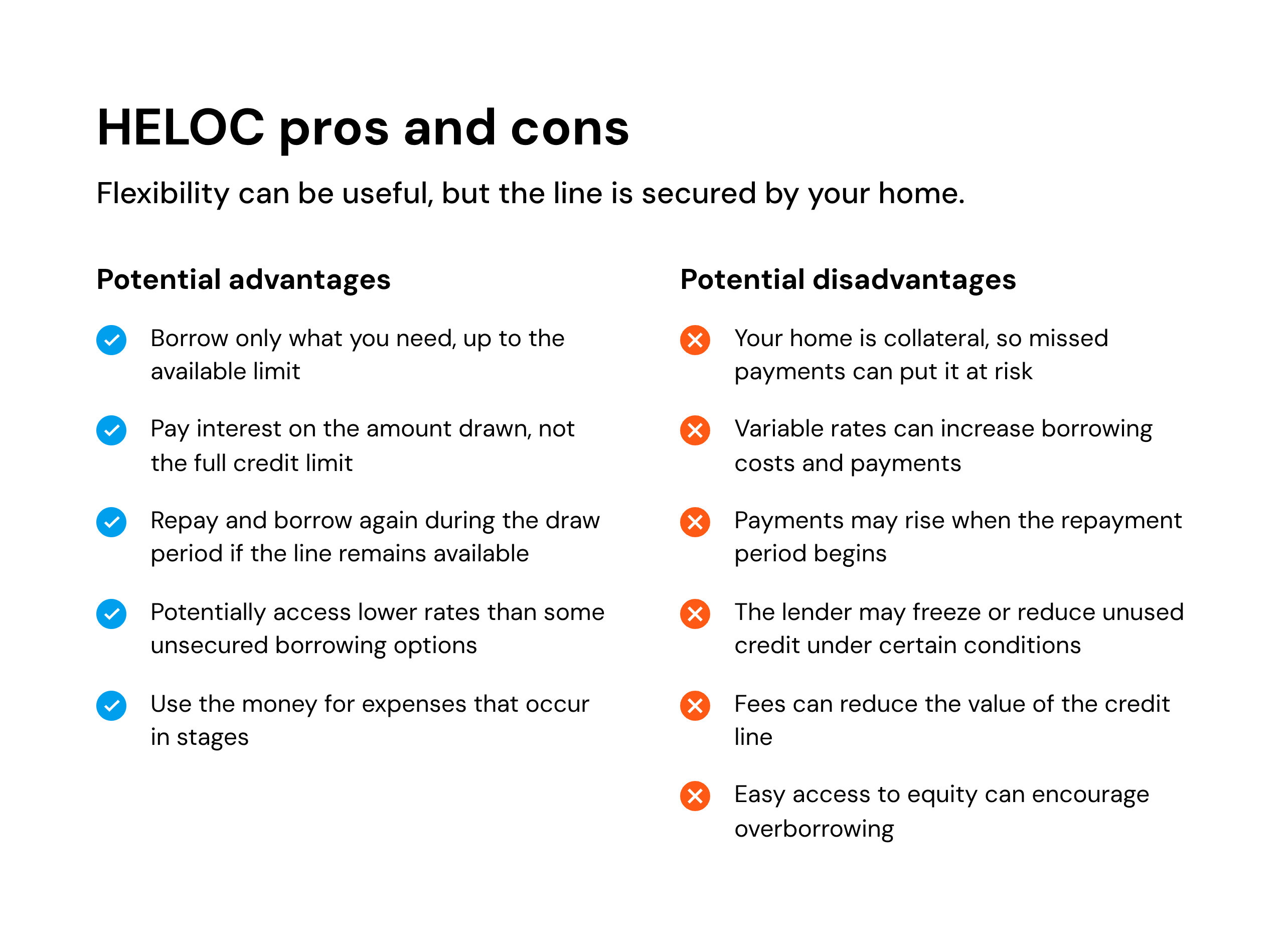
Potential advantages
- Borrow only what you need, up to the available limit
- Pay interest on the amount drawn rather than the full credit limit
- Repay and borrow again during the draw period if the line remains available
- Potentially access lower rates than some unsecured borrowing options
- Use the money for expenses that occur in stages
Potential disadvantages
- Your home is collateral, so missed payments can put it at risk
- Variable rates can increase both borrowing costs and payments
- Payments may rise when the repayment period begins
- The lender may freeze or reduce unused credit under certain conditions
- Fees can reduce the value of the credit line
- Easy access to equity can encourage overborrowing
How to qualify for a HELOC
Requirements vary by lender. A lender may review:
- Your available home equity and proposed CLTV
- Your credit history and scores
- Your income and employment
- Your debt-to-income ratio, or DTI
- The home’s appraised value and condition
- Your history of mortgage and other debt payments
The credit limit, rate, and fees offered may depend on several of these factors. No single credit score or equity percentage assures approval.
When comparing lenders, request the HELOC disclosures and review the rate formula, payment examples, fees, draw restrictions, repayment requirements, and maximum possible rate. A HELOC is not covered by the standard Loan Estimate and Closing Disclosure used for many mortgages, so pay close attention to the Truth-in-Lending disclosures provided for the line.
How a HELOC can affect future refinancing
A HELOC can complicate refinancing your first mortgage. The HELOC lender may need to approve remaining in a junior lien position behind the new mortgage. If it refuses, you may have to pay off or close the HELOC before refinancing, according to the CFPB.
If you expect to refinance soon, ask both lenders how the HELOC would be handled before opening or drawing from the line.
Read more >> How Soon Can You Refinance Your House?
When might a HELOC make sense?
A HELOC may be worth considering when you have stable income, can handle a higher future payment, and need funds over time rather than all at once. Common examples include staged home improvements or expenses with uncertain timing.
It may be a poor fit if you need the line for routine living expenses, would struggle if the rate or payment increased, or are using home equity to fund discretionary purchases you cannot otherwise afford.
HELOC interest is not automatically tax-deductible. The IRS says interest may be deductible, subject to applicable limits, when the money is used to buy, build, or substantially improve the home securing the debt. Interest on money used for personal expenses, such as paying credit card debt, generally does not qualify. Consider consulting a qualified tax professional about your circumstances.
Bottom line
A HELOC provides flexible access to home equity, but the rate, payment, fees, and available credit can change. Before borrowing, calculate how the payment could look during repayment, compare alternatives, and make sure your budget could absorb a higher rate or payment without putting your home at risk.
Credit history is only one part of HELOC underwriting, alongside equity, income, and existing debts. Kikoff’s Credit Account reports your on-time payments to all three major credit bureaus, with no hard credit check to join. It can help you add positive payment history, while HELOC approval and loan terms remain subject to the lender’s requirements.
Build credit with Kikoff and take a step toward stronger credit habits.
Frequently Asked Questions
Article Sources
Disclaimer: The information provided in this blog post is meant for informational purposes only and does not constitute financial advice.