
A credit card hardship program is a temporary agreement with your card company that makes payments easier after a job loss, medical bills, or another setback. Depending on the card company, it might lower your interest rate, cut your minimum payment, waive late fees, or let you skip a few payments. If you’re worried that calling will hurt your credit, asking about a hardship program doesn’t show up on your credit reports. A plan set up before you fall behind can also help keep late payments off them.
How a hardship program works
Each card company sets its own program, and some call it payment assistance instead. You usually have to ask, explain what changed, and show you can afford the new payment. You may need proof, such as a layoff notice or medical bills.
A plan doesn’t erase what you owe. You still repay the full balance, just on easier terms for a while.
Some plans come with conditions, such as autopay or not using the card. Ask about these before you say yes.
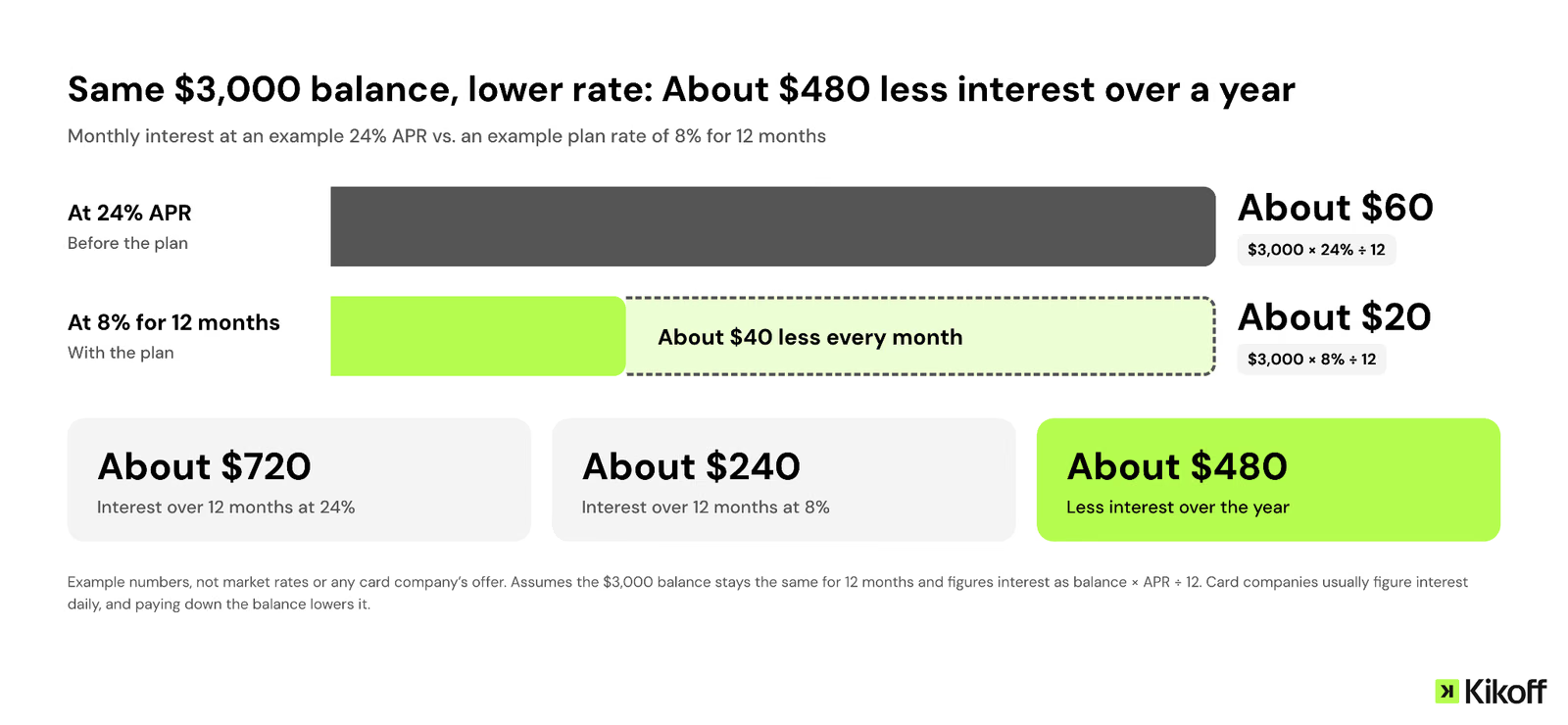
What a lower rate can save. Say you owe $3,000 at a 24% APR. That’s about $60 in interest a month ($3,000 × 24% ÷ 12). If a plan drops the rate to 8% for 12 months, interest falls to about $20 a month, or roughly $480 less over the year. These are example numbers, not market rates or any card company’s offer.
What federal rules say about your rate after the plan
Your card company can raise your rate again when the plan ends or if you don’t keep up with it. Federal credit card rules under the Credit CARD Act put two limits on that:
- No higher than before. On the balance from before the plan, the rate and fees can go back only to their pre-plan levels.
- Terms first. Your card company has to clearly disclose the plan’s terms before it starts, including what happens when it ends or if you miss a payment. If it explains them by phone, it has to follow up in writing as soon as it reasonably can.
A missed plan payment can show up on your credit reports once it’s 30 days late. If you’re more than 60 days late, your card company can apply a penalty rate to your existing balance, and that rate can be higher than your pre-plan rate.
Before you hang up. Ask for the rate, payment, plan length, and end date in writing. Write down the date and who you spoke with, so you have a record if the written terms don’t match the call.
How a hardship program can affect your credit
A hardship plan isn’t a late payment. Making the plan’s payments on time helps keep late payments off your credit reports. Two other effects are worth knowing:
- A note on your report. Your card company may report that the account is in a hardship plan, and lenders could see that. Ask how it will be reported before you agree.
- A closed card. If the card is closed, its limit stops counting toward your available credit. That can raise how much of your available credit you’re using on other cards. The account’s history stays on your report.
During the plan, check your credit reports free every week at AnnualCreditReport.com. A late payment for a month you paid as agreed is an error you can dispute for free with the credit bureau and the card company. Kikoff’s AI Credit Disputes can also help you dispute errors on your credit report for free.
Read more >> How Revolving Credit Accounts Affect Credit Utilization
Hardship program vs. other kinds of debt help
A hardship program covers one card. If you’re behind on several, compare your options.
If the numbers are hard to weigh against each other, the National Foundation for Credit Counseling (NFCC) can connect you with free or low-cost debt counseling at 800-388-2227. Ask any agency what it charges first, since nonprofit doesn’t always mean free.
Federal rules bar debt settlement companies from charging fees before they settle your debt. A company asking for money up front is a red flag.
How to ask for a hardship program
- Know your numbers. Start with what you can pay each month, then note what changed and when.
- Call your card company. Use the number on the back of your card, and ask about hardship or payment assistance programs before you miss a payment if you can.
- Get the terms in writing before your first plan payment, using the questions in the table above.
- Set up autopay for the plan payment if you can. Then check your next statement for the new terms.
If the answer is no, ask whether it can lower your rate or waive a fee without a formal plan, or call a nonprofit credit counselor.
Bottom line
A hardship program gives you easier terms for a while, and when the plan ends, federal rules keep the rate on your older balance from going higher than where it started, as long as you don’t fall more than 60 days behind. The plan protects one account, though. If your card company closes that card, you lose an open line and the limit that came with it. When your budget has room again, Kikoff’s Credit Account reports your on-time payments to all three credit bureaus, with no credit check to sign up. Plans start at $5 a month.
Frequently Asked Questions
Article Sources
Disclaimer: The information provided in this blog post is meant for informational purposes only and does not constitute financial advice.