
A rotating bonus category credit card pays extra cash back on a short list of spending categories, like groceries or gas, and swaps that list every three months. Everything else earns a lower base rate. The ads lead with the big percentage. The fine print adds three limits: a spending cap each quarter, a step you have to take to turn the bonus on, and interest that can wipe out what you earned if you carry a balance.
How rotating categories work
Each quarter goes the same way:
- The card company announces the categories, usually in its app or on its website before the quarter starts.
- You activate the bonus, usually with one tap or click. Until you do, category purchases earn the base rate.
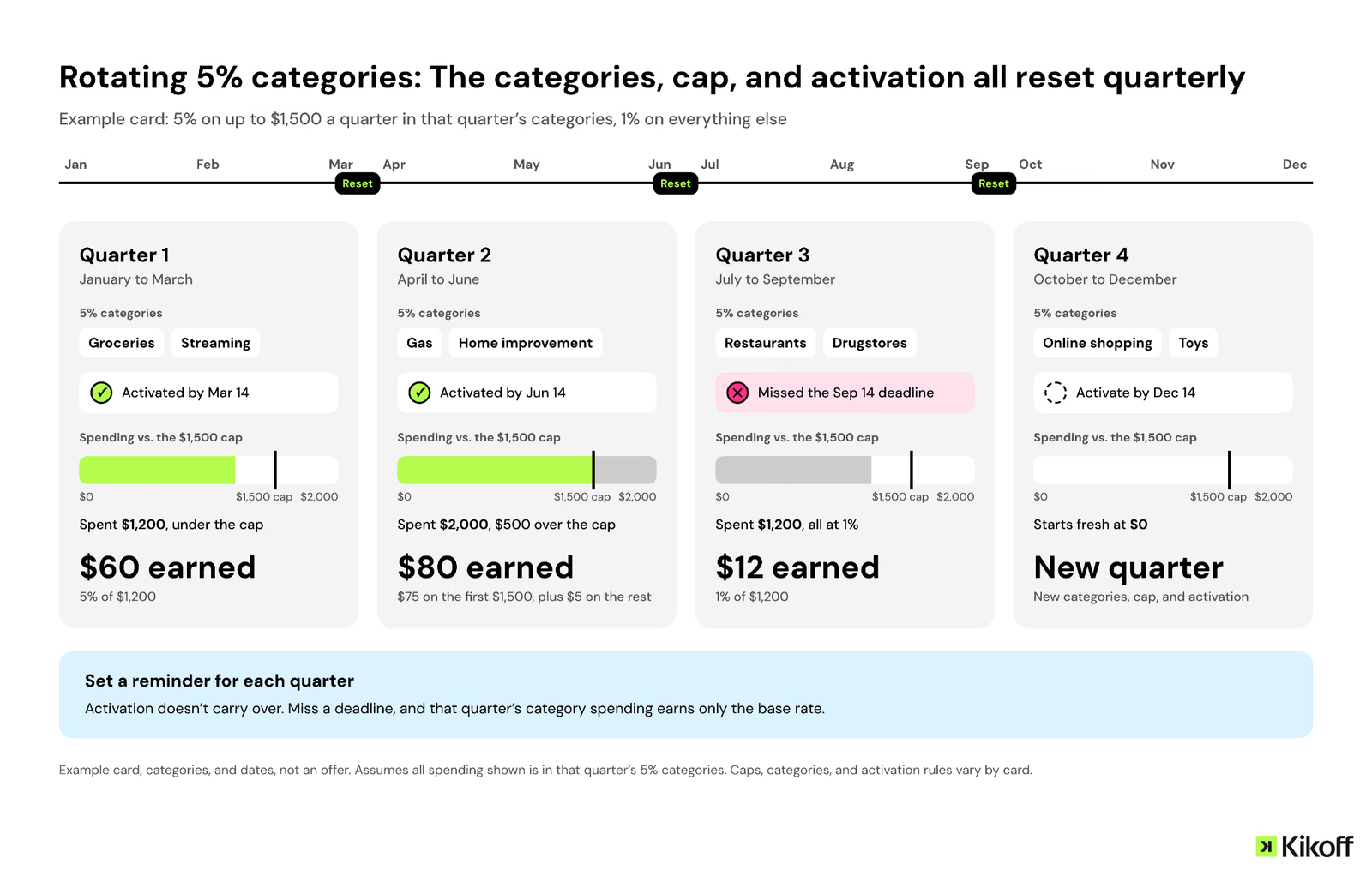
- You earn the bonus rate up to a cap. After that, and outside the categories, you earn the base rate. Then the quarter ends and everything resets.
As of November 2026, the rotating cards from Chase and Discover both pay 5% on up to $1,500 in combined category purchases each quarter you activate. On Chase’s card, spending past the cap earns 1%. So the most the bonus can pay is $75 a quarter, or $300 a year.
Here’s one example quarter on a card that pays 5% on up to $1,500 and 1% on everything else:
What happens if you forget to activate
Your purchases still go through, but they earn only the base rate. On Chase’s card, the 5% applies only in quarters you activate, so on $1,200 of groceries, $60 becomes $12.
Set a phone reminder for the day activation opens. Chase opened activation for its October–December 2026 categories on September 15. Ask the card company whether purchases you made before activating still earn the bonus.
Also check how the store is coded. A warehouse club or superstore may not count as “groceries,” even if that’s what you bought. And under Chase’s terms, the purchase has to post to your account by the last day of the quarter.
When interest cancels out your cash back
Rotating cards usually charge a variable APR, the yearly interest rate on balances you carry, set within a range based on your credit. From 2021 through 2025, the average APR on card accounts that paid interest ran about 16% to 23% a year, according to Federal Reserve data.
Take an example APR of 24%. Carry a $1,500 balance for a month, and you’ll owe about $30 in interest. Carry it for a full quarter, and it’s roughly $90, more than the $75 the bonus can pay.
To keep the bonus and skip the interest, pay your statement balance in full by the due date. Federal rules require your card company to mail or deliver your statement at least 21 days before the payment is due.
Can’t pay the full statement balance this month? Pay as much as you can above the minimum. Every dollar of interest you avoid is worth more than a few cents of cash back.
Federal rules that protect you
The Credit Card Accountability Responsibility and Disclosure Act of 2009, or CARD Act, covers rewards cards like any other credit card. Its rules are in a federal regulation called Regulation Z.
- Notice before key changes. Federal rules require your card company to give you written notice at least 45 days before a significant change in terms, like a higher APR.
- No rate increase in the first year. Card companies generally can’t raise your APR in the first year after you open the account. Exceptions include an intro rate ending or a variable rate moving with its index.
- Extra payments go to the highest rate first. Whatever you pay above the minimum goes to your highest-APR balance first, such as new purchases instead of a 0% intro balance.
- Late-payment deadlines build on each other. Pay at least the minimum as soon as you can. Card companies usually don’t report a late payment to the credit bureaus until it’s 30 days past due, so paying before then can keep it off your credit reports. Before 60 days keeps a penalty APR off the balance you already carry. If a penalty rate does start, six on-time minimum payments in a row require the card company to lower it on that balance.
- Under 21, you’ll need your own income or a cosigner. Card companies can open an account for someone under 21 only with proof of an independent ability to pay or a cosigner who’s at least 21.
The rewards program has its own terms for how categories, caps, and redemption can change. In a May 2024 report, the Consumer Financial Protection Bureau (CFPB) said rewards complaints often involved surprise conditions, devaluation, redemption problems, and revoked rewards. Save a copy of the rewards terms when you open the card. If rewards you earned disappear, contact the card company first, then submit a complaint if it isn’t resolved.
Is a rotating card a good fit for you?
If you’re new to credit, check whether the card company offers a preapproval check before you apply. It uses a soft inquiry, which doesn’t affect your credit. A full application usually means a hard inquiry.
Bottom line
A rotating bonus category card pays extra on categories that change every quarter, as long as you activate, stay under the cap, and pay in full. What it can’t do is get you approved. The card company decides that based on your credit history, and a thin file can mean a denial or a higher APR. Kikoff’s Credit Account reports your on-time payments to all three credit bureaus, with no credit check to sign up. Plans start at $5 a month.
Frequently Asked Questions
Article Sources
Disclaimer: The information provided in this blog post is meant for informational purposes only and does not constitute financial advice.