
A basis point is one-hundredth of a percentage point, or 0.01%. Lenders use it because mortgage rates move in small steps, and “the rate went up 25 basis points” is clearer than “the rate went up a quarter percent.” Those small steps add up, because a mortgage rate is charged on a large balance for decades. In this page’s example, 25 basis points on a $300,000 loan adds about $48 to the monthly payment and about $17,500 over 30 years.
What a basis point is
One basis point is 0.01 percentage point. So 25 basis points is 0.25 percentage point, 50 is half a point, and 100 is a full point. You may see it written as “bps.”
Percent vs. percentage point. If your rate goes from 6% to 6.25%, it went up 25 basis points, or 0.25 percentage point. Going up “0.25%” would technically take a 6% rate to only 6.015%. When a lender quotes a change, ask whether it means basis points.
What 25 basis points does to a mortgage payment
The table shows example rates on a $300,000, 30-year fixed loan, with principal and interest only.
These example rates leave out property taxes and insurance. On this loan, each basis point is worth roughly $2 a month.
Basis points vs. discount points
A basis point measures a rate. A discount point is a fee you pay at closing to get a lower interest rate, and one point equals 1% of the loan amount. On a $300,000 loan, one point costs $3,000.
How much a point lowers your rate depends on the lender, the loan type, and the market. Lender credits work the other way: the lender covers some closing costs, and you take a higher rate. The lender has to send your Loan Estimate within three business days of your application. Points typically appear on page 2, Section A. Lender credits show as a negative number in Section J.
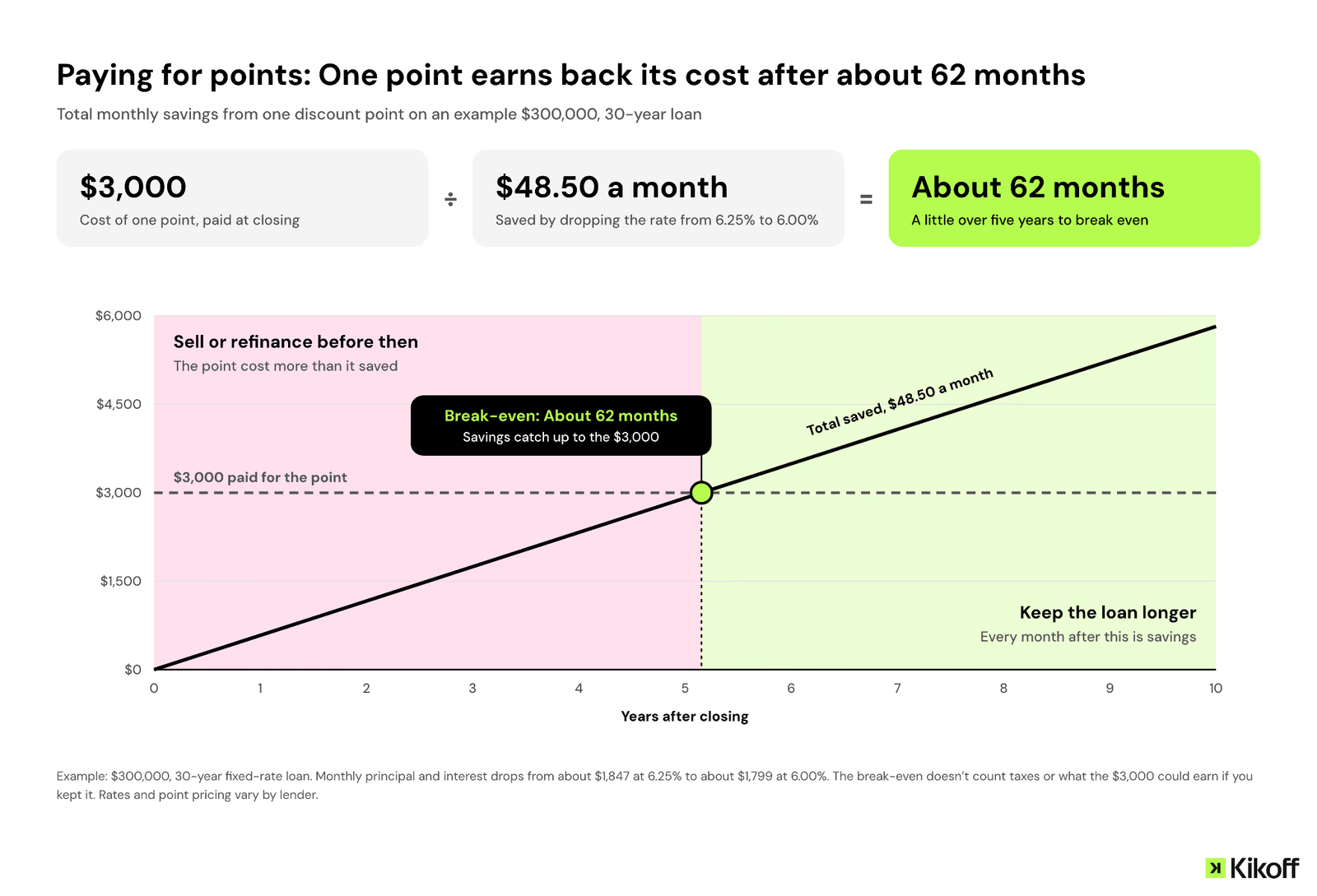
Before you pay for points, figure out when they pay you back. As an example, say one point ($3,000) takes the loan in the table from 6.25% to 6.00%. You’d save $48.50 a month, so it would take about 62 months, a little over five years, to earn back the $3,000. If you sell or refinance sooner, the points cost more than they saved.
To compare offers with different points, look at the APR. A mortgage APR includes the interest rate plus points and other charges to get the loan.
If the trade-offs are hard to weigh, a HUD-approved housing counselor can go over your Loan Estimate with you. Search for a counselor near you.
Basis points on an adjustable-rate mortgage
An adjustable-rate mortgage (ARM) starts with a fixed rate, then adjusts on a schedule to an index plus a margin. The index moves with the market. Your lender sets the margin, and it doesn’t change after closing. So if the index rises 25 basis points, your rate can rise 25 basis points at the next adjustment, up to your loan’s caps.
Rate caps are written in percentage points, so a 2-point cap lets your rate move up to 200 basis points at that adjustment. An ARM’s APR doesn’t show the highest rate you could pay, so before you sign, ask your lender for the first adjustment cap, the cap on later adjustments, and the lifetime cap.
Basis points on credit cards
Many credit cards have a variable APR, meaning a rate tied to an index, such as the prime rate, plus a margin. If the index goes up 25 basis points, your APR usually goes up 25 basis points too.
Federal rules under the Credit CARD Act allow this kind of increase only when the index is one your card company doesn’t control, and no advance notice is required. Raising the margin is a change to your terms. It needs written notice at least 45 days ahead, and it generally can’t happen in the account’s first year. The higher rate also generally can’t touch the balance you already carry unless you’re more than 60 days late on a minimum payment. A missed payment can show up on your credit reports around 30 days late, so pay at least the minimum as soon as you can.
How your credit affects the rates you’re offered
Your credit is one of the things lenders use to decide which rates to offer. In a CFPB example using April 2025 rate data for a $400,000 home with 10% down and a 30-year fixed loan, offers for a 625 credit score ranged from 6.125% to 8.875%. For a 700 score, they ranged from 5.875% to 8.125%. That’s 25 basis points lower at the bottom of the range and 75 at the top. A lower score isn’t a verdict on you. It’s how risk-based pricing works.
Before you apply, get your free credit reports from AnnualCreditReport.com. Checking them doesn’t affect your credit. If something’s wrong, dispute it with the credit bureau and the company that reported it.
Bottom line
Basis points are how lenders measure small rate differences, and on a mortgage, a few dozen of them can mean thousands of dollars over the loan. Discount points, caps, and Loan Estimates help you compare offers, but they don’t change the credit a lender uses to price you. On-time payment history adds to that record. Kikoff’s Credit Account reports your on-time payments to Equifax, Experian, and TransUnion, with no credit check to sign up. Plans start at $5 a month.
Frequently Asked Questions
Article Sources
Disclaimer: The information provided in this blog post is meant for informational purposes only and does not constitute financial advice.