.jpg)




Car loan interest became deductible again in 2025, but the rules leave out most people who have a car loan. You can deduct up to $10,000 a year in interest, no matter if you itemize, through tax year 2028. But it depends on when you took out the loan, where the car was assembled, and how the loan is secured. Used cars don't qualify, leases don't qualify, and refinancing an older loan doesn't bring it in.
If you're self-employed, you can deduct the business share of the interest on a car loan, thanks to an older rule that works differently and has nothing to do with where the car was built.
The new deduction for personal car loan interest
For tax years 2025 through 2028, you can deduct up to $10,000 a year in interest on a car loan — whether or not you itemize. It’s new as part of the One Big Beautiful Bill Act, signed in July 2025.
The loan, your vehicle, and how you use it must meet narrow qualifications, and there’s no partial credit.
The loan
- You took it out after December 31, 2024. A loan from before that doesn't qualify, and refinancing it later doesn't change that.
- You used it to buy the car. Leases don't qualify.
- The car secures the loan, and your lender is first in line on the title. This is what rules out buying a car with a credit card, a personal loan, or a home equity line, even if every dollar went into the car.
The car
- It counted as new when you bought it. The test is whether you're the first person to take delivery after the car was sold, registered, or titled, and whether your loan paperwork describes it as a new vehicle.
- Final assembly was in the United States. You can check yours with the NHTSA VIN Decoder, or read the final assembly point off the window sticker.
- It’s one of six types. That’s cars, minivans, vans, SUVs, pickup trucks, or motorcycles built for use on public roads.
- It meets weight requirements. Its gross vehicle weight rating (the maximum loaded weight the manufacturer rates it for) is under 14,000 pounds. Most passenger vehicles are well under, while some heavy-duty pickups aren't. The sticker in the driver's door jamb tells you.
- It isn't a salvage-title vehicle. And you didn't buy it for scrap or parts.
Two cases where "new" isn't obvious. If you leased a car and then bought it out at the end, you probably don't qualify: the leasing company took delivery first, and buyout paperwork generally doesn't describe the car as new. If you bought a dealer demonstrator that other people had test-driven, you probably do: the dealership was holding it for sale, not using it. A dealer's loaner car is the opposite case. Titling rules for demonstrators vary by state, so check the new-or-used designation on your loan agreement first.
How you use it
- When you took out the loan, you expected to drive the car more than half the time for personal use. It’s a yes or no question only once at signing. If work driving picks up later, you don't lose the deduction.
How much you can deduct
You can deduct up to $10,000 of interest a year. The deduction shrinks by $200 for every $1,000 your modified adjusted gross income runs above $100,000 ($200,000 if you're married filing jointly). At the full $10,000, that wipes it out by $150,000 ($250,000 jointly). If you're claiming less, it disappears sooner.
What you need to claim it
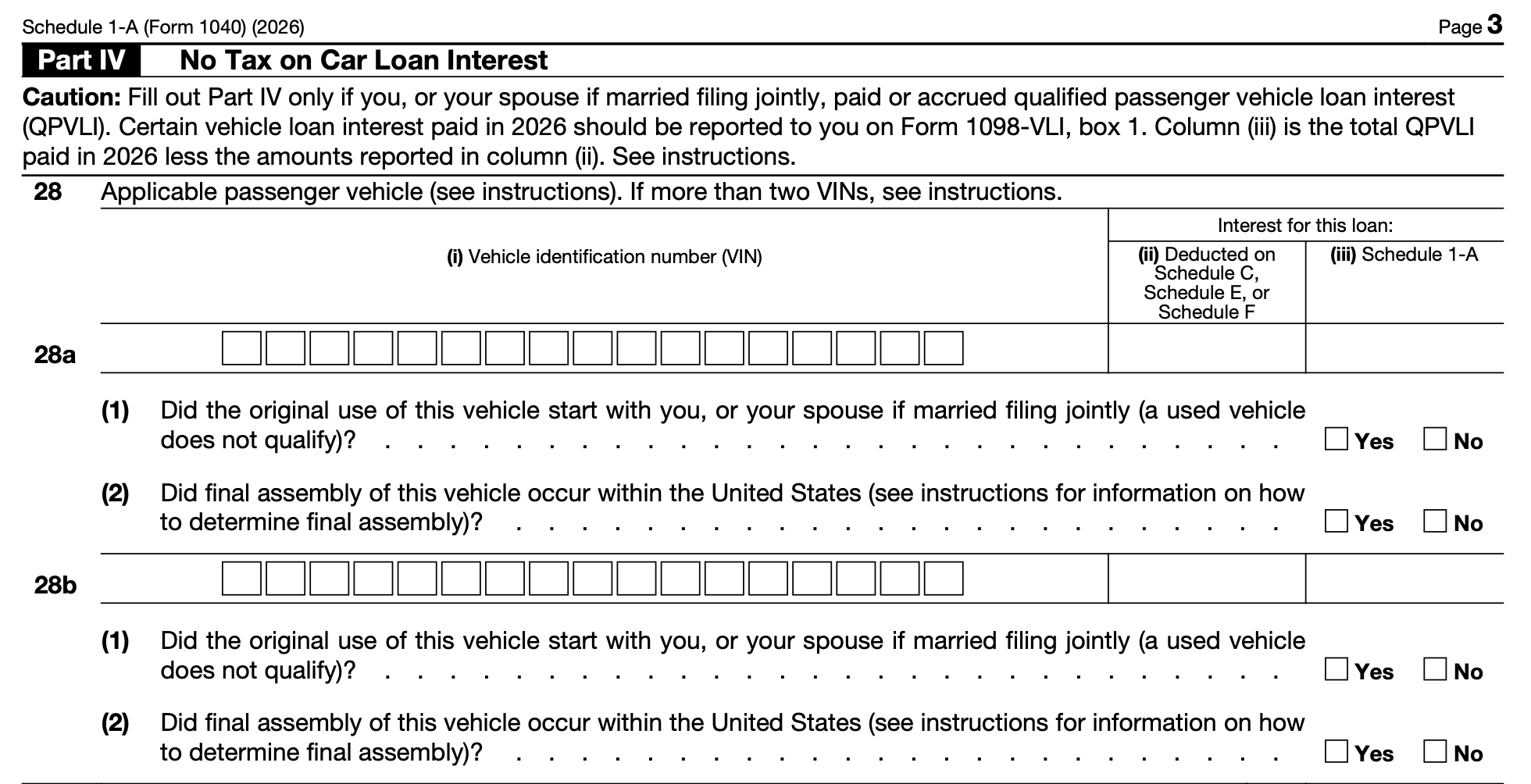
Claim the deduction on Schedule 1-A (Form 1040), Part IV, "No Tax on Car Loan Interest." And have these three numbers on hand when filing:
- The interest you paid. Lenders who collect $600 or more from you in a year now have to report it and make a statement available. It may be in your online loan portal rather than a form in the mail, so check there before you assume you're missing something.
- The car's VIN. Your VIN goes on line 22. Leave it off, and you don't get the deduction.
- Your modified adjusted gross income. Work out your modified AGI in Part I of the same schedule, before you get to Part IV.
If your loan or your car doesn't clear the list, you may still be able to deduct part of the interest based on business use.
Read more >> How to Pay Less Interest on a Car Loan
When car loan interest is tax-deductible
Only those who are self-employed can deduct car loan interest as a business expense. If you're a W-2 employee who drives your own car for work, loan interest is not deductible: employee business expenses have been suspended since 2018, and a 2025 tax law made that permanent. The personal-use deduction is still open to you.
Business use of a vehicle
If you’re self-employed and use your car for business, you can deduct the portion of your car loan interest associated with business use.
Say you paid $3,000 in interest last year on a car you drive 40% for business. You have a choice:
- You can treat the whole $3,000 as personal vehicle loan interest under the new rule, because you expected the car to be mostly personal when you took out the loan. You aren't required to split it.
- You can deduct $1,200 as a business expense on Schedule C and claim the rest under the new rule. What you can't do is count the same dollar twice.
At 60% business use expected when you signed, the car fails the new deduction's test, and your only route is the business one: $1,800 of the $3,000 on Schedule C.
Self-employment and freelance work
Self-employed workers and freelancers can claim vehicle expenses when they use their vehicle to conduct business activities. Examples include driving to meet clients or visit job sites. Keep in mind that commuting from your home to your regular workplace counts as personal driving.
Read more >> Is Car Insurance Tax-Deductible?
You don't have to pay for tax help. The IRS runs Free File for most filers and VITA, which offers free in-person help for people under certain income thresholds, people with disabilities, and limited-English speakers. TCE covers anyone 60 or older. Reach out to 800-906-9887 to find a site, or call AARP Tax-Aide, which runs most TCE sites, at 888-227-7669. Enrolled agents are licensed by the IRS and generally cost less.
If your situation is more complicated, talk with a CPA or financial advisor for guidance specific to your situation.
How to deduct car loan interest for business use
If you want to deduct car loan interest for business use, there are two methods available.
Actual expense method
With this method, you calculate the deductible portion of your vehicle’s qualifying expenses. These expenses may include:
- Gas and oil
- Repairs
- Auto insurance
- Registration fees
- Depreciation
If you use a vehicle for business and personal purposes, you need to divide expenses based on your business use.
Standard mileage rate
The standard mileage rate is a simpler option. Instead of tracking every operating expense, you multiply your qualifying business miles by the IRS mileage rate. The IRS raised the business rate partway through 2026: 72.5 cents a mile through June 30, and 76 cents from July 1. If you're claiming 2026 mileage, you'll need to split your log at that date.
The standard mileage rate covers expenses such as gas, insurance, maintenance, and depreciation. It doesn’t cover interest.
Bottom line
Car loan interest is deductible in two separate ways, and most people qualify for at most one. If you financed a new, US-assembled car after December 31, 2024, up to $10,000 of the interest comes off your taxes through 2028, whether you itemize or not. If you're self-employed and drive for work, the business share is a business expense. If you bought used, leased, or are driving your own car for an employer, neither avenue is open.
Either way, a deduction gives you back only a part of the interest. The rate on the loan decided how much interest there was to give back. And that rate was set by your credit on the day you applied, not by anything you do at tax time.
The Kikoff Credit Account reports to Equifax, Experian, and TransUnion, with no credit check to sign up and plans starting at $5 a month.
Frequently Asked Questions
Article Sources
Disclaimer: The information provided in this blog post is meant for informational purposes only and does not constitute financial advice.