Buying a home is one of the biggest financial milestones you’ll ever reach, but figuring out how to save for a down payment can feel overwhelming at first. How much do you actually need? How long will it take you to hit your savings target? Are there ways to speed up the process?
The good news is that you don’t have to save 20% down, which is a number you may have heard tossed around quite a bit. Saving for a down payment is absolutely within reach with the right plan. There are also down payment assistance programs and first-time homebuyer programs that you may be able to take advantage of.
With some financial discipline, you can save enough money to purchase a house and step into homeownership.
How to save for a down payment
Before you start saving for a down payment, you need to:
- Know your goal
- Build a system
- Stay consistent
Set a clear savings target based on the type of home you want and the loan you plan to use. Next, you need to create a structured savings plan that includes:
- Making automated contributions to your account
- Cutting out wasteful spending
- Increasing your income where possible
Consistency is what gets you across the finish line. Saving for a down payment on your home is about building momentum over time. You don’t have to do everything perfectly, but you should continually be making progress. Even small contributions will add up faster than you think.
How much do you need for a down payment?
The amount you need for a down payment depends on the type of loan you’ll be taking out and your credit score. While many people assume that they need 20%, that’s rarely the case due to the various mortgage options available.
Here’s a breakdown of how much you may have to put down by loan type:
- Conventional Loans: Typically 3% to 20%
- FHA Loans: 3.5%
- VA Loans: 0% for eligible borrowers
- USDA Loans: 0% for eligible rural areas
Imagine you set a budget of $300,000 for your home purchase. Here’s what that translates to in terms of various down payment percentages:
- 3% down = $9,000
- 3.5% down = $10,500
- 10% down = $30,000
- 20% down = $60,000
Putting down 20% can help you avoid private mortgage insurance (PMI), but many buyers choose a lower down payment option to get into a home sooner. You’ll also need to save money for closing costs, which typically add about 2-3% of the home price.
Keep in mind that your savings shouldn’t be zeroed out after closing. You’ll need some cash reserves to use as an emergency fund and to cover any unexpected home repairs that may pop up. Setting aside 3-6 months’ worth of expenses in an emergency fund is a good idea for financial peace of mind and security.
How long does it take to save for a down payment?
There’s no one-size-fits-all timeline for saving for a down payment. Some people are able to save rather quickly by slashing expenses and making extra money. Other prospective homebuyers take longer to hit their down payment goals.
To estimate how long it will take you, set your target amount. Next, determine how much you can save monthly. Divide your target amount by your monthly savings capacity to create a timeline.
Imagine your savings goal is $20,000 and you can put away $1,000 a month. In this case, 20 months is a reasonable savings timeline. If you can only save $500 per month, it could take you 40 months to hit that same savings goal.
How much you can save per month matters more than your starting point. Increasing your monthly contributions can significantly shorten your timeline.
Here’s where things get complicated for some homeowners. Lenders will examine your DTI when evaluating your mortgage application. If your DTI is too high to get approved, you may have to pay off debt to reduce your monthly payments.
Paying off debt can reduce your ability to put away money each month, but lowering your DTI is important for increasing your approval odds.
Make sure to account for extra debt payments when creating your savings plan. It may make more sense to focus on paying down debt for a few months and then shift into savings mode.
How to save for a down payment
Once you know your goal and timeline, you can build a plan that works for your financial situation.
Set a specific savings target
Start with a clear, realistic number. Your savings target should account for:
- Your down payment
- Estimated closing costs
- A small buffer for unexpected expenses
Having a defined goal makes it easier to track your progress and stay motivated. Many financial institutions let you set savings goals in your app. Visualizing your progress with these tools can help you stay motivated and focused.
Even if you plan on applying for a first-time homebuyer or down payment assistance program, don’t bank on that type of support. Save as though you will be covering everything yourself. If you qualify for assistance once you start the home-buying process, you can use any leftover down payment money as extra savings.
Open a dedicated savings account
Mixing your house savings money with other funds can make things messy. Instead, keep your down payment funds in a separate account to reduce temptation and improve visibility.
Look for an account that offers no monthly fees and easy automatic transfers. You may want to put the money in a high-yield savings account to make progress even more quickly.
If you are going to open an account with a different institution than your primary bank or credit union, find one that offers tools to help you save. Let the associate know what you are using the account for and discuss your savings goals. They may be able to recommend products or tools that will support your journey.
Automate your contributions
Setting up automatic transfers can help you stay consistent. If you are going to use this approach, schedule your transfers on a day when you know you have extra cash, such as the day after your paycheck is deposited.
Treat your savings like a non-negotiable bill that you can’t miss. Pay yourself first, and then handle your other financial expenses. Set a transfer amount that you can easily make.
If you have extra money left over after your bills are paid, manually transfer that to your home savings fund. The more you put away, the sooner you’ll hit your savings goal.
Cut expenses and redirect the savings
You don’t have to overhaul your entire lifestyle. Make small adjustments to free up more cash for savings and debt repayment. Here are some expenses to look at first:
- Subscription services you don’t use
- Frequent eating out
- Impulse purchases
- Insurance or utility costs
Remember, every dollar you save can go toward your down payment. While it may be tempting, don’t reallocate savings from these budget cuts into other discretionary spending.
Don’t go overboard. Give yourself a little money to do things you enjoy. If you cut out everything you like to do from your budget, it can be tough to stick to your savings plan.
Look for ways to increase your income
You can only cut out so much spending. Saving for a down payment gets easier if you increase your income. Here are a few options to consider:
- Take on freelance or gig work
- Sell valuables you don’t want or need
- Pick up a part-time job
- Explore advancement opportunities at work
Even a temporary boost to your income can accelerate your progress significantly. Remember that you are taking on the extra work to help you become a homeowner. Work with a purpose and be focused when it comes to saving money. All of your effort will pay off once you close on your home.
Down payment assistance programs
If saving for a down payment sounds like a long, tedious process, down payment assistance programs can help you close the gap. There are different types of programs, such as:
- Grants (no repayment required)
- Forgivable loans
- Low-interest second mortgages
Eligibility requirements vary. When you apply for one of these programs, your eligibility will be determined based on income limits and location. Some programs are only available to first-time buyers. Many state and local governments offer these programs, and they can drastically reduce how much you need to save for out-of-pocket expenses.
Imagine you are shopping for homes that cost $300,000 or less and you qualify for a 3.5% down FHA loan. If you receive $10,000 in down payment assistance, you would only have to pay $500 down out of pocket, plus closing costs. Your path to becoming a homeowner just got much shorter.
First-time homebuyer programs that reduce what you need up front
First-time homebuyer programs are some of the best tools out there to make homeownership more accessible. Many of these programs reduce your upfront costs. Common benefits include:
- Lower down payment requirements
- Reduced interest rates
- Tax credits
- Assistance with closing costs
Even if you’ve owned a home before, you may still be eligible, depending on how long it’s been. For example, some first-time homebuyer programs allow you to apply if you haven’t owned a home in the last five years. Talk to your lender about first–time homebuyer programs in your area to learn more about your options.
How your credit score affects your down payment requirement
Now that you know how to save for a down payment, learn how your credit score impacts your home-buying journey. Lenders set minimum credit score requirements for consumers applying for mortgages. These score requirements vary slightly based on the type of loan you are applying for.
Your credit score also impacts your home-buying journey in other ways. For example, a lower score means a higher interest rate, which could mean the difference between an affordable monthly payment and a burdensome bill that you can’t afford.
A stronger credit profile can help you qualify for lower down payment options, too. FHA loans represent the best example. A traditional FHA loan requires a credit score of at least 580. If you meet the credit score requirements and other eligibility criteria, you will only have to put 3.5% down.
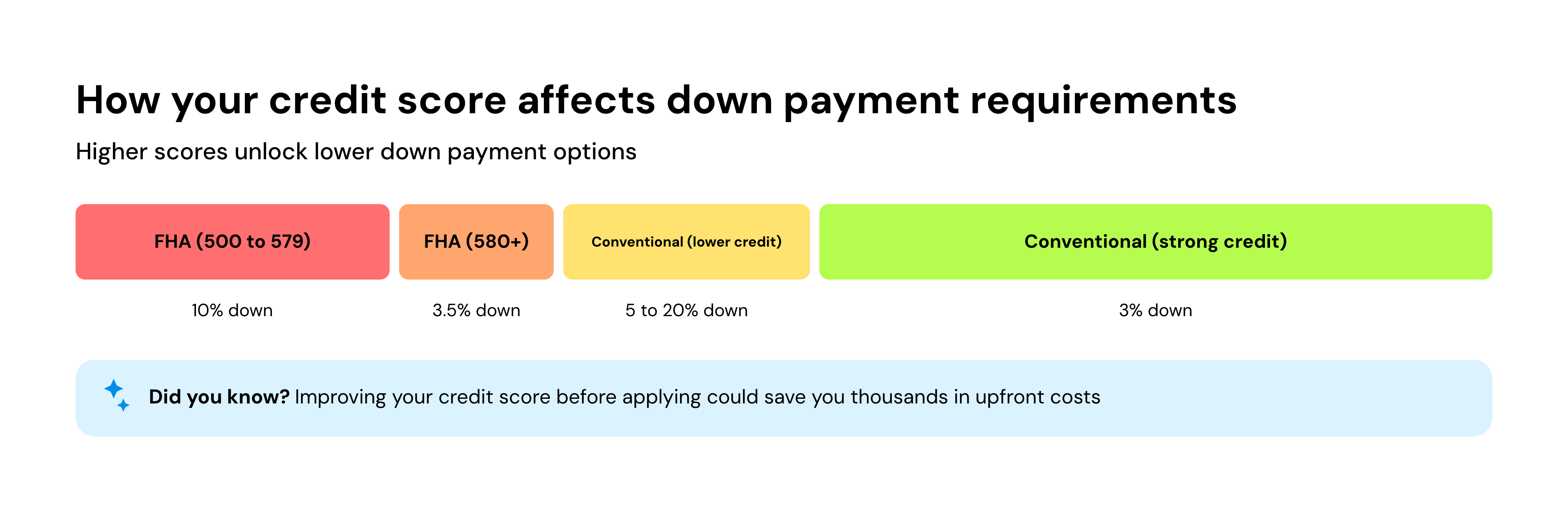
There is also an FHA option for consumers who have a credit score ranging from 500 to 579. However, that type of loan requires 10% down.
Conventional mortgages also feature variable down payment requirements. Most lenders offer a 3% down conventional loan product, but you need a strong credit profile to quality. If your score isn’t high enough, you could be required to put down between 5% and 20%.
If your credit needs improvement, building a positive payment history over time can help. Tools like Kikoff allow you to add consistent, on-time payment activity to your credit profile without a hard credit check. Kikoff also offers other tools, such as verified rent reporting and a credit report error dispute letter generator.
Common mistakes to avoid when saving for a down payment
Even if you have a solid plan, making some common mistakes can slow down your progress.
Not setting a clear goal
Saving without a target makes it harder to stay motivated and measure your progress. If your savings account looks healthy, you may be able to talk yourself into splurge spending or unnecessary purchases. However, if you have a clear goal in mind and know that you haven’t reached it, you can use your target as motivation to keep saving.
Goal-setting helps you stay disciplined for months or years at a time. As you move closer to your goal, you can start exploring your home-buying options more closely. For example, you may start speaking with a real estate agent or lender. But you need to set your goal first.
Forgetting about additional costs
Don’t focus solely on your down payment. You must account for closing costs when building your savings. Consider other expenses, too, such as the home inspection. You don’t want to start the home-buying process, only to find out that you are thousands of dollars short.
Postponing your home search due to poor financial planning can be incredibly frustrating. Accurately estimate your out-of-pocket costs and incorporate all of those expenses into your goal.
Keeping savings in a low-interest account
Stashing your money in a low-yield savings account is unwise. Instead, open a higher-interest account so that your money can earn competitive interest. Over time, you will generate additional earnings in interest, which could shorten your timeline to homeownership.
Being inconsistent about saving
Don’t just save what’s left over. You have to be intentional about saving each month so you can continually work toward your goal. Pay yourself first, take care of your bills, and make discretionary spending the last thing you do. That way, you’ll cut out optional spending first if things get tight.
Taking on new debt
You shouldn’t take on new debt when saving for a home unless absolutely necessary. Adding new bills to your monthly expenses will slow down your savings journey and hurt your DTI. Instead, focus on paying your current bills on time and putting away as much money as possible.
Conclusion
Learning how to save for a down payment is a huge step in the right direction. But even if you put these tips to use, you can’t get financed for a home without an adequate credit score and a healthy DTI ratio. That’s where tools like Kikoff can help close the gap.
Kikoff is a credit-building platform that is packed with tools and features designed to put you in control of your financial journey. Offers include:
- Free Kikoff credit account
- An annual subscription that’s available in three tiers
- Verified rent reporting
- A secured credit card
- Invite-only credit builder loan
- Free dispute tools
- Free debt negotiation
You can upgrade or downgrade your Kikoff subscription at any time. Are you ready to set yourself up as a stronger mortgage applicant?
Frequently Asked Questions
You should set your down payment savings goal based on the type of loan you plan to apply for and the home price you are targeting. Many buyers put between 3% and 10% down. You should also plan for closing costs, which are typically 2-3% of the home’s purchase price.
Saving 20% can help you avoid PMI and lower your monthly payments, but hitting such a large savings goal can be difficult. Many buyers choose to make smaller down payments to enter the market sooner. Explore your options to determine which path is best for your financial situation.
You may be able to buy a home with no down payment if you qualify for a VA or USDA loan. Other mortgage options require a down payment.

.jpg)