






Finding a collection account from CBE Group on your credit report can feel like a gut punch, especially if you weren't expecting it.
The good news is that collection accounts, including those from CBE Group, are not necessarily permanent, and every individual who finds one on their report has real options for disputing or resolving it.
In this post, we'll walk through exactly what CBE Group is, why it might appear on your report, and the steps you can take to get it removed.
Let's jump in.
How to remove CBE Group collections from your credit report
Removing a CBE Group collection from your credit report generally comes down to a few possible paths: disputing inaccurate information, requesting debt validation, negotiating a pay-for-delete, or waiting out the reporting window.
The right approach depends on whether the debt is accurate, whether it's been validated, and how old it is.
Here's a breakdown of each method.
Dispute the collection if it's inaccurate
The single most powerful tool every individual has against a collection account is the right to dispute inaccurate information.
If CBE Group is reporting something that is factually incorrect, be it the wrong balance, wrong account number, wrong dates, or a debt that isn't yours at all, you have the right to file a dispute with the credit bureaus directly.
You can submit disputes with Equifax, Experian, and TransUnion through their websites or by mail.
Once a dispute is filed, the bureau is generally required to investigate within 30 days, and if the information cannot be verified, it must be removed.
Tools like Kikoff make this process super simple, allowing you to submit disputes to the bureaus without having to navigate each bureau's system individually.
Just make sure when writing your dispute that you're as specific as possible about what is inaccurate and why.
Request debt validation
Every individual who is contacted by a debt collector has the right to request debt validation under the Fair Debt Collection Practices Act (FDCPA).
Debt validation effectively requires CBE Group to prove that the debt is yours, that the amount is correct, and that they have the legal right to collect it.
You can send a written debt validation letter to CBE Group within 30 days of first contact, and they are legally required to stop collection activity until they provide the requested documentation.
If they cannot validate the debt, they must stop reporting it to the credit bureaus.
This said, if you're outside the 30-day window, you can still request validation, though CBE Group is not legally obligated to halt collection activity while they respond.
Negotiate a pay-for-delete agreement
If the debt is legitimate and you want to resolve it, negotiating a "pay-for-delete" agreement is one option worth exploring.
A pay-for-delete is basically an arrangement where you agree to pay the debt, either in full or as a settlement, in exchange for CBE Group removing the collection from your credit report.
This is not something every collector will agree to, and it's not required by law, but lots of consumers have had success negotiating this type of arrangement, especially if the debt is relatively small.
Just make sure you get any pay-for-delete agreement in writing before making a payment, because verbal agreements generally won't hold up if CBE Group doesn't follow through.
Wait for the collection to age off
If the debt is legitimate, validated, and you're unable to negotiate a removal, the collection will generally fall off your credit report after seven years from the date of the original delinquency.
This is the reporting limit under the Fair Credit Reporting Act (FCRA), and it applies regardless of whether the debt has been paid or not.
Waiting isn't always the fastest path, but it's a reality for collections that are otherwise verified and undisputable.
This said, a collection's impact on your credit score does typically diminish over time, even before the seven-year mark.
What is CBE Group?
CBE Group is a third-party debt collection agency that collects on behalf of original creditors across industries including healthcare, utilities, financial services, and government agencies.
If CBE Group appears on your credit report, it generally means an original creditor, be it a hospital, utility company, or lender, sold or assigned your unpaid debt to CBE Group for collection.
CBE Group is a legitimate debt collection company headquartered in Cedar Falls, Iowa, and has been operating since 1933.
Seeing their name on your report doesn't automatically mean the debt is valid or that you owe what they're claiming, which is why validating the debt is always a smart first step.
Why is CBE Group on my credit report?
CBE Group typically appears on a credit report because an unpaid debt from an original creditor was assigned or sold to them for collection.
Common sources include medical bills, utility bills, telecom accounts, and financial service accounts that went unpaid and were eventually handed off to a collections agency.
It's also possible for CBE Group to appear on your report in error, be it due to mistaken identity, a previously resolved debt that was re-reported, or an outdated balance.
Every individual who finds a CBE Group entry on their report should verify the details carefully before deciding on a course of action.
If you don't recognize the debt or the details don't match your records, disputing or requesting validation is the right first move.
How does a collection account affect your credit score?
A collection account is one of the more damaging things that can appear on a credit report, primarily because payment history is the single most important factor in your credit score, making up 35% of a FICO score.
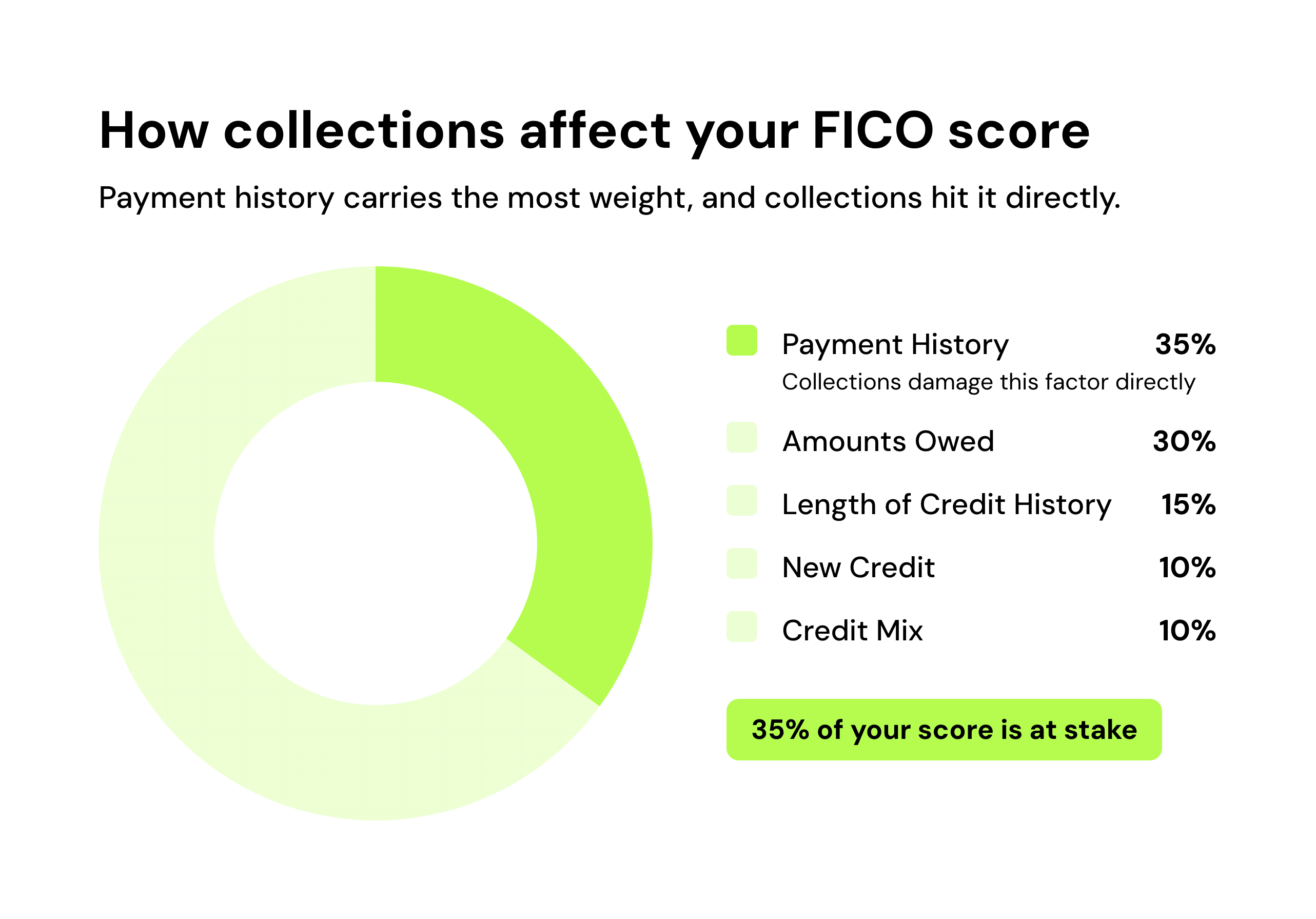
A collection entry effectively signals to lenders that a debt went unpaid long enough to be sent to a collector, which is seen as a significant red flag.
The impact is generally most severe immediately after the collection is first reported and tends to diminish over time as the account ages.
Paid collections are still visible on your report, though some newer scoring models like FICO 9 and VantageScore 4.0 weigh paid collections less heavily than unpaid ones.
This said, if you're actively working to rebuild your credit alongside resolving a collection, opening a credit account like Kikoff can help you build positive payment history that gets reported to all three bureaus, which is one of the most effective ways to offset the damage over time.
Can you remove a legitimate collection from your credit report?
Removing a collection that is accurately reported and properly validated is difficult but not impossible.
A pay-for-delete agreement is the most common path for removing a legitimate collection before the seven-year reporting window expires.
Some creditors and collectors are more open to this than others, and your leverage is generally higher if the debt is old or relatively small.
It's worth noting that if you pay a collection without negotiating a deletion, the account will typically be updated to "paid collection" status on your report, which is better than unpaid but doesn't remove the entry.
If you're unsure whether a deletion agreement is possible, it doesn't hurt to reach out to CBE Group directly and ask, as long as you get the response in writing.
What to do if CBE Group contacts you
If CBE Group contacts you by phone or mail, the first step is generally to request debt validation in writing.
This gives you the documentation you need to verify the debt before making any payment or acknowledgment.
Avoid making any payment or verbally agreeing to anything before you've validated the debt, because acknowledging or paying a debt, even partially, can in some states "re-age" the debt and restart the statute of limitations for legal collection.
Keep records of every communication you have with CBE Group, including dates, what was said, and any written correspondence.
If CBE Group violates any provisions of the FDCPA, be it by calling outside of permitted hours, using abusive language, or making false statements, you may have the right to file a complaint with the Consumer Financial Protection Bureau (CFPB) or take legal action.
Conclusion
Finding CBE Group on your credit report doesn't have to be the end of the road.
Every individual who takes the time to understand their rights under the FDCPA and FCRA is in a much stronger position to dispute, validate, negotiate, or wait out a collection account.
If inaccuracies are present, dispute them quickly. If the debt is valid, explore a pay-for-delete. And regardless of where you land with the collection, building positive credit history going forward is one of the best things you can do.
Kikoff is the perfect tool for doing exactly that, helping you build credit by reporting on-time payments to all three credit bureaus, starting at $5 a month.
Frequently Asked Questions
About the editor

Disclaimer: The information provided in this blog post is meant for informational purposes only and does not constitute financial advice.