






Finding an unfamiliar name on your credit report is stressful, and Capio Partners is one that catches a lot of people off guard.
Whether you recognize the debt or not, a collections account from Capio Partners can do real damage to your credit score and your ability to get approved for loans, housing, or new credit lines.
The good news is that you have options, and there are legitimate steps you can take to dispute, negotiate, or wait out a Capio Partners entry.
Let's jump in.
How to remove Capio Partners from your credit report
Removing Capio Partners from your credit report generally comes down to one of three paths: disputing an inaccurate entry, negotiating a pay-for-delete agreement, or waiting for the account to age off.
Each approach works differently depending on whether the debt is valid, whether it contains errors, and how much time has passed since the original delinquency.
Understanding which path applies to your situation is the single most important step before taking any action.
Check for errors first
The first thing you should do is pull your credit reports from all three bureaus and review the Capio Partners entry closely.
You're entitled to a free copy of your report from each bureau at annualcreditreport.com.
Look carefully for any of the following issues:
- The account doesn't belong to you
- The balance listed is incorrect
- The date of original delinquency is wrong
- The account is being reported past the seven-year reporting window
- The same debt is listed more than once
If you find any of these inaccuracies, you have a strong basis to dispute the entry and potentially get it removed entirely.
Dispute inaccurate information
If the Capio Partners entry contains errors, you can file a dispute directly with the credit bureau reporting it, be it Equifax, Experian, or TransUnion.
Each bureau has an online dispute portal, or you can submit a dispute by mail with supporting documentation.
Once you file, the bureau is generally required to investigate within 30 days and remove or correct the entry if it can't be verified.
This is effectively your most powerful tool when dealing with inaccurate collections entries, because the burden of verification falls on the bureau and the collector, not on you.
Apps like Kikoff make this process much easier by helping you send disputes to the bureaus without having to navigate the process on your own.
If the dispute is successful and the entry is removed, you could see a meaningful improvement in your credit score relatively quickly.
Request debt validation
Before paying anything or engaging with Capio Partners, you have the legal right under the Fair Debt Collection Practices Act (FDCPA) to request written validation of the debt.
This means Capio Partners must send you documentation showing that the debt is yours, that they have the legal right to collect it, and that the amount is accurate.
You generally have 30 days from first contact to send a debt validation request, though it's worth sending one even if that window has passed.
If Capio Partners cannot validate the debt, they are required to stop collection activity and the entry may need to be removed from your credit report.
Send your request by certified mail with return receipt so you have a paper trail.
Negotiate a pay-for-delete agreement
If the debt is valid and you're in a position to pay, a pay-for-delete agreement is worth attempting.
This is effectively a negotiation where you offer to pay the debt, either in full or as a settlement, in exchange for Capio Partners agreeing to remove the entry from your credit report.
Pay-for-delete isn't guaranteed, and not every collector will agree to it, but it's a legitimate strategy that sometimes works.
Get any agreement in writing before you make a payment, because verbal agreements offer no protection if the entry isn't removed afterward.
It's also worth knowing that even if Capio Partners removes their tradeline, the original creditor's entry may still appear on your report, so make sure you understand exactly what will and won't be removed before proceeding.
Wait for the entry to age off
Every collection account has a reporting limit of seven years from the date of the original delinquency.
Once that window closes, the entry must be removed from your credit report by law, regardless of whether the debt has been paid.
If the Capio Partners account is approaching that seven-year mark, it may make more sense to wait it out rather than pay or negotiate, especially if the debt is old and you don't plan to apply for new credit in the near term.
Just make sure you verify the correct start date on the reporting clock, which is the date of original delinquency with the first creditor, not the date Capio Partners acquired the debt.
What is Capio Partners?
Capio Partners is a debt collection agency that purchases delinquent accounts from original creditors and then attempts to recover those funds from the borrower.
They mainly purchase medical debt, though they also collect on other consumer debts depending on the portfolio they've acquired.
When a debt is sold to Capio Partners, they become the new holder of that debt and are legally permitted to attempt to collect it and report it to the credit bureaus.
This means a Capio Partners entry on your credit report is generally tied to an older debt that went unpaid with a different company, and Capio Partners is the third-party collector now responsible for it.
Seeing their name on your report doesn't necessarily mean you owe them directly, but it does mean a collection entry is affecting your credit.
Does paying Capio Partners remove it from your credit report?
Paying a collections account does not automatically remove it from your credit report.
Once paid, the status of the account will typically update to "paid collection," but the entry itself will generally remain on your report for the full seven years from the original delinquency date.
This is why a pay-for-delete negotiation, which is specifically structured to remove the entry in exchange for payment, is usually a better approach than simply paying the balance and hoping for removal.
That said, paying or settling the debt does have value even if the entry stays, because it shows the account is resolved, and some newer credit scoring models treat paid collections more favorably than unpaid ones.
If you're weighing your options, consider both the credit impact and any interest or legal exposure before making a decision.
How Capio Partners affects your credit score
A collections account from Capio Partners can be one of the most damaging entries on a credit report, particularly if it's recent.
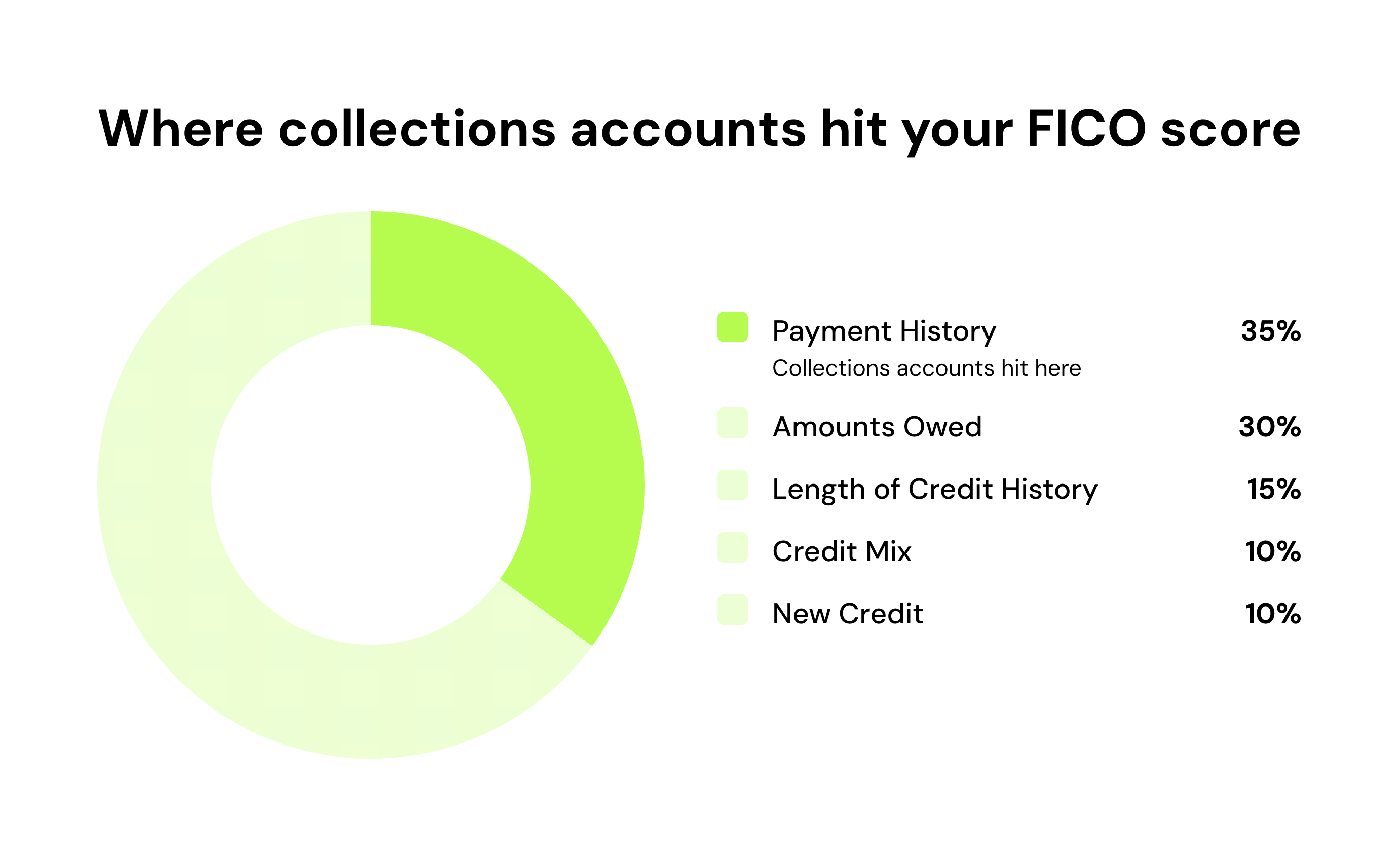
Collections fall under the payment history factor of your credit score, which is the single most important factor and makes up 35% of your FICO score.
The newer the collection and the higher the original balance, the more damage it generally causes.
Over time, the negative impact of a collections entry does lessen, especially as you build positive payment history on other accounts.
This is where tools like Kikoff can be particularly helpful, because adding a credit account that reports on-time payments to all three bureaus helps offset the impact of negative entries by building positive history alongside them.
Basically, the most effective approach is to address the Capio Partners entry directly while also actively building positive credit at the same time.
Your rights when dealing with Capio Partners
Every individual who has a collections account on their credit report has protections under federal law.
The Fair Debt Collection Practices Act (FDCPA) prohibits collectors from using abusive, deceptive, or unfair practices, be it harassing phone calls, false representations of the debt, or threats they can't legally follow through on.
The Fair Credit Reporting Act (FCRA) gives you the right to dispute inaccurate information and requires that only accurate, verifiable information appears on your credit report.
If Capio Partners violates either of these laws, you may have grounds to file a complaint with the Consumer Financial Protection Bureau (CFPB) or even pursue legal action.
Keep records of all communications with Capio Partners, including dates, times, and the content of any calls or letters.
Conclusion
Dealing with a Capio Partners entry on your credit report is frustrating, but it's a manageable situation with the right approach.
Start by reviewing your report for errors, request debt validation if you haven't already, and decide whether to dispute, negotiate, or wait based on the specifics of your account.
Throughout this process, don't lose sight of the bigger picture: removing negative entries is only one side of building a healthy credit profile.
Adding positive payment history with a tool like Kikoff helps you build credit while you work through the dispute or negotiation process, so your score has somewhere to grow even before the collections entry is resolved.
Frequently Asked Questions
About the editor

Disclaimer: The information provided in this blog post is meant for informational purposes only and does not constitute financial advice.