.jpg)



If your credit is less than ideal, having a cosigner when you buy a car can be extremely helpful. Your cosigner may allow you to qualify for a car loan when you otherwise wouldn’t. And even if you could qualify on your own, a cosigner with strong credit may help you access better loan terms.
But what happens when you want to release your cosigner from that obligation? Learn how to remove a cosigner from a car loan.
Can you remove a cosigner from a car loan?
The short answer is yes. If you want to keep paying for your vehicle on your own, you have a few options:
- Refinance the car in your name only
- Pay off the loan entirely
- Ask your lender about a cosigner release
- Sell or trade in the car
Directly removing the cosigner often isn’t possible, but in many cases, you can find a way to continue paying for the car by yourself.
Refinance the loan in your name only
If you’re wondering how to remove a cosigner from a car loan, this is one of the most common ways to do so. When you refinance, you apply for a new car loan without a cosigner. If you’re approved, the new lender pays off the old loan, and you make payments toward the new loan.
How to qualify for refinancing
Generally, lenders look at several factors when deciding whether to approve your application:
- Your debt-to-income ratio (below 36% is ideal)
- Your income
- Payoff requirements for your current loan
- Your credit score
A “good” credit score is 670 or higher, but the better your score is, the more likely you are to qualify for favorable loan terms. Many lenders will still approve you if your score is lower, but you’ll likely end up paying more in interest.
Steps to refinance your car loan
If you want to refinance, here’s how to do it:
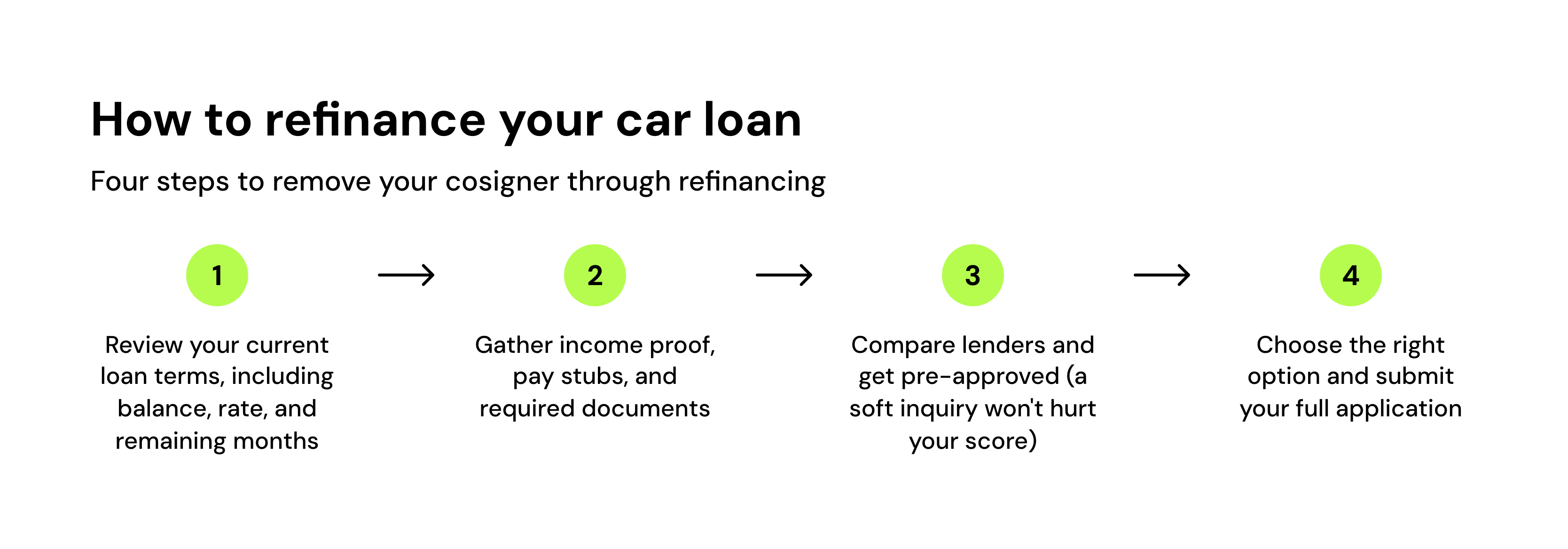
- Review the terms of your current loan
- Gather proof of income and other documents
- Compare lenders (get pre-approved to check rates without hurting your credit)
- Choose the best option and apply
When you refinance a car loan (or any other debt), a good rule of thumb is to never accept a refinance with a higher interest rate than the original loan. However, depending on your circumstances, you might decide that accepting a loan with a slightly higher interest rate is worth the trade-off.
For example, imagine that you have poor credit, and your cosigner doesn’t. Your relationship with the cosigner has soured, and you want to remove them from the loan to avoid any more conflict.
When you apply to refinance, you can only qualify for loans with higher interest rates than your current one, but you determine that refinancing is still the best course of action.
Pay off the loan early
For many people, paying off a car loan early isn’t feasible. However, if you think you’ll be able to pay off your loan soon, that may be the easiest way to release your cosigner from their obligation.
Ask your lender about a cosigner release
Some loan agreements include clauses that allow for a cosigner release. Car loan companies that offer this option allow you to apply to assume the loan yourself.
Removing a cosigner creates risk for the lender because if you default, there’s no one else they can pursue to pay the loan. Even if your lender allows for a cosigner release, you’ll still need to show that you have sufficient income and good enough credit to take full responsibility for the loan yourself.
Sell or trade in the vehicle
If you can’t refinance, pay the loan off early, or qualify for a cosigner release, it may be worth considering selling the car or trading it in. When you do this, the buyer or the dealer pays off the rest of your existing loan.
If you want to finance a new vehicle after selling or trading in the old one, you can apply for a car loan without a cosigner.
Want to improve your credit before refinancing?
Often, knowing how to remove a cosigner from a car loan isn’t the same as actually being able to do it. If you want to remove your cosigner but are having trouble because you have poor credit or a thin credit file, it’s easy to feel stuck.
The good news is that having bad credit or a limited credit history isn’t permanent. When you have a plan and are willing to put in the effort, you might see your credit score start to climb faster than you’d expected.
Kikoff is here to help support you on your credit journey. We connect you with interest-free credit lines and other tools to build positive payment history and take control of your finances. On average, new members with credit scores under 600 improve by 86 points in a year.
Are you ready to see how we may be able to help you? Sign up with no credit check today!
Frequently Asked Questions
About the editor

Disclaimer: The information provided in this blog post is meant for informational purposes only and does not constitute financial advice.