

.jpg)
.jpg)



Having no credit history can make auto financing harder, but it does not rule out a car loan. You may be able to qualify on your own, with a cosigner, or after taking time to establish credit. The right path depends on the offers available to you and what you can comfortably afford.
How to buy a car with no credit history
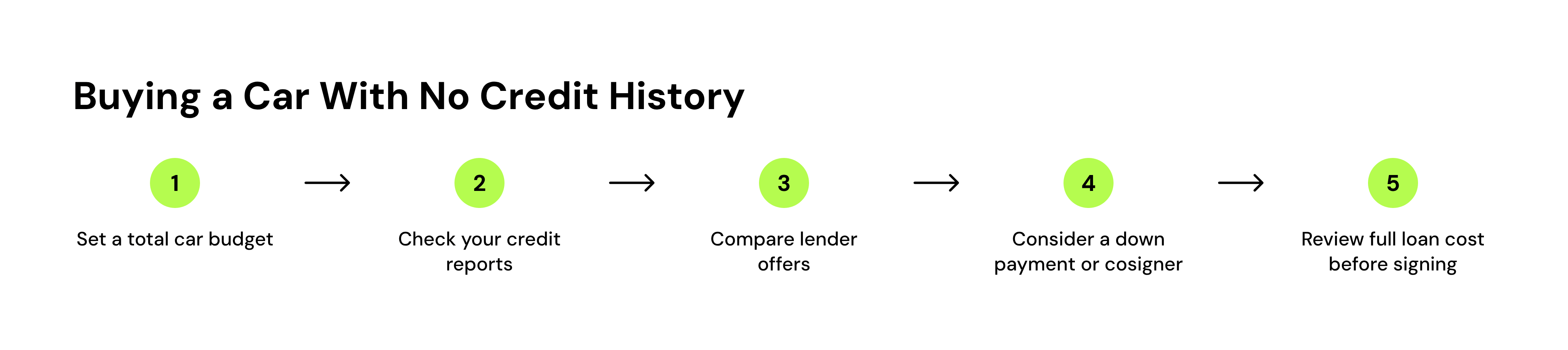
1. Set a budget for the whole car
Start with a monthly amount you can afford for the loan, insurance, fuel, maintenance, and repairs. Also account for taxes and registration. A lower loan payment can look attractive, but stretching the loan over more months can increase its total cost. The Consumer Financial Protection Bureau (CFPB) recommends comparing the amount financed, APR, loan term, and payment, not the payment alone.
Check your credit reports before applying. Even if you expect a blank file, a report may contain an account you forgot about or an error worth disputing. You can request your reports at AnnualCreditReport.com.
2. Compare lenders before visiting the dealership
Ask banks, credit unions, and online lenders whether they consider applicants with little or no credit history. A lender where you already bank may be worth asking, but an existing relationship does not assure approval. Seek preapproval where available, then compare those terms with any financing arranged by the dealership. Lenders may consider your income, debts, down payment, and the vehicle, along with your credit file.
Compare offers using the APR, amount financed, repayment term, monthly payment, and total of payments. Ask which add-ons or fees are optional, and review the final contract against the offer you accepted. Shopping with multiple lenders is worthwhile: the CFPB says auto-loan inquiries made within a 14- to 45-day window generally count as one inquiry for scoring, depending on the scoring model.
3. Consider a larger down payment
A down payment reduces how much you need to borrow and may improve the terms a lender offers. It can also lower your payment and the interest you pay over the loan’s life. The CFPB notes that a larger down payment may reduce the interest rate, though approval still depends on the lender. Keep enough cash for insurance, registration, repairs, and an emergency instead of putting every dollar into the purchase.
4. Ask about a cosigner if you need one
A cosigner with a strong credit history may help you qualify or receive better terms, but you do not automatically need one because you lack a score. Ask the lender whether you qualify alone and how the offer would change with a cosigner. The CFPB explains that a cosigner is responsible for repayment if you cannot pay, and late payments or default can hurt both people’s credit. Both of you should understand that obligation before signing.
5. Treat buy here, pay here financing with caution
A buy here, pay here dealership typically finances the car itself and may serve buyers with no credit history. It is one option, not necessarily your only one. Its interest rates tend to be higher than those offered by other lenders, according to the CFPB. Some dealers report late payments without reporting on-time payments. If you consider this route, compare its full cost with other offers and ask in writing whether it reports positive payment history to the credit bureaus.
Read more >> What Is the Minimum Credit Score for an Auto Loan?
Is having no credit the same as having bad credit?
No credit generally means there is little or no reported borrowing history for a lender to evaluate. You might have no credit score, or you may have a thin credit file that does not meet a scoring model’s requirements. Bad credit means your file contains information that has produced a low score. Neither label determines your loan terms by itself. Lenders set their own requirements and may weigh your income, existing debt, and down payment differently.
How to build credit before buying a car
If you can wait, establishing a record of on-time payments may give lenders more information to consider. You could look into a secured credit card or a credit-building account that reports to the major credit bureaus. Check any fees and terms, use only what you can afford, and pay on time. You do not need to take out an unnecessary loan or carry a credit-card balance just to establish a history.
Rent or utility payments generally do not build credit automatically. The CFPB says most utility companies do not report on-time payments to the three nationwide bureaus. If you use a reporting service, confirm which payments it accepts, which bureaus receive them, and what it costs.
Kikoff’s Credit Account reports account activity to Equifax, Experian, and TransUnion, with no credit check to sign up.
Read more >> How Long Does It Take to Build Credit?
Bottom line
You can buy a car with no credit history, but the loan still needs to fit your budget. Compare financing offers, consider a manageable down payment, and weigh the responsibilities of a cosigner before signing. If the offers are too expensive, waiting while you build credit or save more may put you in a better position.
Frequently Asked Questions
Article Sources
Disclaimer: The information provided in this blog post is meant for informational purposes only and does not constitute financial advice.