.jpg)
.jpg)



Refinancing Parent PLUS loans could lower your interest rate, change your monthly payment or combine several loans into one. However, refinancing replaces your federal loans with a private loan. That decision is permanent, and you give up federal repayment options, forgiveness programs and other borrower protections.
Before applying, compare the potential savings with the federal benefits you would lose. If your main goal is a lower monthly payment, check your federal repayment options before refinancing.
What does refinancing Parent PLUS loans mean?
Direct PLUS Loans for parents, commonly called Parent PLUS loans, are federal loans made to parents who borrow for a dependent undergraduate student.
When you refinance, a private lender pays off one or more of those federal loans and issues a new private student loan. The new loan may have a different interest rate, monthly payment and repayment term.
Refinancing is different from federal Direct Consolidation. Federal consolidation combines eligible federal loans into another federal loan, preserving federal status. Its interest rate is generally a fixed weighted average of the loans being consolidated, rounded up to the nearest one-eighth of a percentage point, so it does not ordinarily reduce your interest rate.
Private refinancing may offer a lower rate, but the Consumer Financial Protection Bureau warns that replacing federal loans with a private loan cannot be reversed.
Read more >> How to Refinance Student Loans
Check your federal options before refinancing
Parent PLUS repayment options changed substantially on July 1, 2026. Your choices may depend on when your loans were disbursed and whether they were consolidated before that date.
Parent PLUS loans are not eligible for an income-driven repayment plan on their own. According to Federal Student Aid, a Direct Consolidation Loan that paid off Parent PLUS loans may qualify for an income-driven plan only if the consolidation occurred before July 1, 2026. Parent PLUS loans and consolidation loans that repaid them are not eligible for the new Repayment Assistance Plan.
Federal options may still include a standard or tiered standard repayment plan, depending on the loan’s disbursement date. Some borrowers may also qualify for deferment, forbearance, discharge or Public Service Loan Forgiveness based on their circumstances.
Sign in to your StudentAid.gov account and use the federal Repayment Calculator to see the plans available for your specific loans. You can also contact your federal loan servicer before replacing the debt with a private loan.
Read more >> How Income-Driven Repayment Plans Lower Student Loan Payments
How to refinance Parent PLUS loans
If you have compared your federal options and still want to refinance, follow these steps.
Step 1: Decide what you want refinancing to accomplish
Start with a clear goal. You may want to:
- Lower your interest rate.
- Reduce your monthly payment.
- Pay off the debt faster.
- Combine several Parent PLUS loans into one payment.
- Transfer responsibility for the debt to your child.
These goals can require different loan terms. For example, extending the repayment period may lower your monthly payment but increase the total interest you pay. Choosing a shorter term may reduce the total cost but produce a higher monthly payment.
Step 2: Review your credit and finances
Private lenders set their own approval and pricing standards. They commonly consider your:
- Credit history and credit scores.
- Income and employment.
- Existing debts.
- Debt-to-income ratio.
- Loan balance and requested repayment term.
Your debt-to-income ratio, or DTI, compares your required monthly debt payments with your gross monthly income. DTI is not part of your credit score, but lenders may use it when deciding whether you can afford another loan payment.
There is no universal minimum credit score for refinancing Parent PLUS loans. A stronger credit profile may help you qualify or receive a more competitive rate, but each lender uses its own criteria.
Review your credit reports for errors before applying. You can request free weekly reports from Equifax, Experian and TransUnion at AnnualCreditReport.com.
Step 3: Compare private lenders
Some lenders let you check potential rates through prequalification, which generally uses a soft credit inquiry that does not affect your credit scores. Confirm how a lender will check your credit before submitting information. A formal application typically involves a hard inquiry.
Compare more than the advertised interest rate. Review:
- Annual percentage rate, or APR.
- Fixed and variable rate options.
- Monthly payment.
- Repayment term.
- Total amount repaid.
- Origination or administrative fees.
- Late-payment policies.
- Deferment or forbearance options.
- Death or disability discharge provisions.
- Cosigner requirements and release policies.
- Whether the loan can be transferred to your child.
A lender’s lowest advertised rate may be available only to applicants with specific qualifications or repayment terms. Compare the actual offers you receive.
Step 4: Choose between a fixed and variable rate
A fixed interest rate remains the same for the life of the loan. This makes your scheduled principal and interest payment more predictable.
A variable rate can change based on the benchmark specified in the loan agreement. Your initial rate may be lower, but both the rate and payment could rise later.
Federal Parent PLUS loans have fixed rates. Moving to a variable-rate private loan introduces a risk that you do not currently have.
Step 5: Decide who will become responsible for the new loan
A Parent PLUS loan is legally the parent’s debt, not the student’s. A federal loan cannot simply be transferred to the child.
Some private lenders allow an adult child to refinance the Parent PLUS balance into the child’s own name. The child must qualify under the lender’s credit and income requirements. If approved, the parent’s federal loan is paid off and the child becomes responsible for the new private loan.
Transferring the balance may help the parent’s cash flow, but the child should independently review the payment, total cost and federal protections being lost before accepting the debt.
Step 6: Gather the required documents
Requirements vary, but a lender may request:
- Government-issued identification.
- Social Security number.
- Recent pay stubs, tax returns or other income documentation.
- Employment information.
- Current loan statements.
- Loan account numbers.
- A payoff statement from your federal loan servicer.
Check the lender’s requirements before applying so that missing documentation does not delay the process.
Step 7: Submit the application
Once you select a lender, complete the formal application. The lender will review your finances and may perform a hard credit inquiry.
Applying does not guarantee approval or the rate shown during prequalification. Review the final offer rather than assuming it will match the preliminary estimate.
Step 8: Review the final terms before signing
Compare the final private loan offer with your existing Parent PLUS loans. Review:
- The fixed or variable interest rate.
- APR and fees.
- Monthly payment.
- Repayment period.
- Total projected repayment amount.
- Hardship assistance.
- Death and disability provisions.
- Cosigner obligations.
- Autopay requirements for any advertised discount.
Also confirm which federal benefits you will surrender. Refinancing federal loans with a private lender generally ends access to federal deferment, forbearance, forgiveness and discharge protections. Private lenders may offer their own hardship programs, but the terms vary.
Consider talking with a financial advisor or nonprofit student loan counselor before giving up federal benefits, particularly if you are pursuing forgiveness or anticipate difficulty making payments.
Step 9: Confirm the old loans were paid off
Continue paying your federal loan servicer until both the private lender and federal servicer confirm that the payoff is complete. Stopping too early could result in a missed payment.
After the refinance closes, review your federal account and the new private loan account. Keep the payoff confirmation, final disclosure and new loan agreement with your financial records.
Pros of refinancing Parent PLUS loans
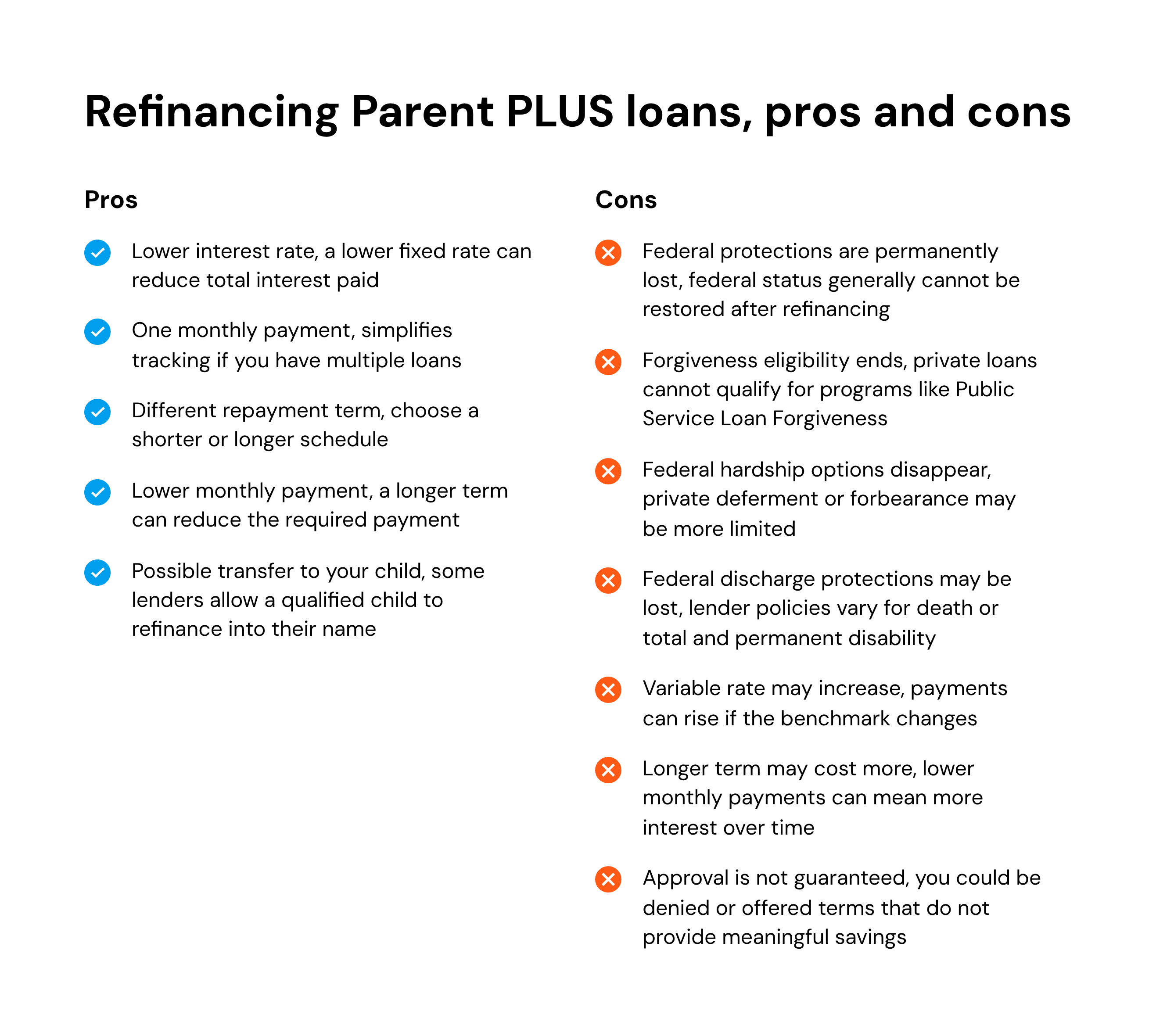
Refinancing may offer several benefits:
- A lower interest rate: A lower fixed rate could reduce the total interest you pay.
- One monthly payment: Refinancing multiple loans can make repayment easier to track.
- A different repayment term: You may choose a shorter or longer schedule.
- A lower monthly payment: A longer term can reduce the required payment, although it may increase the total cost.
- A possible transfer to your child: Some lenders allow a qualified child to refinance the debt into their own name.
These benefits depend on the loan offer. Compare total repayment costs rather than focusing only on the monthly payment.
Cons of refinancing Parent PLUS loans
The potential disadvantages are significant:
- Federal protections are permanently lost: You generally cannot restore federal status after refinancing.
- Forgiveness eligibility ends: A refinanced private loan cannot qualify for federal programs such as Public Service Loan Forgiveness.
- Federal hardship options disappear: Private deferment or forbearance policies may be more limited.
- Federal discharge protections may be lost: Private treatment of death or total and permanent disability varies by lender.
- A variable rate may increase: Your payment could rise if the loan’s benchmark changes.
- A longer term may cost more: Lower monthly payments can result in more interest over time.
- Approval is not guaranteed: The lender may deny the application or offer a rate that does not provide meaningful savings.
When refinancing Parent PLUS loans may make sense
Refinancing may be worth considering if:
- You qualify for a meaningfully lower rate.
- You have stable income and a strong emergency fund.
- You do not expect to need federal hardship options.
- You are not pursuing federal forgiveness or discharge.
- The total cost of the new loan is lower.
- You understand the risks of any variable rate.
- Your child wants to assume the debt and can qualify independently.
If the new loan merely lowers your payment by extending repayment, calculate the total interest before proceeding.
When to keep your Parent PLUS loans federal
Keeping the loans federal may be the better option if:
- You may need deferment or forbearance.
- You are pursuing Public Service Loan Forgiveness.
- You have a qualifying pre-July 2026 consolidation and access to an income-driven plan.
- You may qualify for a federal discharge.
- Your income or employment is uncertain.
- The private rate is not meaningfully lower.
- The new loan requires a variable rate you are not comfortable accepting.
Do not refinance solely because a private payment appears lower. The payment may reflect a longer term, and the federal benefits you lose have financial value.
Bottom line
Refinancing Parent PLUS loans can lower your rate, change your payment or transfer the balance to a qualified child. However, it permanently replaces federal debt with a private loan.
Check your federal repayment options first, particularly because Parent PLUS eligibility changed in July 2026. Then compare the private loan’s APR, monthly payment, total cost and borrower protections with what you have now.
If your credit profile is keeping you from receiving competitive offers, focus on positive credit habits before applying. Kikoff’s Credit Account reports on-time payments to all three credit bureaus, with no hard credit check to sign up. Approval and refinancing terms still depend on the private lender.
Frequently Asked Questions
Article Sources
Disclaimer: The information provided in this blog post is meant for informational purposes only and does not constitute financial advice.