


.jpg)
.jpg)



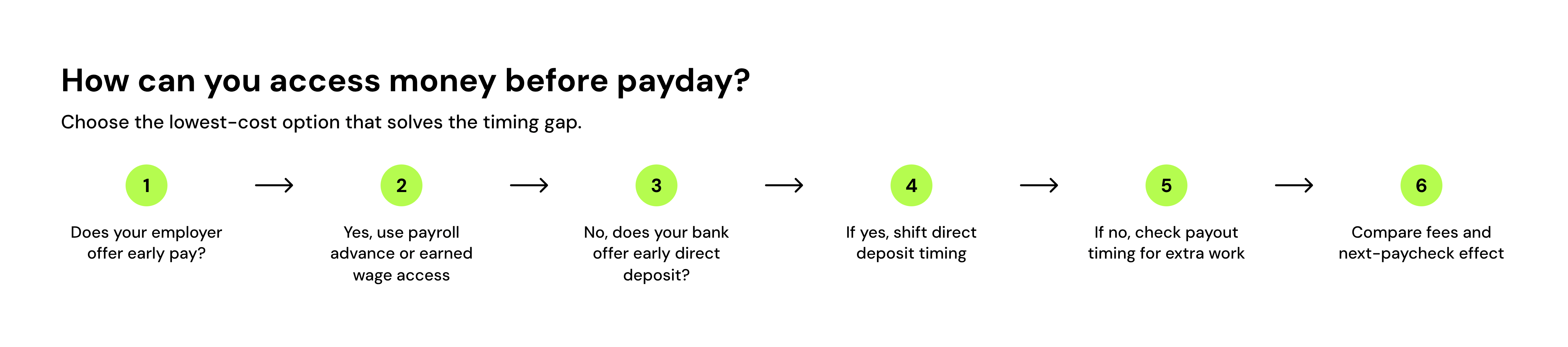
Sometimes payday cannot come soon enough, especially when a bill or unexpected expense is due first. You may be able to access money early through your employer, an earned wage access program, or a bank that offers early direct deposit. Each option works differently, and some involve fees or reduce your next paycheck.
Before choosing one, confirm whether you are receiving wages you have already earned, borrowing against future pay, or simply getting a direct deposit early.
Can you get your paycheck early?
Yes, but only if your employer, payroll provider, or financial institution offers an early-pay option. Common arrangements include:
- A payroll advance from your employer
- Employer-sponsored earned wage access
- Early direct deposit through your bank or credit union
- Faster payouts from extra shifts or gig work
A cash advance app is not necessarily the same as receiving your paycheck early. Some direct-to-consumer apps estimate your expected income and advance money that is later withdrawn from your bank account. Review the product terms instead of relying on the word “paycheck” in its marketing.
4 ways to access money before payday
1. Ask your employer about a payroll advance
Start with your manager, HR department, or payroll team. Your employer may offer a one-time advance, allow you to receive wages you have already earned, or use a third-party earned wage access provider.
Ask these questions before accepting:
- How much can I receive?
- Is there a fee?
- Will the amount come out of my next paycheck?
- Will taxes or other payroll deductions change?
- How long will delivery take?
Do not assume an employer advance is free. Policies and costs vary, and receiving part of your pay now means less money may be available on your normal payday.
2. Review an employer-sponsored earned wage access program
Earned wage access, sometimes called EWA, generally lets you receive a portion of wages already earned during the current pay period. The advance is then deducted from your paycheck.
Some programs offer a free delivery method but charge for faster transfers. The Consumer Financial Protection Bureau found that expedited transfers generated most of the fee revenue among the employer-partnered providers it studied. Repeat use was also common.
Before using EWA, compare every transfer fee, subscription charge, and optional tip. Then calculate what will remain in your paycheck after repayment.
3. Check whether your bank offers early direct deposit
Some banks and credit unions make electronically deposited payroll funds available as soon as they receive them. Depending on when your employer submits the payroll information and your financial institution’s policy, that may give you access before the payday on your employer’s schedule.
This is different from an advance because the institution is making an incoming deposit available sooner rather than lending you money. The CFPB recommends asking your bank or credit union about its direct-deposit availability policy.
Confirm that the feature is early direct deposit rather than a direct-deposit advance. A direct-deposit advance is borrowed money and may include substantial fees.
4. Look for extra work with a clear payout schedule
An extra shift, freelance project, or local job can bring in money without reducing your regular paycheck. However, this is additional income, not early access to wages from your existing pay period.
Before relying on gig work, confirm:
- Whether you can begin immediately
- When your first payout becomes available
- Whether instant payout costs extra
- What you will spend on fuel, supplies, or platform fees
A job that advertises same-day earnings may still delay a new worker’s first payout. Compare the net amount you will keep with the expense you need to cover.
Read more >> How to Get Emergency Money
What to check before accepting an advance
Getting money sooner can solve today’s problem while making the next payday tighter. Before accepting any advance, write down:
- The amount you will actually receive
- Every required and optional fee
- The date and method of repayment
- The amount that will remain in your next paycheck
- The consequences of a failed automatic withdrawal
- Whether you can cancel or change repayment authorization
An advance does not increase your income. It moves money from a future paycheck into today’s budget, and fees can make the total gap larger.
Avoid choosing an option based only on “no credit check” or “no interest.” A product can still be expensive if it charges transfer fees, subscription fees, or tips. If you repeatedly need advances for regular expenses, the National Foundation for Credit Counseling can connect you with a certified nonprofit credit counselor.
Read more >> How to Pay Bills With No Money
What if the bill due date is the real problem?
If your income covers your expenses but the dates do not line up, moving the bill may be more useful than moving your paycheck. Contact the biller before the due date and ask whether you can:
- Change your monthly due date
- Split a payment
- Receive a short extension
- Enter a hardship or payment plan
Not every company will agree, and changing a due date may not take effect immediately. The CFPB recommends comparing monthly income and expenses before asking a biller to change a due date.
Once the immediate gap is handled, set aside a small amount from each paycheck for irregular expenses. Even a modest buffer can reduce how often you need to move money from a future pay period.
Read more >> How to Save Money Fast on a Low Income
Bottom line
You may be able to get paid early through your employer, an earned wage access program, or early direct deposit. Start with the option that has no fee, confirm how repayment affects your next paycheck, and avoid treating advances as additional income.
Kikoff does not provide paycheck advances. When the immediate timing problem is under control, building positive payment history can help you create more financial options over time. Kikoff’s free Credit Account reports on-time payments to all three major credit bureaus, with no hard credit check to sign up.
Frequently Asked Questions
Article Sources
Disclaimer: The information provided in this blog post is meant for informational purposes only and does not constitute financial advice.