.jpg)




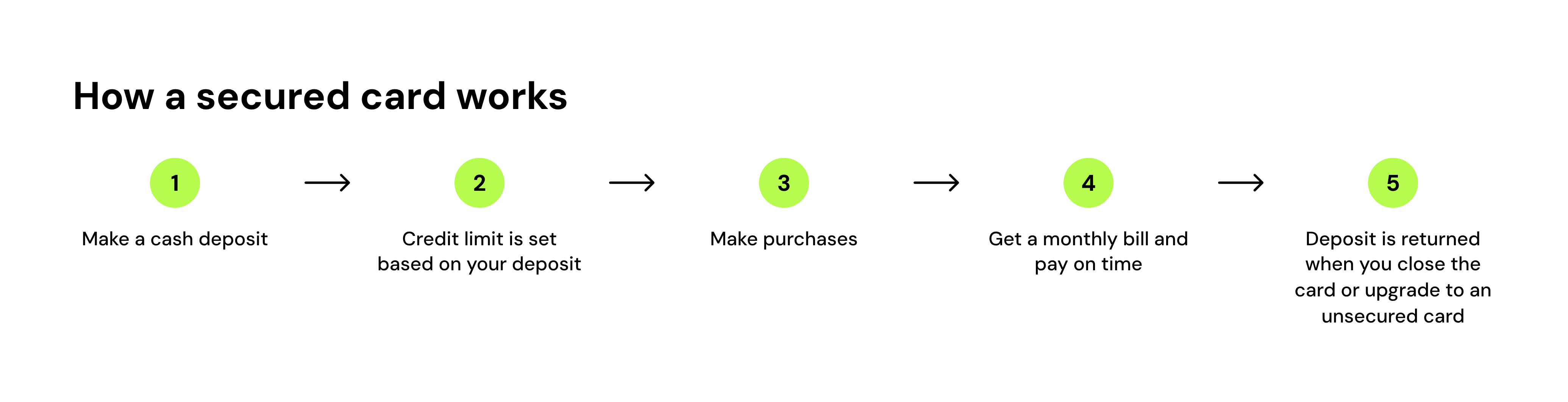
A secured credit card asks for a cash deposit up front, and that deposit usually becomes your credit limit: put down $300, get a $300 limit. The deposit isn’t a payment toward what you charge. The issuer holds it as collateral, and you get it back when you close the account with the balance paid or the issuer moves you to an unsecured card.
What is a security deposit on a credit card?
A security deposit is collateral. You pay it when you open the account, and the issuer holds it under the terms in your cardholder agreement.
The deposit doesn’t pay your bill. If you charge $100, you still owe at least the minimum payment by the due date on your statement. The issuer only uses the deposit if you default. Then it applies the deposit to what you owe.
Read more >> How to Get a Secured Credit Card
How much do you need to deposit?
Many secured card issuers allow you to choose a credit limit between $200 and $2,000, depending on the card. You usually deposit the same amount.
Before you apply, check card details that include:
- The minimum and maximum deposit
- The annual fee and any other fees
- The interest rate (APR)
- Whether the card reports to all three credit bureaus: Equifax, Experian, and TransUnion. If it doesn’t, your on-time payments won’t show up everywhere a lender might look.
- Whether the issuer reviews accounts to move you to an unsecured card, and when
- What you need to qualify
How the deposit relates to your credit limit
Your limit usually matches your deposit. Deposit $500 and you get a $500 limit. Some issuers set a limit higher than the deposit, and some raise it later after a stretch of on-time payments.
A small limit fills up fast. Your credit utilization, meaning how much of your available credit you’re using, is 20% if you carry $100 on a $500 limit. The same $100 on a $2,000 limit is 5%.
When do you get your deposit back?
There are two main ways to get it back:
- Close the account. Pay the balance to zero and close the account, and the issuer returns your deposit.
- Move to an unsecured card. Some issuers will offer to convert your account to an unsecured card, sometimes after six to 12 months of on-time payments. When that happens, you typically get your deposit back.
What happens to your deposit if you miss a payment?
If you miss a payment, you’ll likely pay a late fee. The issuer can also report it to the credit bureaus, which can lower your score. The deposit doesn’t cover a missed payment.
If payments keep going unpaid, the issuer can close the account and apply your deposit to the balance. You still owe anything the deposit doesn’t cover, and the issuer can send that amount to collections.
Your deposit won’t cover a missed payment. A deposit protects the issuer, not your credit. If you miss a payment on a secured card, it can be reported like any other late payment.
Call the issuer before the due date if you’re going to be short. A hardship program or a later due date costs nothing to ask for. If several bills are behind, the National Foundation for Credit Counseling can connect you to free or low-cost counseling at 800-388-2227.
Alternatives to secured credit cards for building credit
- Credit-builder loan. You make monthly payments while the lender holds the loan amount, and you get the money at the end. Payments build history only if the lender reports them to the credit bureaus.
- Authorized user. Someone adds you to their credit card, and the card’s history may show up on your report. It’s their account, though. If they remove you or fall behind, that history can change or disappear.
- A no-deposit credit account. Kikoff’s Credit Account doesn’t take a deposit, so you don’t have to set money aside to start.
Read more >> 6 Ways to Build Credit Without a Credit Card
Bottom line
A secured card’s deposit comes back to you, but it’s money you can’t use while the account is open. If setting that cash aside is the hard part, the Kikoff Credit Account works without a deposit. There’s no credit check to sign up, plans start at $5 a month, and your payments are reported to Equifax, Experian, and TransUnion.
Frequently Asked Questions
Disclaimer: The information provided in this blog post is meant for informational purposes only and does not constitute financial advice.