





A checking account holds money you’ll spend soon. It’s connected to your debit card, it pays your bills, and you can use it as often as you need. A savings account holds money you’re setting aside. It’s a little harder to get to, and it usually pays more interest. One thing neither account does is build your credit, because bank accounts don’t show up on your credit report.
Read more >> What Are the 6 Types of Bank Accounts?
What is a checking account?
A checking account is the bank account you use to move money in and out. For most people, it’s where direct deposits land and where most bills get paid. With a checking account, you can:
- Pay online or in person with a debit card or check
- Get cash from an ATM
- Set up automatic bill payments
- Transfer money to savings or another bank
- Connect to payment apps like Venmo and Cash App
Checking accounts pay little or no interest. That’s the trade-off for being able to use your money anytime.
Read more >> Do You Need a Credit Score to Open a Bank Account?
What is a savings account?
People usually put money in savings for one of two reasons:
- To build a cushion for emergencies
- To save for long-term goals
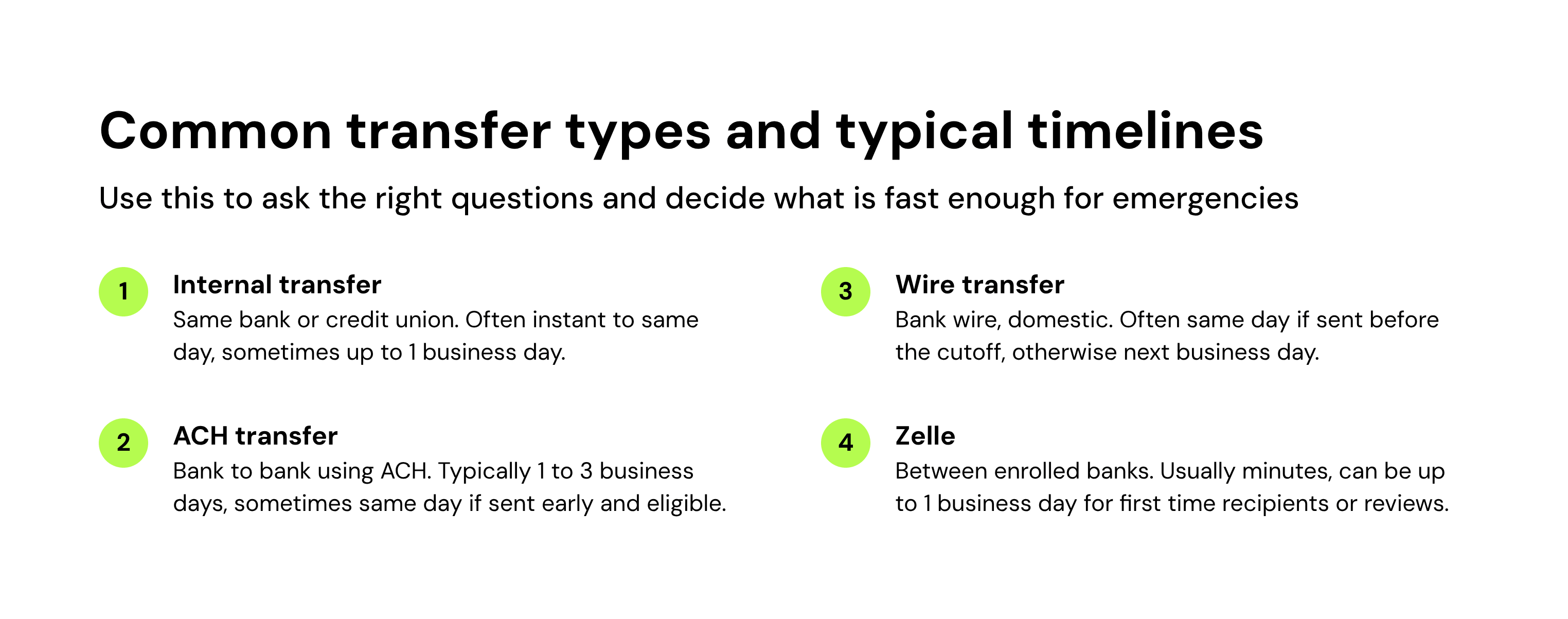
A traditional savings account keeps your emergency fund within reach. Ask your bank how quickly a transfer from savings shows up in checking.
Savings accounts usually pay more interest than checking accounts, but not by much. The national average rate for savings accounts is 0.38% as of October 2026, according to the FDIC.
To earn more, look at a high-yield savings account (HYSA). They’re often offered by online banks and can pay several times the national average. Compare the APY before you open one.
Read more >> Are Online Savings Accounts Safe?
That six-transfer rule? Gone since 2020. Federal rules used to cap savings withdrawals and transfers at six a month — online transfers, phone transfers, and automatic payments, though not ATM or in-person withdrawals. The Federal Reserve removed that limit in April 2020 and hasn’t reinstated it.
But banks can still set their own, and a few still do. Check your account agreement before you assume transfers are unlimited, because some still charge a fee past six.
Do checking and savings accounts affect your credit?
Not directly. Your credit report tracks how you pay back money you’ve borrowed. Bank accounts hold your own money, so they don’t appear on it. They can still affect your credit indirectly, for better and for worse.
Where bank accounts help
Both accounts can help you avoid late payments:
- Autopay from checking means you won’t forget a payment.
- A cash buffer in savings gives you something to draw on when a bill is due and money is tight.
They can also help if you’re buying a home soon. Mortgage lenders typically ask for recent bank statements to confirm you have enough for the down payment and closing costs.
Where they can cost you
An unpaid overdraft can hurt your credit. If your balance stays below zero, the bank may close the account and send what you owe to a collection agency. A collection can stay on your credit report for seven years, counted from 180 days after the account first went past due.
An unpaid overdraft can also follow you in a place your credit report doesn’t reach. When a bank closes an account because of an unpaid negative balance, it typically reports that closure to a checking account reporting company like ChexSystems. This report is separate from your credit report. Banks and credit unions use these reports to decide whether to let you open a new checking account, so a negative entry can make it harder to get one. In practice, some of these companies ignore information that’s more than five years old, according to the CFPB.
If your account is overdrawn, contact your bank as soon as you can and ask whether you can pay the negative balance over time. To avoid overdraft fees on debit card purchases and ATM withdrawals, ask your bank to turn off overdraft coverage for those transactions. They’ll be declined instead.
Read more >> What Happens When Your Bank Account Goes Negative?
Turned down for a checking account? It may be because a bank closed an old account with a negative balance, reported to ChexSystems or Early Warning Services. Request your free annual report from each and dispute anything that's wrong. While some records drop off after five years, second-chance checking accounts are available in the meantime.
Bottom line
Use checking for money you’ll spend soon and savings for money you’re setting aside. Neither one shows up on your credit report.
That has a downside if you pay your bills from checking. Your bank keeps a record of every on-time payment, but that record stays with your bank. Kikoff’s Credit Account reports your on-time payments to Equifax, Experian, and TransUnion, with no credit check to sign up. Plans start at $5 a month.
Frequently Asked Questions
Article Sources
Disclaimer: The information provided in this blog post is meant for informational purposes only and does not constitute financial advice.