


.jpg)


If you've been researching home loans, you've probably seen that the FHA loan credit score minimum is 500.
If your score is somewhere in the 400s, that number might feel just out of reach. And if you've already tried applying for a mortgage, you've likely been turned away before the conversation even started.
Here's where things stand: a credit score in the 400-499 range falls below the FHA's minimum requirement, which means you can't currently qualify for an FHA loan. But that doesn't mean homeownership is impossible.
Discover what the FHA requires, why scores in the 400s don't qualify today, and what you can do to close the gap.
With the right habits and a realistic timeline, you can build your score into qualifying territory.
Can you get approved for an FHA loan with a credit score in the 400s?
No. Federal Housing Authority guidelines set the minimum credit score for FHA loans at 500. Any score below that is ineligible, regardless of your income, down payment size, or other financial strengths.
This isn't a case of lenders being overly strict.
Unlike borrowers in the 500–579 range, where lenders technically can approve you but often choose not to, scores in the 400s hit a hard program-level cutoff. No lender can issue an FHA-backed mortgage below 500, full stop.
What the FHA actually says about credit score minimums
The FHA sets 500 as its absolute floor.
Lenders are not permitted to go lower than FHA guidelines, so even a well-compensating application, including strong income, large down payment, and low debt, can't overcome a sub-500 score on an FHA loan.
The more commonly cited threshold is 580. That's what you need to qualify for the standard 3.5% down payment option. Borrowers between 500 and 579 can still get approved, but they're required to bring at least 10% down.
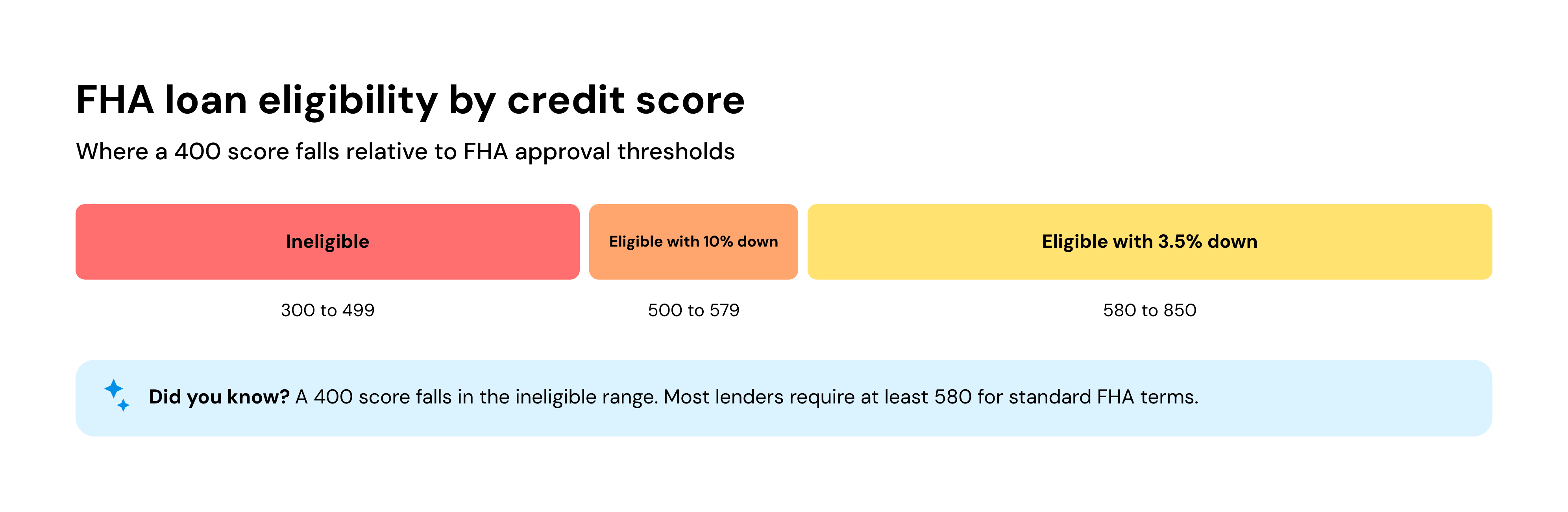
If your score is in the 400s, the roadmap has two milestones: get to 500, then get to 580.
Why getting to 500 is just the first step
Crossing 500 makes you technically eligible, but most lenders set their own internal minimums higher, often at 580 or above. The FHA allows lenders to enforce stricter standards, and most do, because borrowers with lower scores represent a higher risk of default.
That means reaching 500 is a meaningful milestone, but reaching 580 is what opens the door to a real pool of willing lenders and better loan terms.
What a path to approval looks like from the 400s
Depending on where in the 400s your score sits, you may be looking at a moderate rebuild or a more substantial one. Either way, the levers are the same:
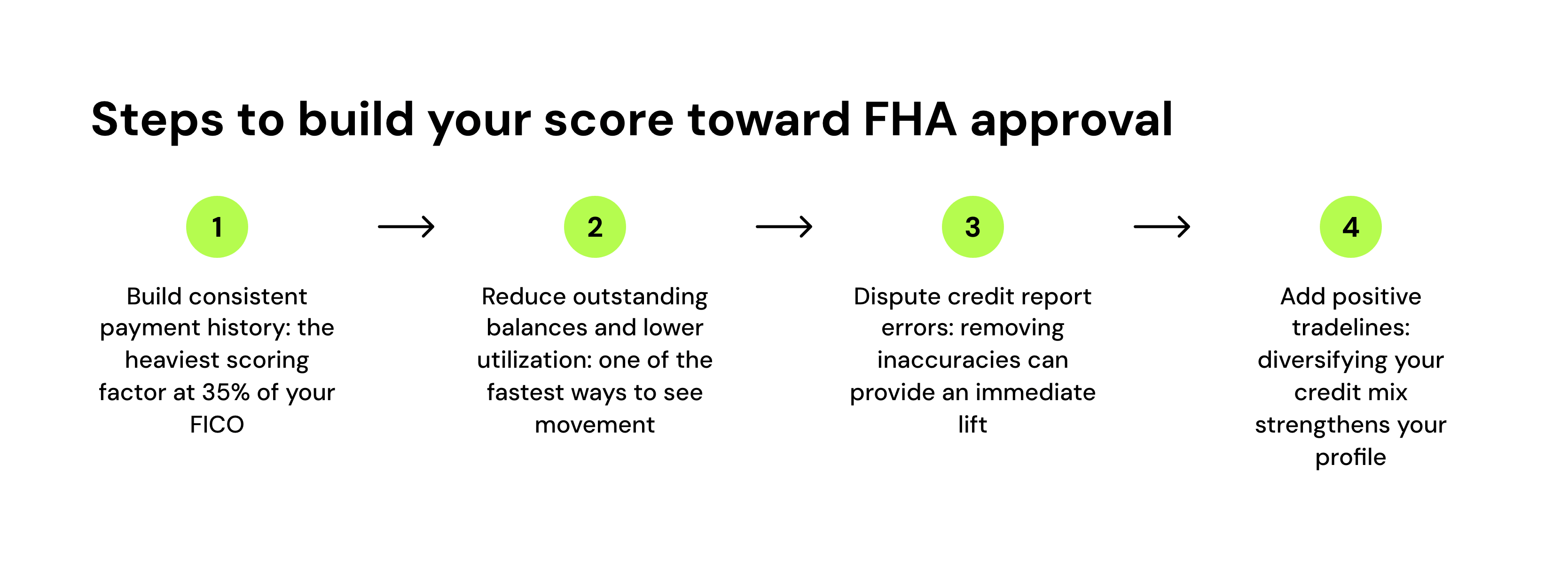
Build a consistent payment history. Payment history is the most heavily weighted factor in your credit score. Months of on-time payments, without exception, are the foundation of any score improvement.
Reduce your outstanding balances. High credit utilization (the ratio of what you owe to your available credit limit) can significantly suppress your score. Paying down revolving balances is one of the faster ways to see movement.
Check your credit report for errors. Inaccurate negative items are more common than most people realize. Use a tool like Kikoff's free debt dispute feature to flag and remove anything that shouldn't be there.
Add positive tradelines. Opening a credit-building account gives you a new line of positive payment history and can help diversify your credit profile over time.
What to expect once you qualify
Once you reach 500, you'll still face steep terms. Most lenders that will work with sub-580 scores require a 10% down payment. On a $300,000 home, that's $30,000 before closing costs, which typically add another 2–5%.
Getting to 580 drops the required down payment to 3.5%, so $10,500 on that same home. Interest rates also improve meaningfully at higher scores, which can translate to tens of thousands in savings over a 30-year loan. Use the time you're building your score to save aggressively toward a down payment as well.
Conclusion
A credit score in the 400s puts FHA eligibility out of reach for now, but the gap is closable with consistent effort.
Kikoff is a credit-building platform with tools built for exactly this situation, including verified rent reporting, free debt dispute tools, and more. Every point you gain brings you closer to the 500 and 580 milestones that matter most.
Frequently Asked Questions
About the editor
Disclaimer: The information provided in this blog post is meant for informational purposes only and does not constitute financial advice.