.jpg)


If you've been researching home loans with a 320 credit score, you've likely come across the FHA program and its reputation for being more lenient with borrowers.
That reputation is mostly true, but there are limits.
A 320 credit score falls below the minimum threshold that the FHA sets for any of its loan programs, which means lenders cannot approve you for an FHA mortgage at this score, even if you have a large down payment or strong income.
The good news is that a 320 score is not a permanent ceiling.
With the right strategy and a few consistent habits, you can raise your score enough to qualify, and understanding exactly where you stand is the first step.
Let's jump in.
Can you get approved for an FHA loan with a 320 credit score?
No. The FHA loan credit score minimum is 500, and a 320 credit score does not meet that threshold.
This isn't a lender preference or a guideline that can be waived. It's a hard floor set by the Federal Housing Administration itself.
Even if a lender wanted to approve you, they cannot issue an FHA loan to a borrower below 500. Every individual who applies for an FHA mortgage, regardless of income, down payment size, or employment history, must meet that baseline first.
It's also worth noting that many lenders set their own minimums even higher, often at 580, where the more favorable 3.5% down payment requirement kicks in.
A 320 score is basically in the territory where most traditional mortgage products are off the table entirely, which means the path to homeownership right now runs through credit building first.
What the FHA actually requires
The FHA loan program exists to help lower-income and first-time buyers access homeownership, and it's generally more accessible than conventional loan programs.
That said, there are two credit score tiers that determine your terms.
Borrowers with a score of 580 or higher can qualify with a down payment as low as 3.5% of the purchase price.
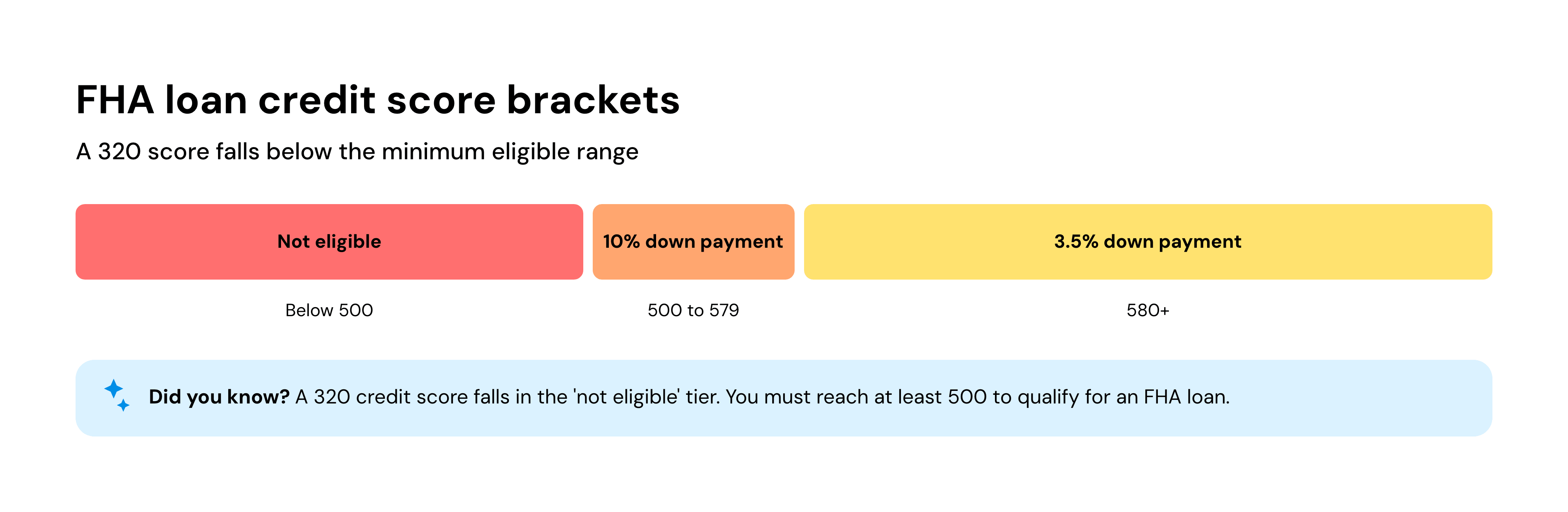
Borrowers with scores between 500 and 579 can still qualify, but they're required to put at least 10% down, which is a meaningful difference, especially on higher-priced homes.
Borrowers below 500, which is where a 320 score falls, are not eligible for FHA loans at all under current guidelines.
This structure exists because the FHA doesn't lend money directly. It insures loans issued by approved lenders, and those lenders take on real financial risk, so the credit minimums are in place to keep that risk at a manageable level.
Why a 320 credit score is treated differently
A 320 credit score is usually the result of serious negative items on a credit report, such as collections, charge-offs, late payments, or a recent bankruptcy or foreclosure.
Lenders and the FHA treat these scores differently because they paint a picture of a borrower who has had significant difficulty meeting past financial obligations.
It's not a judgment, just a signal that lenders use to assess how likely repayment is.
Scores in this range typically reflect multiple derogatory marks rather than just one missed payment, and that pattern is what creates the most friction when applying for credit.
This said, the distance between 320 and 500 is roughly 180 points, which sounds daunting but is achievable over time with consistent effort.
Generally, borrowers who focus on the right areas can see meaningful progress within 12 to 24 months.
What you can do to move toward mortgage eligibility
The single most effective thing you can do with a 320 score is shift your focus entirely to credit building before doing anything else mortgage-related.
Here's a breakdown of the most impactful areas to work on.
Pay every bill on time going forward.
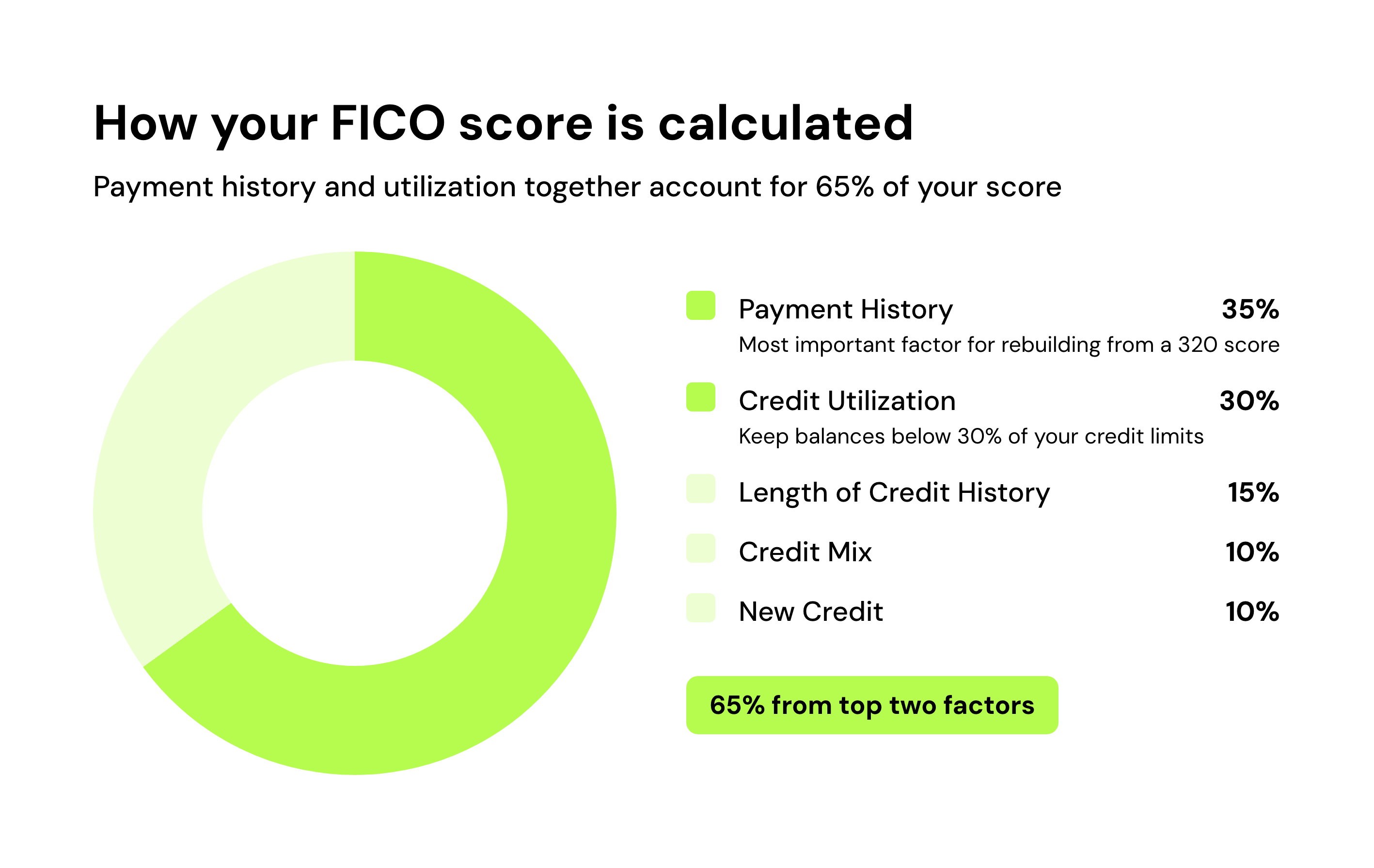
Payment history is the single most influential factor in your credit score, making up around 35% of your FICO score, so even one consistent year of on-time payments can start to shift your number meaningfully.
Address collections and derogatory marks.
Dispute any errors on your credit report first, since inaccurate information is more common than most people realize. For legitimate collections, negotiating a "pay for delete" agreement or settling old balances can help reduce the weight of negative items over time.
Add positive tradelines.
Every individual who is building credit from a damaged starting point benefits from adding accounts that report positive payment activity to the bureaus. A product like Kikoff lets you build credit through on-time monthly payments reported to all three major credit bureaus, with no hard credit check to get started.
Keep utilization low.
Credit utilization, the ratio of your balance to your credit limit, is the second biggest factor in your score. Keeping individual card balances below 30% of their limits generally helps, and below 10% is even better.
Report your rent.
If you're currently renting, your monthly rent payments can be reported as positive credit activity with the right tool. Kikoff's rent reporting feature does exactly that, sending verified rent payments to Equifax and TransUnion each month so your housing costs actually work in your favor.
How long it realistically takes to reach FHA eligibility
There's no formula that guarantees a specific timeline, but there are some realistic expectations.
Getting from 320 to 500 requires removing or reducing the weight of negative items and layering in new positive payment history.
Most credit experts estimate that borrowers who are actively working on all of the factors above can reach the 500 threshold within 12 to 24 months, depending on what's currently on their report.
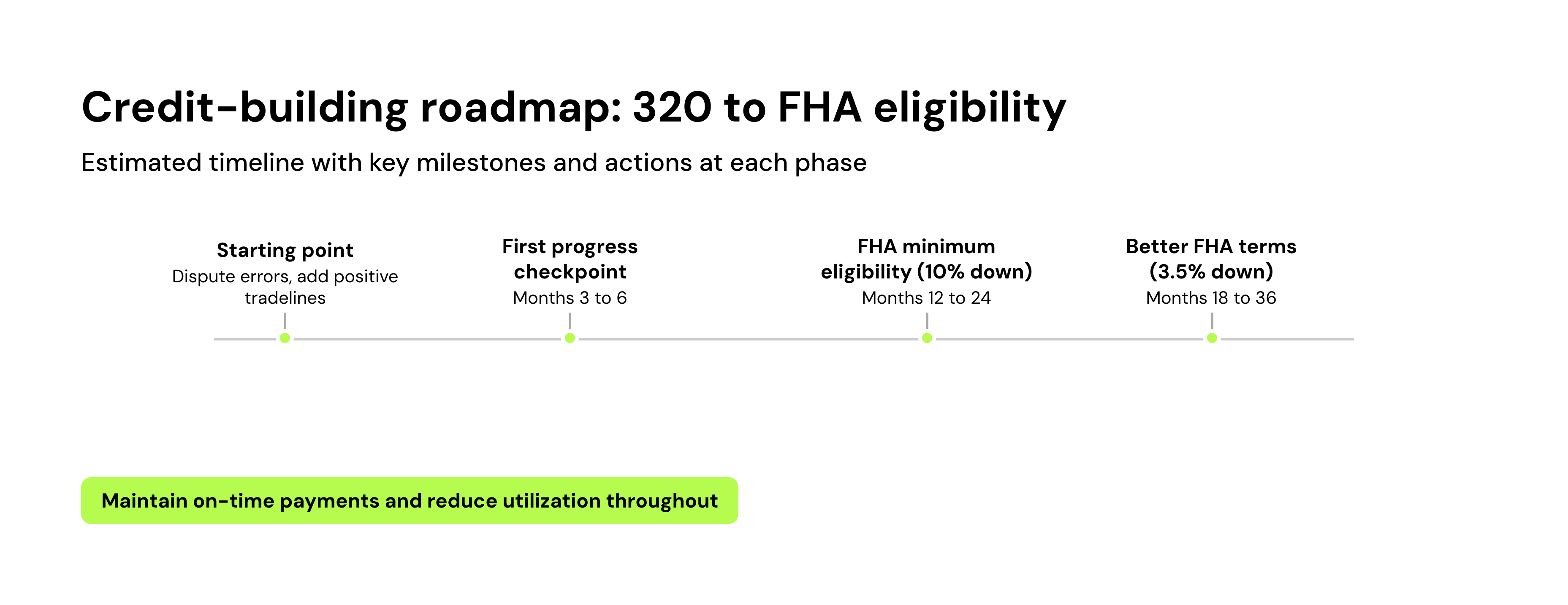
Reaching 580, which unlocks the better FHA down payment terms, typically takes longer, but lots of borrowers find that once momentum builds, the jump from 500 to 580 happens faster than the initial climb.
Luckily, you don't need a perfect score to qualify. You just need to get above the minimum and show enough financial stability to satisfy a lender.
What to avoid while rebuilding
There are a few common mistakes that can set you back while you're trying to raise a 320 score.
Applying for lots of new credit at once is one of them. Every hard inquiry can temporarily lower your score, so just make sure you're applying strategically rather than broadly.
Closing old accounts is another trap. Even accounts with a low balance or zero balance contribute to your available credit, and closing them can raise your utilization ratio overnight.
Ignoring your credit report is also a missed opportunity. Errors on credit reports are more common than most people expect, and disputing inaccurate negative items is one of the fastest ways to see score movement.
Kikoff's free dispute tools let every individual dispute inaccurate items electronically with TransUnion, or by mail with Experian and Equifax, all at no cost.
Conclusion
A 320 credit score puts FHA loan approval out of reach right now, but it doesn't mean homeownership is impossible.
It mainly means the work happens before the mortgage application, not during it.
With consistent on-time payments, reduced balances, and the right credit-building tools, reaching the FHA minimum of 500 is a realistic goal within one to two years.
Kikoff is a credit-building platform designed for exactly this kind of starting point. No hard credit check to sign up, no interest, and multiple tools that report positive activity to the major bureaus each month.
Build credit responsibly with Kikoff and take your first step toward mortgage eligibility.
Frequently Asked Questions
About the editor
Disclaimer: The information provided in this blog post is meant for informational purposes only and does not constitute financial advice.