.jpg)



If you’ve paid any attention to car prices in recent years, you know that vehicle costs have skyrocketed. And if you’re hoping to buy a car soon, you know that interest rates can make the total cost even higher.
Many factors influence car loan rates, but the most significant is your credit score. Let’s examine the average car loan interest rate by credit score.
Average car loan interest rate by credit score
To set car loan rates by credit score, lenders sort borrowers into five FICO score categories:
- Super prime (781–850)
- Prime (661–780)
- Near prime (601–660)
- Subprime (501–600)
- Deep subprime (300–500)
Here’s a closer look at car loan rates by credit score. (Note that the data here is based on early 2026 car loan rates.)
Super prime (781–850)
If you have outstanding credit, you’ll likely qualify for super prime rates. Here are some typical interest rate ranges:
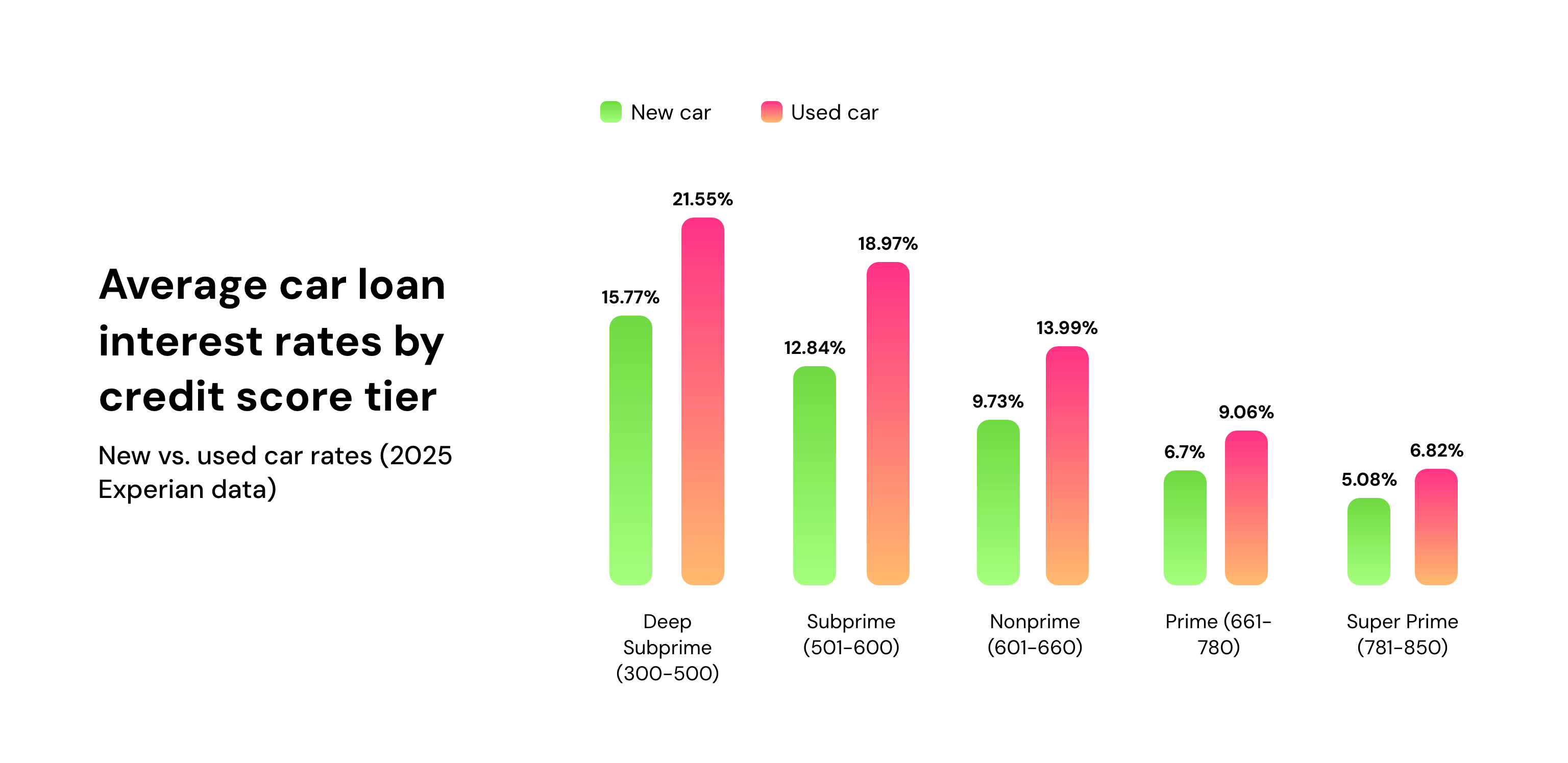
- New Car Loans: 4.66%–5.08%
- Used Car Loans: 7.41%–7.70%
One of the best ways to understand the impact of an interest rate is to look at a specific example.
If you took out a $20,000 new-car loan with a five-year term and 5.08% interest rate, you’d pay $2,689.49 in interest over the life of the loan. If you took out a $15,000 used-car loan with a five-year term and 9.98% interest rate, you’d pay a total of $3,119.81 in interest.
Prime (661–780)
Borrowers in the prime range have good or very good credit, so they still qualify for decent rates:
- New Car Loans: 6.27%–6.70%
- Used Car Loans: 9.63%–9.98%
If you took out a $20,000 new-car loan with a five-year term and 6.07% interest rate, you’d pay $3,238.44 in interest over the life of the loan. If you took out a $15,000 used-car loan with a five-year term and 9.98% interest rate, you’d be looking at $4,113.48 in interest.
Near prime (601–660)
Borrowers in the near-prime (sometimes called “non-prime”) range have fair credit, so they qualify for higher rates:
- New Car Loans: 9.57%–9.77%
- Used Car Loans: 14.07%–14.49%
For a $20,000 new-car loan with a five-year term and 9.77% interest rate, you’d pay $5,360.86 in interest in total. If you were to take out a $15,000 used-car loan with a five-year term and 14.49% interest rate, you’d end up paying $6,170.76 by the end of the term.
Subprime (501–600)
Since subprime borrowers have poor credit, they’re typically subject to much higher rates:
- New Car Loans: 13.00%–13.34%
- Used Car Loans: 18.95%–19.42%
Let’s say you took out a $20,000 new-car loan with a five-year term and 13.34% interest rate. That’s $7,513.00 in interest over the loan’s lifespan. A $15,000 used-car loan with a five-year term and 19.42% interest rate would require you to pay $8,554.98 in interest.
Deep subprime (300–500)
Deep subprime borrowers have very poor credit, so they only qualify for extremely high rates:
- New Car Loans: 13.76%–15.97%
- Used Car Loans: 19.32%–21.58%
These car loan rates can add many thousands of dollars in interest.
For example, if you took out a $20,000 new-car loan with a five-year term and 15.97% interest rate, you’d have to pay $9,162.54 in interest by the time it’s all said and done. For a $15,000 used-car loan with a five-year term and 21.58% interest rate, that’s $9,642.58 in total interest.
Other factors that affect your car loan rate
Because your credit score is one of the most important factors that determines your rate, it’s important to understand the average car loan interest rate by credit score before you borrow.
However, your FICO score isn’t the only factor to look at. The following considerations have some influence as well.
Used vs. new cars
Interest rates on loans for new cars are generally lower than those for used cars. Because used vehicles tend to depreciate faster, it will be harder for the lender to get their money back if you default on the loan and they repossess your car.
The loan term
Shorter loan terms are less risky for lenders, so they generally have lower interest rates. When the loan term is longer, interest rates are often higher, while monthly payments are lower.
Your down payment
By making a larger down payment, you can decrease the total amount you have to finance. Doing so also reduces the lender’s overall risk. As a result, you may secure a lower interest rate.
Type of lender
Loan rates can also vary somewhat depending on the type of lender you work with. Credit unions, for instance, usually offer better rates than banks and car dealerships.
Conclusion
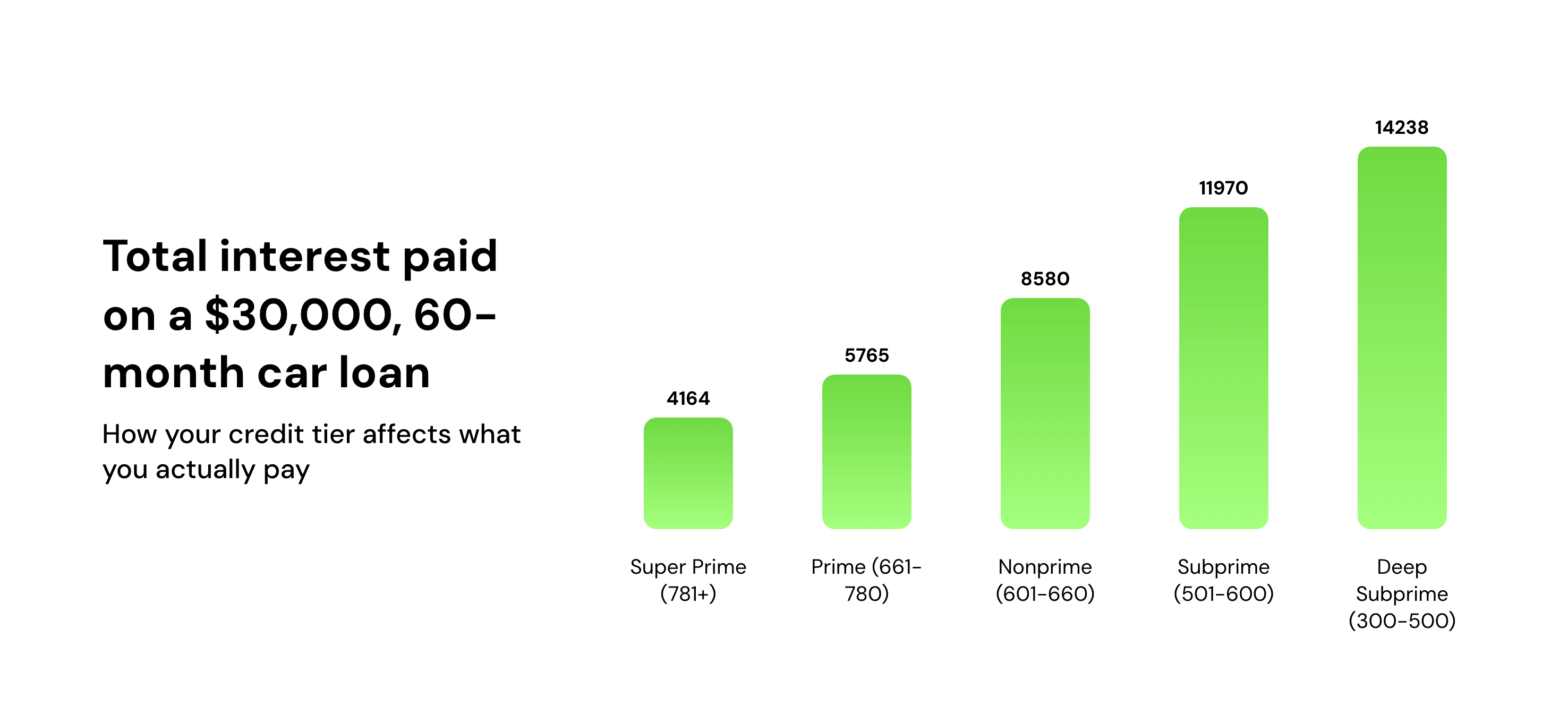
The gap between credit tiers on an auto loan is measured in thousands of dollars, not percentage points.
A super prime borrower and a deep subprime borrower on the same $20,000 new-car loan can differ by more than $6,000 in total interest over five years. That's the clearest argument for waiting a few months if your profile needs work.
Your term length, down payment, and choice of lender all move the number too, and credit unions generally beat banks and dealerships.
Kikoff gives eligible users access to a Kikoff Credit Account with no interest and no hard credit check to sign up, with monthly payments reported to all three credit bureaus.
Build credit with Kikoff and build credit responsibly with Kikoff's plans.
Frequently Asked Questions
About the editor

Article Sources
Disclaimer: The information provided in this blog post is meant for informational purposes only and does not constitute financial advice.