



Seeing an unfamiliar entry on your credit report can be alarming, especially when it comes with a name like "SYNCB/PPC" that doesn't immediately ring a bell.
The good news is that SYNCB/PPC is generally a legitimate entry tied to a specific type of consumer credit account, and understanding what it means can help you figure out exactly what you're looking at and whether any action is needed.
What is SYNCB/PPC on your credit report?
SYNCB/PPC stands for Synchrony Bank / PayPal Credit.
Synchrony Bank is one of the largest issuers of retail and co-branded credit products in the United States, and PayPal Credit is effectively a revolving line of credit offered through PayPal that allows users to finance purchases and pay them off over time.
When you open or use a PayPal Credit account, Synchrony Bank, which issues and manages the product, reports that account activity to the major credit bureaus under the name SYNCB/PPC.
This means that if you've ever applied for or used PayPal Credit, be it for a one-time purchase or as an ongoing credit line, that account will appear on your credit report under this label.
It's one of many "store card" style tradelines that Synchrony Bank manages, and SYNCB is a common prefix you'll see across lots of their retail credit products.
Why does SYNCB/PPC appear on your credit report?
SYNCB/PPC appears on your credit report because PayPal Credit is a formal credit product that is reported to the major credit bureaus.
Every individual who opens a PayPal Credit account triggers a credit inquiry at sign-up, and once the account is open, ongoing activity like payments, balance changes, and account status updates are reported regularly.
There are a few specific reasons you might see SYNCB/PPC on your report.
You applied for PayPal Credit
If you applied for PayPal Credit, even if you were denied, a hard inquiry from Synchrony Bank will appear on your credit report under this name.
Hard inquiries typically stay on your credit report for two years, though their impact on your credit score generally fades after about 12 months.
This said, a single inquiry has a minor impact on your score, so one SYNCB/PPC inquiry on its own is generally not a cause for concern.
You have an open PayPal Credit account
If you were approved and have an active PayPal Credit account, SYNCB/PPC will appear as an open tradeline on your report.
This tradeline will reflect your credit limit, current balance, payment history, and account age, all of which contribute to your credit score.
Keeping this account in good standing, mainly by making on-time payments and keeping your balance low relative to your credit limit, can actually be a positive factor for your credit over time.
You have a closed PayPal Credit account
Even after closing a PayPal Credit account, the entry can remain on your credit report for up to 10 years if the account was in good standing, or up to 7 years if it was associated with negative marks like late payments.
Closed accounts in good standing can actually help your credit by contributing to your length of credit history, so seeing a closed SYNCB/PPC account isn't necessarily a bad thing.
You don't recognize the account
If you see SYNCB/PPC on your report and you have no memory of ever opening a PayPal Credit account, this is worth investigating closely.
It's possible the entry is the result of identity theft or fraud, meaning someone may have used your personal information to open a credit account in your name.
This situation requires prompt action, which we'll cover further in this post.
Is SYNCB/PPC a hard inquiry or a tradeline?
SYNCB/PPC can appear as either a hard inquiry, a tradeline, or both, depending on where you are in the PayPal Credit lifecycle.
A hard inquiry shows up in the "inquiries" section of your credit report and indicates that Synchrony Bank pulled your credit as part of an application review.
A tradeline, on the other hand, appears in the "accounts" section and represents the ongoing credit account itself, including your balance, payment history, and account status.
If you applied but were denied, you'll see only the inquiry.
If you were approved, you'll see both the inquiry and the tradeline listed separately.
Does SYNCB/PPC affect your credit score?
Yes, SYNCB/PPC can affect your credit score in a few different ways depending on account behavior.
How it can help your credit
If you have an open PayPal Credit account and you use it responsibly, it can contribute positively to several key credit score factors.
On-time payments add to your payment history, which is the single most important factor in your credit score at 35%.
Keeping a low balance relative to your credit limit helps your credit utilization rate, which makes up another 30% of your score.
Over time, the account also contributes to your length of credit history, and having a revolving credit line in your credit mix can broaden your overall credit profile.
How it can hurt your credit
SYNCB/PPC can hurt your credit if you applied for PayPal Credit recently, since the hard inquiry will cause a small, temporary dip.
Missed or late payments on the account will have a significant negative impact on your payment history, and carrying a high balance relative to your credit limit will damage your utilization rate.
If the account was sent to collections or had a charge-off, that negative mark can stay on your report for up to 7 years and weigh heavily on your score during that time.
What to do if you don't recognize SYNCB/PPC on your report
If you see SYNCB/PPC and don't remember opening a PayPal Credit account, it's important to act quickly.
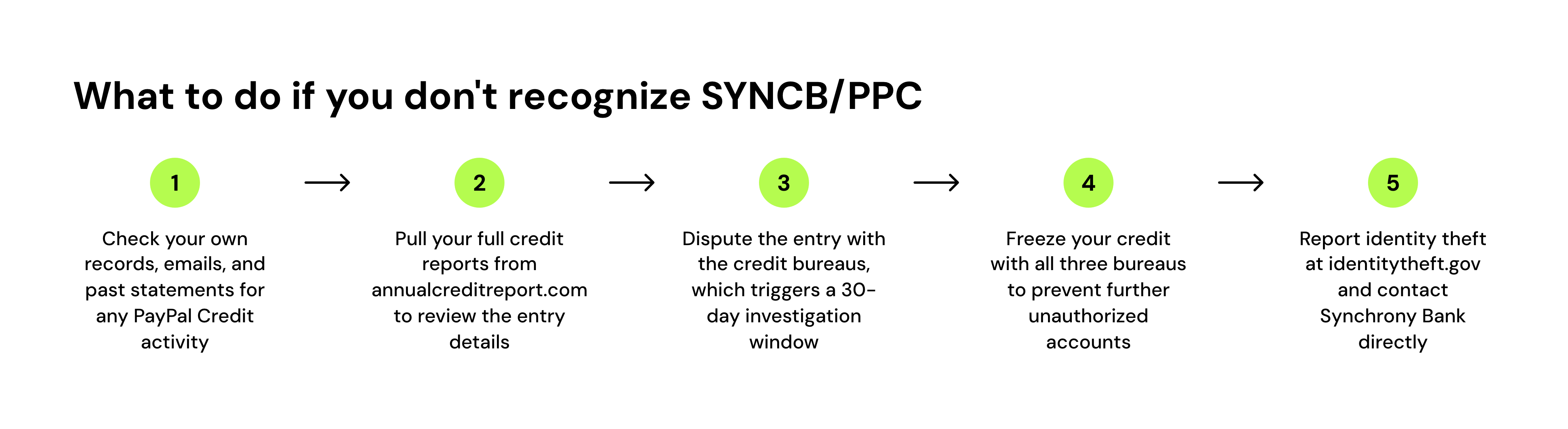
Check your records first
Before assuming the worst, do a quick check of your own records.
It's possible you signed up for PayPal Credit during a checkout flow without fully registering it as opening a separate credit account, since PayPal often promotes it as a "pay later" option at checkout.
Also look for any older email confirmations from PayPal or Synchrony Bank that might confirm the account's origin.
Pull your full credit report
Visit annualcreditreport.com to pull your full credit report from all three bureaus, Experian, Equifax, and TransUnion.
Review the account details under SYNCB/PPC closely, including the open date, account number, and any associated activity to see if anything confirms or contradicts your memory of the account.
Dispute the entry if it's inaccurate
If you're confident the account doesn't belong to you, you have the right to dispute it with the credit bureaus.
You can send dispute letters directly to Experian, Equifax, and TransUnion, or you can use a platform like Kikoff that provides free dispute tools to help you file a dispute electronically with TransUnion or generate a letter to send to the other bureaus.
Luckily, the dispute process is a consumer right protected under the Fair Credit Reporting Act, and bureaus are required to investigate within 30 days.
Freeze your credit
If you believe your personal information has been compromised, placing a credit freeze with all three bureaus is a super effective way to prevent anyone from opening new accounts in your name.
A credit freeze is free, doesn't affect your existing accounts or credit score, and can be lifted temporarily whenever you need to apply for credit yourself.
Report identity theft
If the account is confirmed to be fraudulent, file a report at identitytheft.gov and consider contacting Synchrony Bank directly to notify them and begin the dispute and fraud investigation process.
How SYNCB/PPC fits into your broader credit picture
Understanding what SYNCB/PPC means is also a good reminder of how important it is to regularly monitor your credit score.
Errors and unfamiliar accounts, be it from fraud, reporting mistakes, or just forgotten accounts, are more common than most people realize, and catching them early can save you lots of headaches down the line.
Beyond monitoring for issues, if you're looking to actively build or improve your credit, adding positive payment history through a dedicated credit-building product is one of the most reliable strategies available.
Kikoff offers a free Credit Account that reports on-time payments to all three major credit bureaus, helping you build a positive credit history without a hard credit check to sign up.
Conclusion
SYNCB/PPC on your credit report is effectively Synchrony Bank's label for a PayPal Credit account, and it's usually a legitimate entry tied to a past application or open account.
If you recognize it, just make sure you're keeping the account in good standing to take advantage of its positive impact on your payment history and utilization.
If you don't recognize it, take action quickly by reviewing your records, disputing the entry, and considering a credit freeze to protect yourself from further exposure.
And if you're looking to build a stronger credit foundation while you get things in order, Kikoff makes it easy to start building positive credit history with no hard credit check required.
Frequently Asked Questions
About the editor

Disclaimer: The information provided in this blog post is meant for informational purposes only and does not constitute financial advice.