







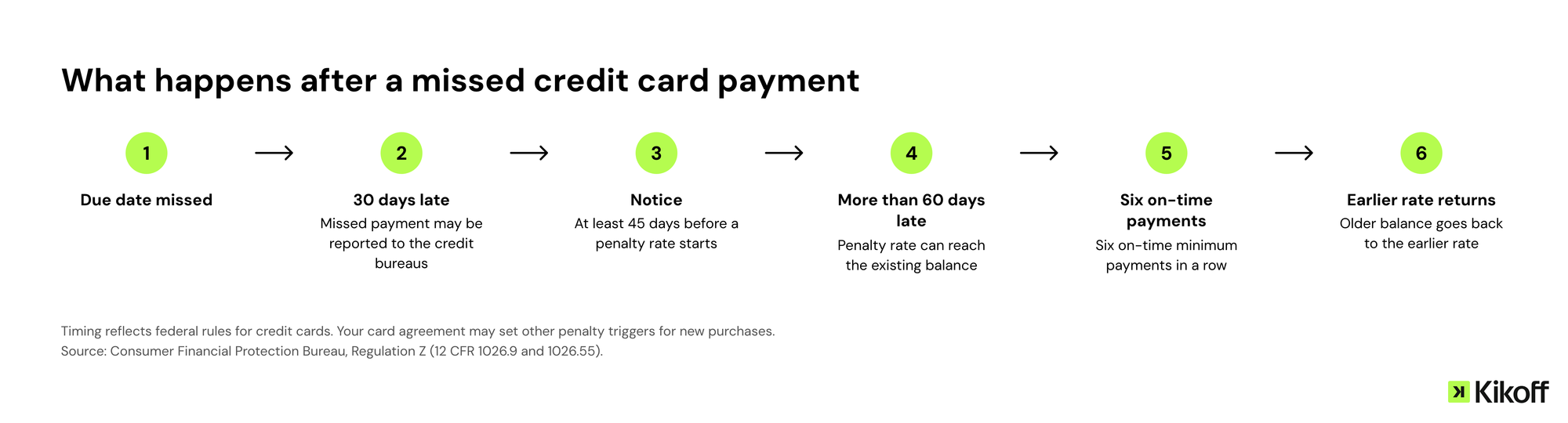
A penalty APR is a higher interest rate your credit card company can charge after certain triggers in your card agreement, most often a late payment. If you’ve just missed a payment, watch the calendar. Around 30 days late, the missed payment can show up on your credit reports. Past 60 days, your card company can apply the higher rate to the balance you already carry. Before that, federal rules generally limit it to new purchases, and only after 45 days’ notice.
How a penalty APR works
Your annual percentage rate (APR) is the yearly cost of carrying a balance. A penalty APR replaces your regular rate when you trigger certain terms.
Card companies have to list the penalty rate, the events that trigger it, and how long it lasts in the rates table you got when you applied. That table is often called the Schumer box.
If your card includes a penalty APR, it’s listed in a row labeled “Penalty APR and When it Applies.”
A penalty APRs is typically higher than your purchase APR, up to 29.99% for many cards. It can apply if you miss a minimum payment or a payment is returned. The same card charges a late fee of up to $40, separately. So one missed payment can cost you a fee and a higher rate.
Not every card has a penalty APR. Check your card’s rates table, or look it up in the CFPB’s credit card agreement database.
Read more >> When Does a Debt Become Delinquent?
What federal rules limit
The rules treat the balance you already have differently from new purchases.
- Notice comes first. Your card company must send written notice at least 45 days before a penalty rate takes effect. It must include up to four main reasons and say which balances the rate applies to. Purchases more than 14 days after the notice count as new transactions.
- Your existing balance has more protection. The higher rate can reach what you already owe only if your minimum payment isn’t received within 60 days after the due date.
- New purchases have less. After notice, the penalty rate can apply to new purchases for any trigger your agreement lists. In your account’s first year, your card company generally can’t raise the rate on new transactions, but being more than 60 days late is an exception.
How long a penalty APR lasts
If your rate went up because you were more than 60 days late, your card company must lower it after six on-time minimum payments in a row, starting with the first payment due after the increase. The rate goes back to what applied before. This covers transactions from before the notice through 14 days after it.
Don’t panic if your agreement says the penalty rate may apply “indefinitely.” Federal rules bar card companies from listing the six-payment reset in that table, but it still covers your older balance. Newer purchases can stay at the higher rate.
Your card company also has to review a rate increase at least every six months and lower it if appropriate. Note that a review doesn’t mean the rate has to come down.
What a penalty APR can cost
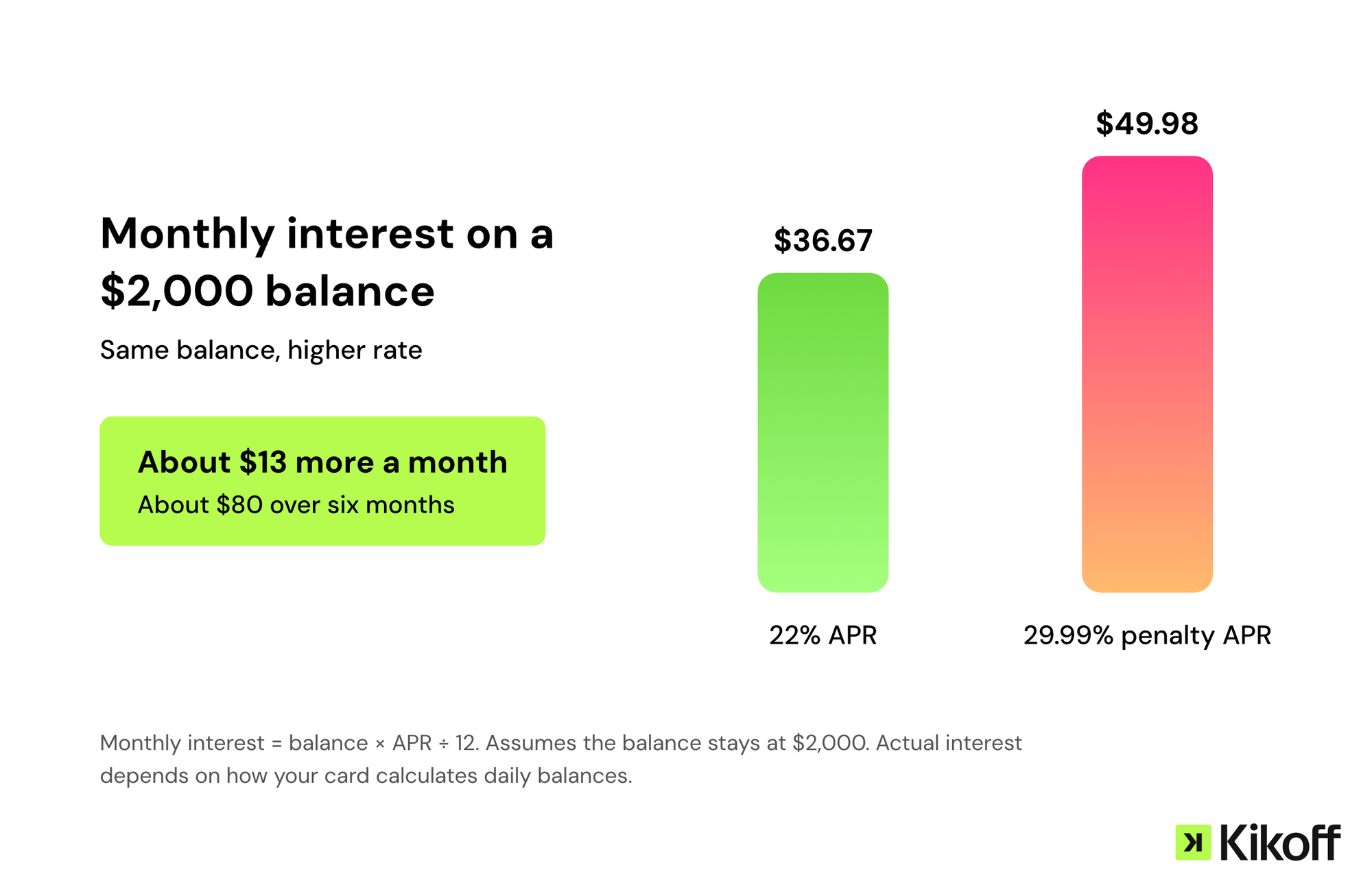
Say you have a $2,000 balance at a 22% APR, resulting in interest that’s about $36.67 a month ($2,000 × 22% ÷ 12). At a 29.99% penalty APR, it increases to about $49.98. That’s roughly $13 more a month, or about $80 over six months.
The interest you pay depends on your card company, the daily balance, and new purchases.
Read more >> What Are the Fees and Costs of Using a Credit Card?
What to do if you’re facing a penalty APR
- Pay at least the minimum as soon as you can. Before 30 days late helps keep the missed payment off your credit reports. Before 60 days keeps the higher rate off your existing balance.
- Read your card notice. It tells you which balances the new rate covers, when it starts, and why.
- Call your card company. Ask whether it can waive the penalty rate or late fee, and whether it has a hardship program. Write down who you spoke with and what they said.
- Set up autopay for at least the minimum. If your rate went up after a 60-day late payment, six on-time payments in a row bring your older balance back to the old rate.
- Check your credit reports. Check your credit reports each week at AnnualCreditReport.com. A penalty APR itself doesn’t appear on them, but a late payment can once it’s about 30 days past due. If it’s one you paid on time, you can dispute it with the bureau for free. Kikoff’s AI Credit Disputes can help with that too.
Can’t make the minimum? Call your card company within 60 days of your due date and ask about hardship options. The National Foundation for Credit Counseling (NFCC) can connect you with free or low-cost debt counseling at 800-388-2227. If you think your card company broke these rules, submit a complaint to the CFPB.
Bottom line
A penalty APR is a higher rate triggered by a late payment or other terms in your agreement. Federal rules limit when it can touch your existing balance and how you get out from under it. Getting your old rate back doesn’t take an accurate late payment off your credit report. What you can add is more on-time history around it.
Kikoff’s Credit Account reports your on-time payments to Equifax, Experian, and TransUnion, with no credit check to sign up. Plans start at $5 a month.
Frequently Asked Questions
Article Sources
Disclaimer: The information provided in this blog post is meant for informational purposes only and does not constitute financial advice.