
What Is a Convenience Fee, and How Do You Avoid It?

Convenience fees can quietly add up across rent, utilities, and everyday purchases. Here's what they are, why companies charge them, and how to avoid paying them.

Kikoff Team
What Is a Convenience Fee, and How Do You Avoid It?

Convenience fees have a way of showing up at the worst possible moment, right at the end of a checkout or payment flow when you've already committed to the transaction.

They're small enough to feel negligible in the moment but add up surprisingly fast across rent, utilities, and recurring bills.

In this post, we'll break down exactly what a convenience fee is, why companies charge them, and the most effective ways to avoid them.

What is a convenience fee?

A convenience fee is effectively a charge added by a business when you pay through a method or channel that's considered outside their standard payment process.

It's the business's way of passing along the cost of processing that payment to you rather than absorbing it themselves.

Let's jump in.

Why businesses charge convenience fees

To understand convenience fees, it helps to understand what's happening on the business's side of the transaction.

Every time a credit or debit card payment is processed, the merchant pays a fee to the card network and the payment processor, generally ranging from 1.5% to 3.5% of the transaction amount.

For businesses with thin margins or high transaction volumes, those fees add up to a significant operational cost over the course of a year.

Rather than build that cost into their pricing across the board, some businesses choose to charge it only to customers who use a specific payment method, be it a credit card, a debit card, or a third-party payment platform.

This is especially common in industries like utilities, government services, rent payments, and ticketing, where the base cost of the service is already fixed and the business has little flexibility on price.

What's the difference between a convenience fee and a surcharge?

These two terms are often used interchangeably, but they're technically different things and the distinction matters depending on where you live.

A convenience fee is charged for using an alternative payment channel, such as paying a bill online or over the phone instead of in person.

A surcharge is specifically added for paying with a credit card, regardless of the channel, and is subject to stricter rules in many states.

Several states, including California, Colorado, Connecticut, Florida, Kansas, Maine, Massachusetts, New York, Oklahoma, and Texas, have laws that limit or prohibit credit card surcharges specifically.

Convenience fees, on the other hand, are generally more widely permitted as long as the business offers a no-fee payment alternative.

Common places you'll encounter convenience fees

Convenience fees show up in a lot of places that most people don't think to look for them.

Here's a breakdown of the most common situations where they appear:

  • Rent payments through third-party portals like Zelle, PayNearMe, or Rentler
  • Utility bills paid online or by phone
  • Property tax and government fee payments
  • Concert, sports, and event tickets purchased through platforms like Ticketmaster
  • Airline ticket purchases made over the phone or through a third-party booking site
  • Tax preparation software and IRS payment plans
  • College tuition payments processed through student payment portals

Basically any time you're paying a fixed-cost obligation through a payment portal that wasn't built in-house, there's a decent chance a convenience fee is baked into the flow.

How to avoid convenience fees

Luckily, convenience fees are usually avoidable with a small amount of planning.

Every business that charges a convenience fee is generally required to offer a no-fee alternative, so the key is knowing what that alternative is before you pay.

Pay by ACH or bank transfer

The single most reliable way to avoid convenience fees is to pay directly from your bank account via ACH transfer.

ACH payments, also called direct bank transfers or e-checks, cost significantly less for businesses to process than card payments, which is why most platforms waive their convenience fee entirely when you use this method.

Most utility providers, rent portals, and government payment systems list ACH as a free option even when card payments carry a fee.

Pay in person or by mail

Many businesses that charge convenience fees for online or phone payments still accept payments in person or by mail with no added fee.

This is especially common for government services, utilities, and property tax payments, where a physical office or a mailing address for checks is usually available.

It's not the most convenient approach, but for larger payments where the convenience fee percentage adds up to a meaningful dollar amount, it's worth the extra step.

Use a bank account-linked bill pay service

Most banks and credit unions offer a free bill pay feature that lets you send payments directly from your checking account to businesses, without going through the merchant's own payment portal.

Since the payment effectively arrives as a bank transfer or check on the merchant's end, you generally bypass their convenience fee entirely.

This is a super practical option for recurring bills like utilities and subscriptions where you'd otherwise be paying the fee every month.

Ask for a fee waiver

It's not widely advertised, but many businesses will waive a convenience fee if you simply ask, particularly if you're a long-standing customer or paying a large amount.

This is especially worth trying with property management companies, insurance providers, and utility companies that have customer service lines.

The worst they can say is no, and in many cases a quick phone call saves you the fee entirely.

Use a no-fee payment method when available

Some businesses structure their payment portals so that certain card types are exempt from the convenience fee.

Prepaid cards, for example, are sometimes processed differently than standard credit cards and may not trigger the fee.

It's worth checking the payment portal's fee disclosure before choosing your payment method, since the fee structure isn't always obvious upfront.

How much are convenience fees typically?

Convenience fees vary widely depending on the industry and the payment processor involved.

For rent and utilities, they're usually a flat fee ranging from $2 to $10 per transaction or a percentage of the payment amount, generally around 2% to 3%.

For ticketing platforms, convenience fees are often per-ticket charges that can range from a few dollars to over $30 on premium events, which is why the total at checkout can look dramatically different from the face value of the ticket.

For government payments, the IRS charges a convenience fee of around 1.82% to 1.98% for credit card payments, while debit card payments carry a flat fee of around $2.20 per transaction.

Convenience fees and your budget

Individually, convenience fees often feel too small to think about.

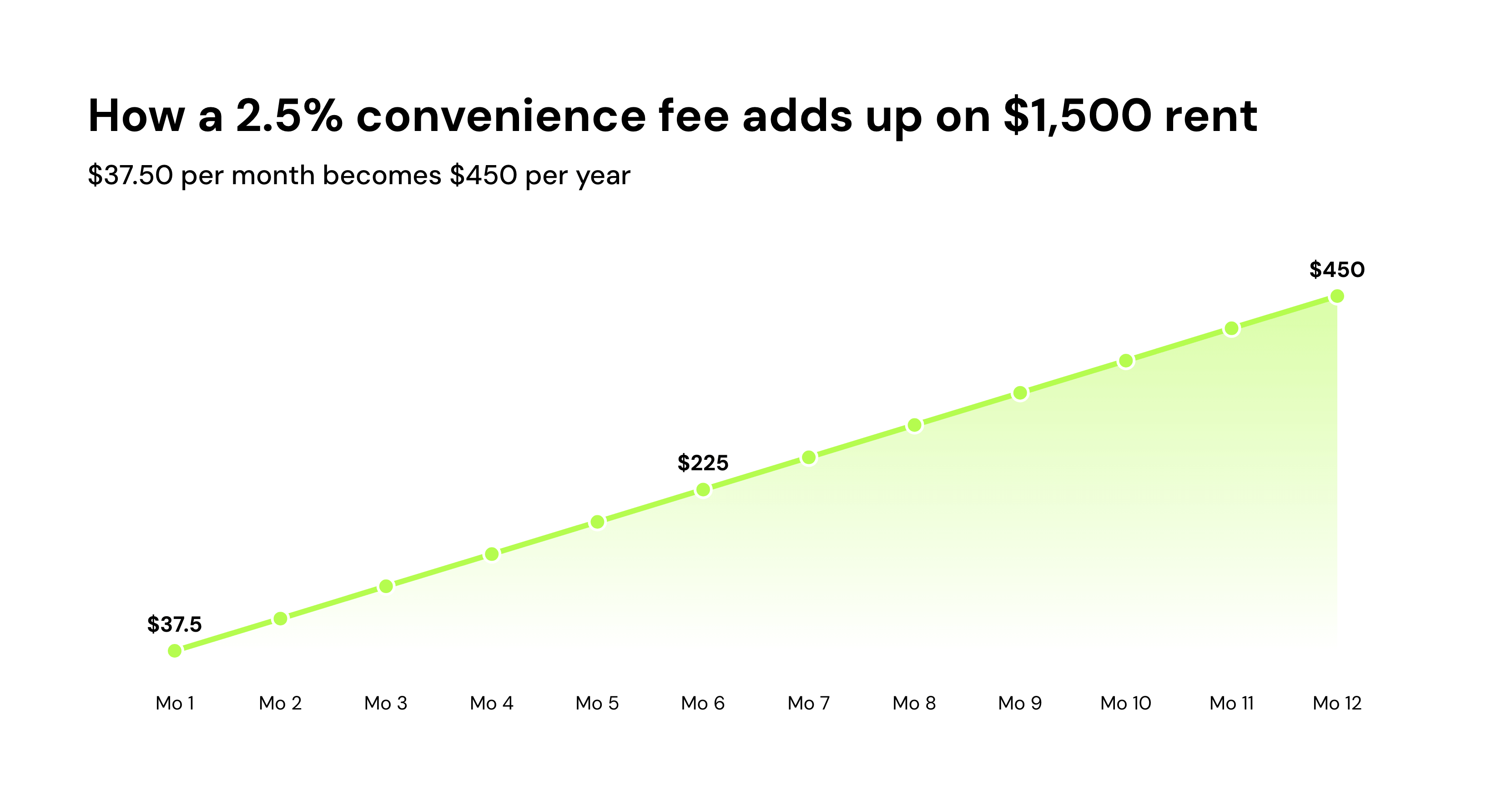
But if you're paying a 2.5% convenience fee on a $1,500 monthly rent payment, that's $37.50 a month, or $450 over the course of a year, for a payment method you may not have even chosen intentionally.

Tracking where convenience fees are showing up in your regular expenses and replacing them with free alternatives is a straightforward way to recover money without changing your spending habits.

That kind of mindful financial management, alongside building good credit habits, is generally what creates a strong financial foundation over time.

If building credit is part of your financial goals, Kikoff makes it easy to add positive payment history to your credit profile with no hard credit check required to sign up.

Conclusion

Convenience fees are a normal part of paying bills in 2026, but they're almost always avoidable with the right approach.

Paying by ACH transfer, using your bank's bill pay service, or paying in person will eliminate the fee in most cases.

And for the fees you can't avoid, knowing the exact amount upfront lets you decide whether the convenience is actually worth the cost.

For anyone focused on building a stronger financial foundation alongside smarter spending habits, Kikoff can help you get started with no hard credit check required.

Frequently Asked Questions

Are convenience fees legal?
Can I dispute a convenience fee with my credit card company?
Do convenience fees show up on my credit report?
Is a convenience fee the same as a service fee?

Sources

About the author

Kikoff Team
Kikoff Team

Articles written by our team of expert finance writers here at Kikoff.

About the editor

Browse additional topics

Disclaimer: The information provided in this blog post is meant for informational purposes only and does not constitute financial advice.

Bonus:

On This Page

Hot off the press

Read more