

.jpg)




Paying off a car loan early saves you interest. How much depends on your rate, the months left, and how your loan calculates interest. It usually makes sense once higher-rate debt is handled and you’d still have savings after. Just keep in mind that paying extra payments won’t lower your monthly bill, and it’s cash you can’t get back if something goes wrong.
Pros of paying off a car loan early
You save money on interest
Among the biggest perks of paying off your vehicle loan early is saving money on interest, which can add up to hundreds or thousands of dollars over the life of your loan.
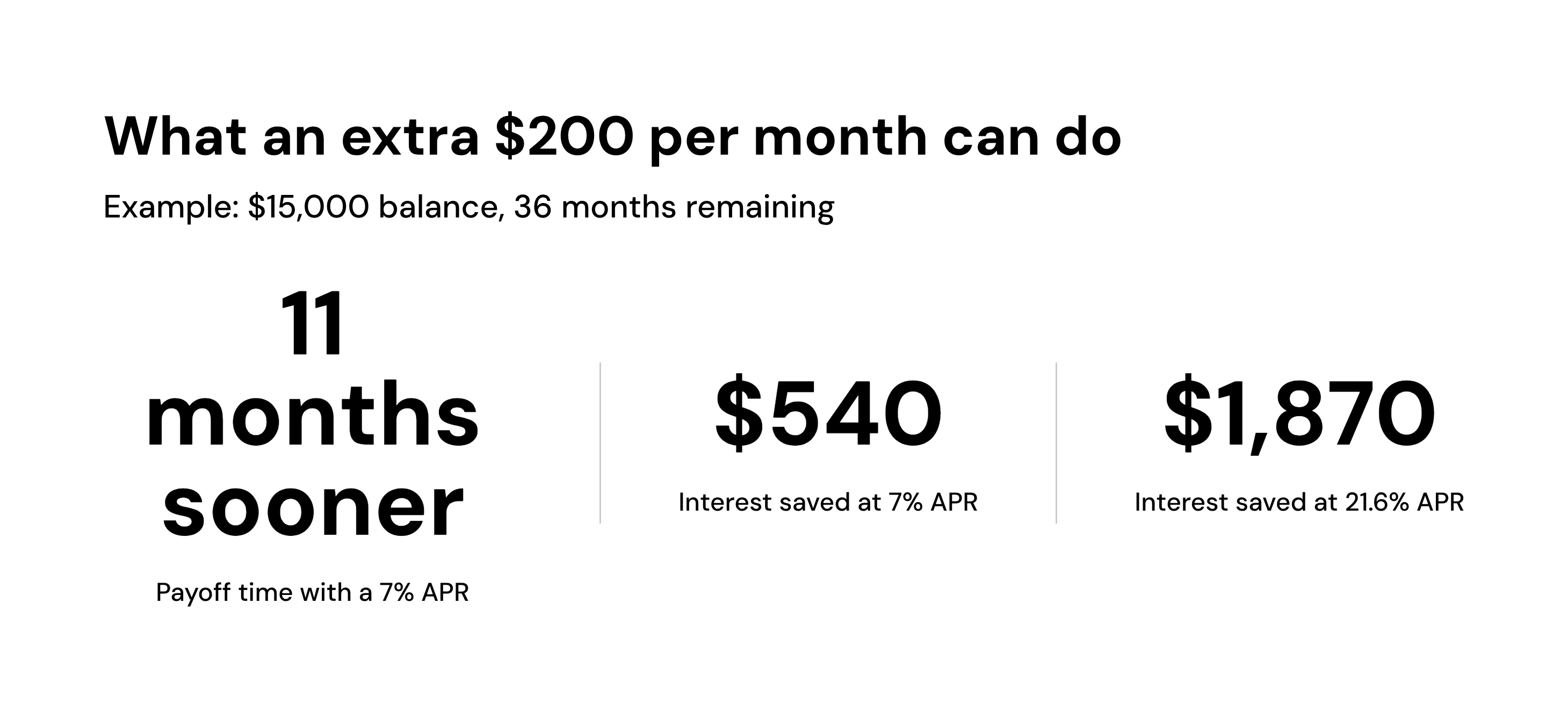
How much you save depends on your rate. Say you owe $15,000 at 7% with 36 months left. Adding $200 a month pays it off 11 months sooner and saves about $540. At 21.6%, the same extra $200 saves about $1,870.
Check how your lender charges interest too. If it precomputes interest, the total interest is calculated up front and built into what you owe, so paying early saves less than it would on a loan with simple interest. Your contract and Truth in Lending disclosure will tell you what kind of loan you have.
If you send extra cash to your lender, make sure you specify that you want the money to be allocated toward the principal.
You free up monthly cash flow
Once the loan is gone, the whole payment is yours. That’s $765 a month for the average new car loan in the second quarter of 2026, according to Experian. You could use that money for whatever financial goal is next up on your list, such as paying down other debts, building your emergency fund, or planning for a vacation.
Until then, extra payments don’t typically lower what you owe each month.
You own the car outright
Knowing that you own a vehicle free and clear is a huge win. You are free to drive it without a payment, sell it, or trade it in. That flexibility can provide peace of mind.
After your last payment, confirm the lender has released its lien and that you receive the title. Your state motor vehicle agency handles the title. You can also revisit insurance coverage your lender required, since that decision is now yours.
Your debt-to-income ratio improves
Your debt-to-income ratio (DTI) is your monthly debt payments divided by your gross monthly income. Dropping a car payment typically lowers it, which can make it easier to qualify for a mortgage or other loans.
If you’re shopping for a home, ask the loan officer whether paying off your auto loan can help with mortgage approval. Fannie Mae’s guidelines generally let lenders leave out installment loans with 10 or fewer payments left.
Run the numbers >> Use Kikoff’s auto loan calculator to see how your down payment and loan term change your monthly payment and total interest.
Cons of paying off a car loan early
You tie up cash you might need
Money you send to a lender early is locked in your car. If your hours get cut or a big bill arises unexpectedly, you can’t get that money back, and your monthly payment stays the same. Make sure to have an emergency cushion before paying ahead.
You could pay a prepayment penalty
Some lenders charge a fee for paying off your loan early. Look for a prepayment section in your loan agreement and on your Truth in Lending disclosure. If there’s a fee, compare that fee against what you’d save in interest by paying early.
And if your lender says one thing and your contract says another, report it to your state’s attorney general’s office.
You might miss out on higher-priority debt payoff
Paying off your car loan early may not help your overall finances. Credit cards usually cost more. Card accounts charged interest averaged about 22% in mid-2026, according to the Federal Reserve, while bank rates on 60-month new-car loans averaged about 7%. Used-car loans can run far higher, averaging above 21% for borrowers with deep subprime credit, according to Experian.
Compare your own rates rather than assuming the car loan is the cheap one.
Read more >> Debt Repayment Strategies: Snowball vs. Avalanche
How paying off a car loan early affects your credit
When you pay off a loan, the account is reflected as closed on your credit report. With one fewer account open, your mix of credit types changes. If your car loan was your only installment loan, it could potentially lower your score temporarily by a few points.
But a loan paid in full stays on your reports for up to 10 years, on-time payments included, and it keeps counting toward the age of your credit history the whole time.
Read more >> The Importance of On-Time Payments in Building Credit
What actually changes when the loan closes
• Your payment history sticks around. Every on-time payment remains on your report for up to 10 years, and that's the largest scoring factor.
• Your credit mix and number of open accounts might shift. If the car loan was your only installment account, losing it can cost a few points.
• Your new payment history stops. The account quits reporting fresh activity the month it closes.
When it makes sense to pay off your car loan early
Paying off your vehicle early can be a wise move if you’ve already addressed other high-interest debt. You should also have a clear plan for how to use your vehicle payment money once you’ve gotten rid of that loan.
When it might be better to keep making payments
If another debt charges a higher rate, putting early cash there usually saves more. If you’re using the snowball method, your smaller balance comes first regardless of rate.
If you’re behind on any of these payments, a nonprofit credit counselor can help you sort out which to pay first. The National Foundation for Credit Counseling (NFCC) can connect you to free or low-cost counseling at 800-388-2227.
Read more >> How to Pay Less Interest on a Car Loan
Bottom line
Paying off a car loan early is worth it when your rate is high, your contract doesn’t charge a fee for it, and you’ll still have savings after. The small credit dip isn’t a reason to wait.
What does change is that the loan stops reporting a new on-time payment each month. If it was one of your few open accounts, a Kikoff Credit Account can help keep that record building. It reports to Equifax, Experian, and TransUnion, there’s no credit check to sign up, and plans start at $5 a month.
Frequently Asked Questions
Article Sources
Disclaimer: The information provided in this blog post is meant for informational purposes only and does not constitute financial advice.