


If you're researching credit apps and comparing Kikoff and Dovly, it helps to understand that these two platforms are built around different core ideas.
Dovly is primarily an AI-powered credit repair and monitoring service, designed to automate dispute letters and remove inaccurate negative items from your credit report.
Kikoff is a dedicated credit-building platform, designed to add positive credit history to your file through a revolving tradeline, rent reporting, and free dispute tools.
In this post, we'll break down how each platform works, what it costs, and which one is the better fit depending on where you're starting from.
Which is better for building credit: Kikoff or Dovly?
Kikoff is the stronger option for most people focused on building credit, offering a revolving tradeline, rent reporting, all-three-bureau reporting, and free dispute tools starting at $5 a month.
Dovly is a legitimate credit repair platform that does automated dispute work well, but its credit-building products are locked behind a Premium plan at $19.99/month in the Dovly app, and reaching all three bureaus requires enrolling in two separate builders. For anyone who needs to build positive credit history, rather than primarily dispute errors, Kikoff covers more ground for less money. Let's jump in.
What is Kikoff?
Kikoff is a San Francisco-based fintech company founded in 2019, built around the idea that credit building should be affordable and accessible to every individual who needs it.
Kikoff's core product is a revolving line of credit called the Kikoff Credit Account, which functions like a store credit card on your credit report. Users are approved without a hard credit inquiry, and their monthly payments are reported to Equifax, Experian, and TransUnion every month. Kikoff has grown into a full credit-building platform over time, adding rent reporting and free dispute tooling to give users multiple ways to strengthen their credit profile simultaneously.
How Kikoff works
When you sign up for Kikoff, you're approved for a revolving credit line starting at $750, with higher limits available on premium plans.
There is no hard credit check, no interest, and no hidden fees. You use that credit line to finance the purchase of your Kikoff plan each month, and your balance and on-time payments are reported to all three major credit bureaus. Because Kikoff's tradeline is revolving, it targets payment history, credit utilization, and average account age at the same time, which is basically three of the five factors that determine your credit profile working in your favor at once.
Kikoff plans and pricing
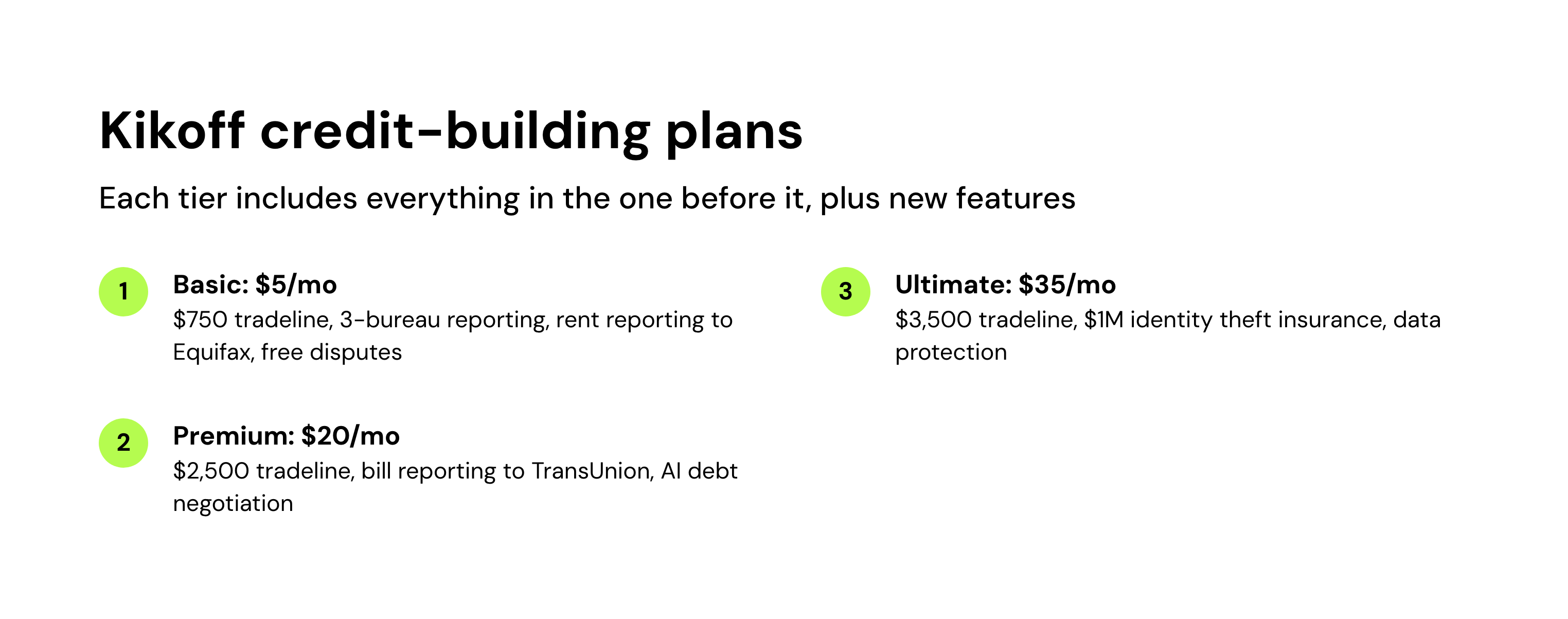
Kikoff offers three paid tiers, each building on the last:
- Basic ($5/month): $750 revolving tradeline reporting to all three bureaus, weekly credit report, free dispute tools, and rent reporting to Equifax and TransUnion.
- Premium ($20/month): Everything in Basic plus a $2,500 tradeline, three-bureau credit reports and scores, bill reporting to TransUnion, AI-powered debt negotiation, and subscription cancellation tools.
- Ultimate ($35/month): Everything in Premium plus a $3,500 tradeline, up to $1M in identity theft insurance, and personal data protection.
Plans can be upgraded, downgraded, or canceled at any time.
Other Kikoff features
Rent reporting is included on all Kikoff plans, allowing users to report verified rent payments to Equifax and TransUnion each month, which is a no-brainer for anyone who pays rent and wants to put those payments to work toward their credit profile.
Kikoff also offers free dispute letter generation to any consumer, regardless of plan, making it straightforward to challenge errors on your credit report. On Premium and Ultimate, Kikoff handles the postage and paperwork and submits the dispute to the bureau for you.
What is Dovly?
Dovly is an AI-powered credit repair and monitoring service founded in 2018, designed to help people remove inaccurate or outdated negative items from their credit reports through automated dispute letters.
Dovly's main appeal is automation. Rather than manually writing and sending dispute letters to the credit bureaus yourself, Dovly's AI analyzes your credit report and handles the dispute process on your behalf. The platform is mainly geared toward individuals who have existing negative marks, errors, or outdated items dragging their credit down, and who want a hands-off way to address them.
How Dovly works
After signing up, Dovly pulls your TransUnion credit report and its AI engine reviews it for items that may be inaccurate, outdated, or in violation of the Fair Credit Reporting Act.
The system then automatically generates and submits dispute letters to the credit bureaus on an ongoing basis, not as a one-time effort. You monitor progress through Dovly's dashboard, where you can see which disputes are pending and which items have been addressed. One important thing to understand is that Dovly, like any credit repair service, cannot remove accurate negative information from your report. What it can do is challenge items that creditors cannot verify, which often results in their removal.
Dovly plans and pricing
Dovly offers a free plan and a paid Premium plan at $19.99 per month in the Dovly app. Dovly's website lists $39.99 per month, and an annual option at $99.99 per year.
The free plan includes a monthly TransUnion credit report and score and the ability to manually select disputes with TransUnion. The Premium plan adds weekly TransUnion reports, unlimited AI-powered dispute automation, enhanced monitoring, and access to both of Dovly's credit-building features: a $2,000 tradeline that reports to Experian and Equifax, and a bill-reporting builder for rent, telecom, and utility payments that reports to TransUnion. This means the credit-building functionality, which is what lots of people searching for a comparison are primarily looking for, is only available on the Premium plan.
Dovly's credit-building tradeline
Dovly Premium includes a $2,000 tradeline that is added to your credit report, with on-time monthly payments reported to Experian and Equifax.
This tradeline functions similarly to a credit-builder product: you make a flat monthly payment, and that payment is reported as positive payment history. It does add to your available credit, which can help your utilization ratio.
Dovly's separate bill-reporting builder covers TransUnion, so members enrolled in both products can reach all three bureaus. No single Dovly product covers all three on its own, and both require the Premium plan. Dovly's credit-building features are also a secondary component of a platform that is fundamentally designed around dispute and repair work.
Kikoff vs Dovly: a side-by-side comparison
Here's a breakdown of the main differences between Kikoff and Dovly across the factors that matter most for credit building:
How each platform affects the five credit score factors
Every individual who has a credit score has it determined by the same five factors: payment history, credit utilization, length of credit history, credit mix, and new credit inquiries.
Here's a breakdown of how Kikoff and Dovly each address these factors.
Payment history (35%)
Payment history is the single most important factor in your credit score, and both platforms contribute to it, just differently.
Kikoff adds positive payment history to all three major credit bureaus every month through its revolving tradeline, and users on any plan can additionally report rent payments to Equifax and TransUnion. Dovly's tradeline reports payment history to Experian and Equifax, its bill-reporting builder covers TransUnion, and its dispute work primarily focuses on TransUnion.
This means Dovly's approach to this factor is split across products, with all three bureaus covered only if you're on Premium and enrolled in both builders, whereas Kikoff's approach is consistent across all three from one tradeline.
Credit utilization (30%)
Credit utilization is the second biggest factor, and Kikoff's revolving tradeline structure has a direct positive effect on it.
Kikoff's $750-$3,500 credit line is reported as a revolving account with a very low balance relative to the limit, which generally keeps utilization well below the 30% threshold lenders want to see. Dovly's $2,000 tradeline adds to your total available credit, which can help your utilization ratio.
This said, Dovly's tradeline reports to Experian and Equifax, and its bill-reporting builder isn't a revolving account, so the utilization benefit isn't reflected on the TransUnion view of your credit profile.
Length of credit history (15%)
Length of credit history looks at the average age of your open accounts over time.
Both platforms add an account to your credit file that will age and contribute to this factor as time passes. Kikoff's revolving account remains open as long as you maintain your plan, meaning it keeps aging as an active account. Dovly's tradeline similarly stays active as long as you remain a Premium member.
Credit mix (10%)
Credit mix measures the variety of credit types you've managed, be it credit cards, installment loans, mortgages, or other account types.
Kikoff's revolving Credit Account adds a credit card-style tradeline, which is the most useful type for most people starting from scratch. Kikoff's higher-tier plans provide a larger reported credit line, which adds more weight to your overall revolving credit profile. Dovly's tradeline adds a revolving line of credit to two bureaus, with TransUnion covered by a bill-reporting stream rather than a second credit account.
New credit inquiries (10%)
Neither Kikoff nor Dovly requires a hard credit inquiry to sign up.
This means opening an account with either platform will not result in a hard pull appearing on your credit report. This is super important for anyone whose score is already in a fragile range and who cannot absorb any additional dings from new applications.
Credit repair vs. credit building: understanding the difference
This is the most important distinction to understand when comparing Kikoff and Dovly.
Credit repair is the process of identifying and disputing inaccurate or outdated negative items on your credit report, such as errors, collections that have aged past their reporting window, or accounts that aren't actually yours.
Credit building is the process of adding new positive payment history, improving your utilization rate, and growing the age and variety of your accounts. These are two different problems, and the best tool depends on which one you actually have.
If your credit is suffering primarily because of errors or negative items that shouldn't be there, Dovly's dispute automation can be genuinely useful.
If your credit is low because you don't have enough positive credit history, or you're starting from scratch, credit building is what you need, and Kikoff is designed specifically for that. Luckily, Kikoff's free dispute tools mean you don't have to choose a separate service just to address errors, making it a more complete solution for most people.
Who should use Kikoff?
Kikoff is a no-brainer for anyone whose primary goal is adding positive credit history and strengthening their credit from the ground up.
It's especially well-suited for individuals who are new to credit, rebuilding after past issues, or who want to combine a revolving tradeline with rent reporting and free dispute tools in a single platform. The $5/month Basic plan covers the core of what most people need: all-three-bureau reporting, rent reporting, and free dispute access, with no banking requirement and no contract.
Who should use Dovly?
Dovly is a workable option for someone whose credit problems are mainly driven by errors or inaccurate negative items, and who wants an automated, hands-off approach to disputing them.
The Premium plan's dispute automation is its strongest feature, and for users with a long list of items to challenge, the automation saves real time. This said, at $19.99 per month in the app, its credit-building tools require the Premium plan and full bureau coverage means running two separate builders, and those tools are secondary to its repair focus. Every individual who is primarily looking to build credit rather than address errors will find a simpler path with a dedicated credit-building platform.
Conclusion
Dovly is a legitimate credit repair tool, and its dispute automation has real value for users with errors to address.
But as a credit-building platform, it splits the work across two Premium-only products, and building credit isn't what it was primarily designed to do.
Kikoff starts at $5 a month, reports to all three major bureaus from a single tradeline, includes free dispute tools on every plan, and is purpose-built to add the positive payment history and utilization improvements that contribute to stronger credit.
You can get started with Kikoff today, no hard credit check required.
Frequently Asked Questions
About the editor
Article Sources
Disclaimer: The information provided in this blog post is meant for informational purposes only and does not constitute financial advice.