.jpg)



Private mortgage insurance (PMI) premiums are deductible again for tax year 2026, the first time since 2021. Whether you get it depends on whether you itemize, when your policy was issued, and what the loan paid for, and what you earn. It also depends on your income: The deduction starts shrinking at $100,000 of adjusted gross income and disappears above $109,000.
Which matters less than it sounds like it should. PMI is what a conventional lender charges for letting you buy with less than 20% down, and the premium itself is set largely by your credit score.
Who qualifies for the PMI tax deduction?
While the PMI tax deduction expired at the end of 2021, 2025 tax reform legislation brought it back starting with the 2026 tax year (the return you’ll file in 2027).
You can claim the reinstated PMI tax deduction if you itemize deductions on your tax return. For 2026 the standard deduction is $16,100 for single filers and married filing separately, $32,200 for married filing jointly, and $24,150 for head of household. PMI only helps if your itemized deductions clear that.
The loan must also fall under a cap that applies to all debt secured by the home combined, not just the one loan:
Going over the cap doesn’t disqualify you. It just means that you deduct PMI on the portion of the debt within the limit.
Income limits and phaseouts
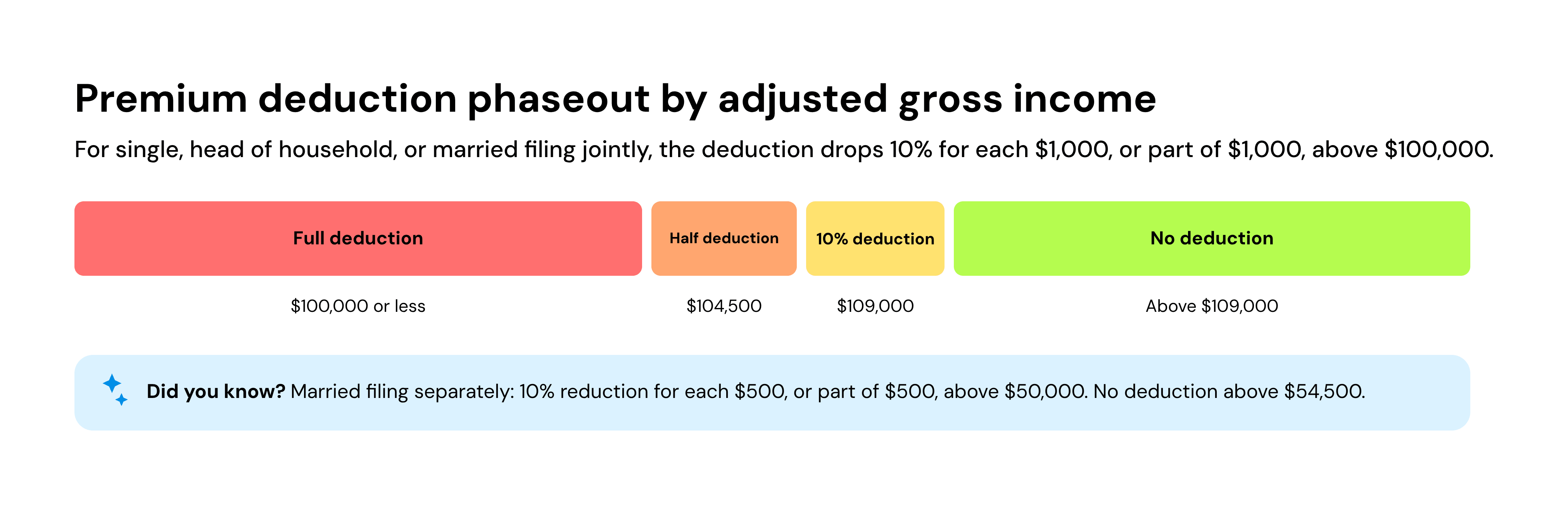
The deduction phases out in steps above $100,000 of adjusted gross income (AGI). For every $1,000 — or part of $1,000 — that your adjusted gross income exceeds $100,000, you lose 10% of the deduction. (Married filing separately, it's 10% for every $500 above $50,000.)
This means at $104,500 of AGI, you still deduct half your premiums. At $109,000, you deduct 10% of them. Above $109,000 (or above $54,500, if married filing separately), there's no deduction left.
This is adjusted gross income, not taxable income, so it's measured before your itemized deductions come off.
Read more >> Is Homeowners Insurance Tax-Deductible?
You can't amend an old return. The deduction didn't exist for tax years 2022 through 2025, so there's nothing to recover by going back. Tax year 2026 is the first year it's available again.
How the PMI tax deduction works
Your lender reports premiums of $600 or more in Box 5 of Form 1098, which is the same statement reporting your mortgage interest. (You still pay taxes on lower premium amounts, so check your own statements if Box 5 is blank.)
Where to find PMI: Form 1098, Box 5
If you paid a premium upfront instead of monthly (say, for an FHA mortgage insurance premium), you can’t deduct it all in one year. Instead, you spread it evenly over either the loan term or 84 months, whichever is shorter. Upfront charges on VA and Rural Housing Service loans are exempt.
How to pay less on PMI
The deduction gives back a slice of what you already paid. These strategies reduce the bill itself.
Get to 20% equity
Federal law requires loan servicers to automatically terminate your PMI once your loan balance is scheduled to reach 80% of the original value of the home if you ask and you’re current on payments.
It comes off automatically at 78%, as long as you're current. And the servicer has to end it the month after your loan hits the midpoint of its amortization schedule, whatever the balance is.
[CALLOUT] "Original value" means the lesser of the purchase price or the appraisal from when you closed, not what the house is worth now. A rising market doesn't move the automatic date. Cancelling early on appreciation is a separate request, with its own appraisal and its own rules, so ask your servicer what it requires.]
Put down more than the minimum
PMI rates vary by down payment and credit score. More of either lowers the premium, so even if 20% is out of reach, putting down what you can still cuts the cost.
Build credit before you apply
At the same 3.5% down, PMI can cost between 0.46% and 1.50% of your loan amount each year, depending on your credit score. On a $400,000 loan, that’s between $1,840 a year (about $153 a month) and $6,000 a year (about $500 a month) — a spread of more than $4,150.
Read more >> How to Reduce Closing Costs When Buying a Home
You don't have to pay for tax help. The IRS runs Free File for most filers and VITA, which offers free in-person help for people under certain income thresholds, people with disabilities, and limited-English speakers. TCE covers anyone 60 or older. Reach out to 800-906-9887 to find a site, or call AARP Tax-Aide, which runs most TCE sites, at 888-227-7669.
If your situation is more complicated, talk with a CPA or enrolled agent for guidance specific to your situation. Enrolled agents are licensed by the IRS and generally cost less.
Bottom line
PMI is deductible again for tax year 2026, but you must itemize, premiums must attach to the loan, and the deduction phases out between $100,000 and $109,000 of income. It also arrives a year late, and it returns a small part of what you paid.
Your credit score affects the other end of the same bill: It sets the PMI rate itself, and at the same down payment the gap between a score in the 620s and one above 760 runs about $4,000 a year on a $400,000 loan, every year, until the insurance comes off. No deduction closes that.
The Kikoff Credit Account reports to Equifax, Experian, and TransUnion, opens with no credit check, and plans start at $5 a month.
Frequently Asked Questions
Article Sources
Disclaimer: The information provided in this blog post is meant for informational purposes only and does not constitute financial advice.