


.jpg)




Homeowners insurance isn’t deductible for the home you live in. The IRS lists homeowners insurance premiums by name among the things a homeowner can't deduct. That changes only when part of your home stops being purely personal: a space used regularly and exclusively for a business you're self-employed in, or a property you rent out. Even then you deduct the business or rental share, not the whole premium.
Can you deduct home insurance?
If you solely use a home as your personal residence, you can’t deduct your insurance premiums come tax time. The IRS doesn’t consider personal expenses, such as property insurance, deductible.
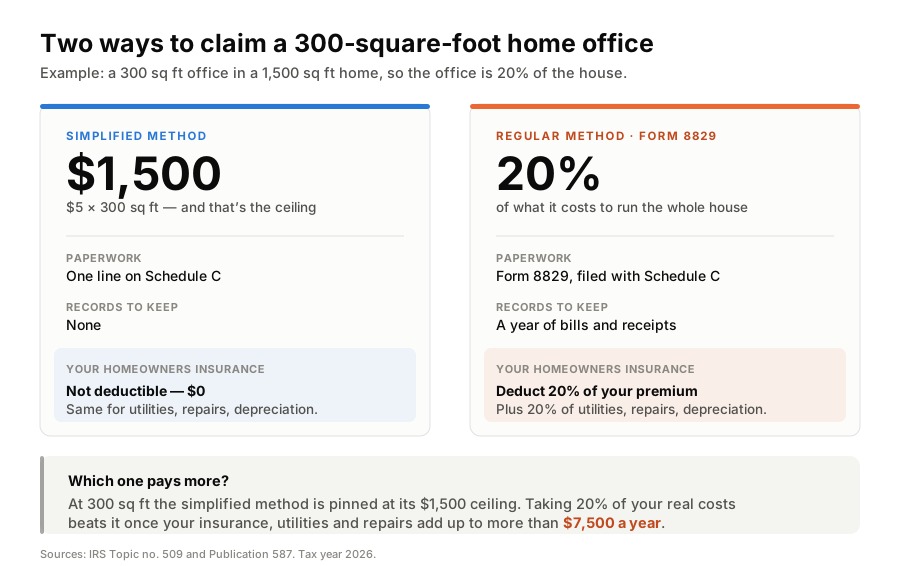
However, the answer changes when you use your home to produce income or as an office space. If you qualify for the home office deduction and use the regular method, you can deduct the business percentage of your homeowners insurance.
⚠️ After a disaster: File the claim first. If a federally declared disaster damages your home, part of the loss may be deductible, but only the portion insurance didn't cover, and only if you actually filed a claim. The IRS is explicit that you can't skip the claim and deduct the loss instead. State-declared disasters don't qualify.
When homeowners insurance is tax-deductible
Homeowners insurance isn’t typically tax-deductible with a few key exceptions for people who are self-employed or own properties they rent out.
Home office deduction
If you're a W-2 employee, you can’t deduct any part of your homeowners insurance even if you work from home full time, and even if you have a dedicated office. Congress ended the deduction for unreimbursed employee expenses starting in 2018, and the 2025 tax law made that permanent.
If you’re self-employed or a partner, the space has to be used regularly and exclusively for business, and it has to be your principal place of business, a place where you regularly meet clients or customers, or a separate structure on your property (like a detached garage or studio). If you meet the requirements, the IRS treats your homeowners insurance as an indirect expense, and you deduct the share that matches your office.
Exclusively is what can catch you up. A desk in the corner of your primary bedroom doesn't count, because the room does other things. A spare room you only work in does count. If your employer reimburses home office costs, that's between you and your employer. It isn't a tax deduction.
Rental properties
The policy on a property you rent out is deductible, but it isn't an itemized deduction. Technically, the policy on a rental property is a landlord or dwelling policy, not home insurance. But both rental income and expenses go on Schedule E, so you deduct the insurance whether you itemize or take the standard deduction.
If you live in the property part of the year and rent it the rest, you split every expense between the two uses and deduct only the rental share. And if you paid a premium covering more than one year (some landlord policies are written that way), you can't deduct the whole thing in the year you wrote the check. You spread it across the years it covers.
What homeowner expenses are tax-deductible?
In addition to homeowners insurance tax deductions for properties used for business purposes, you may be able to deduct other home-related expenses.
Mortgage interest
You can deduct interest on the first $750,000 of mortgage debt ($375,000 if you're married filing separately), and that cap now applies to all the debt secured by your home combined, first mortgage and home equity borrowing together. The 2025 tax law made both the cap and the home equity restriction permanent, so the expiration date you may have read about elsewhere no longer applies.
You may be able to deduct the interest you pay on a home equity line of credit or home equity loan when you use the borrowed funds to buy, build, or substantially improve the home securing the loan.
Mortgage insurance premiums
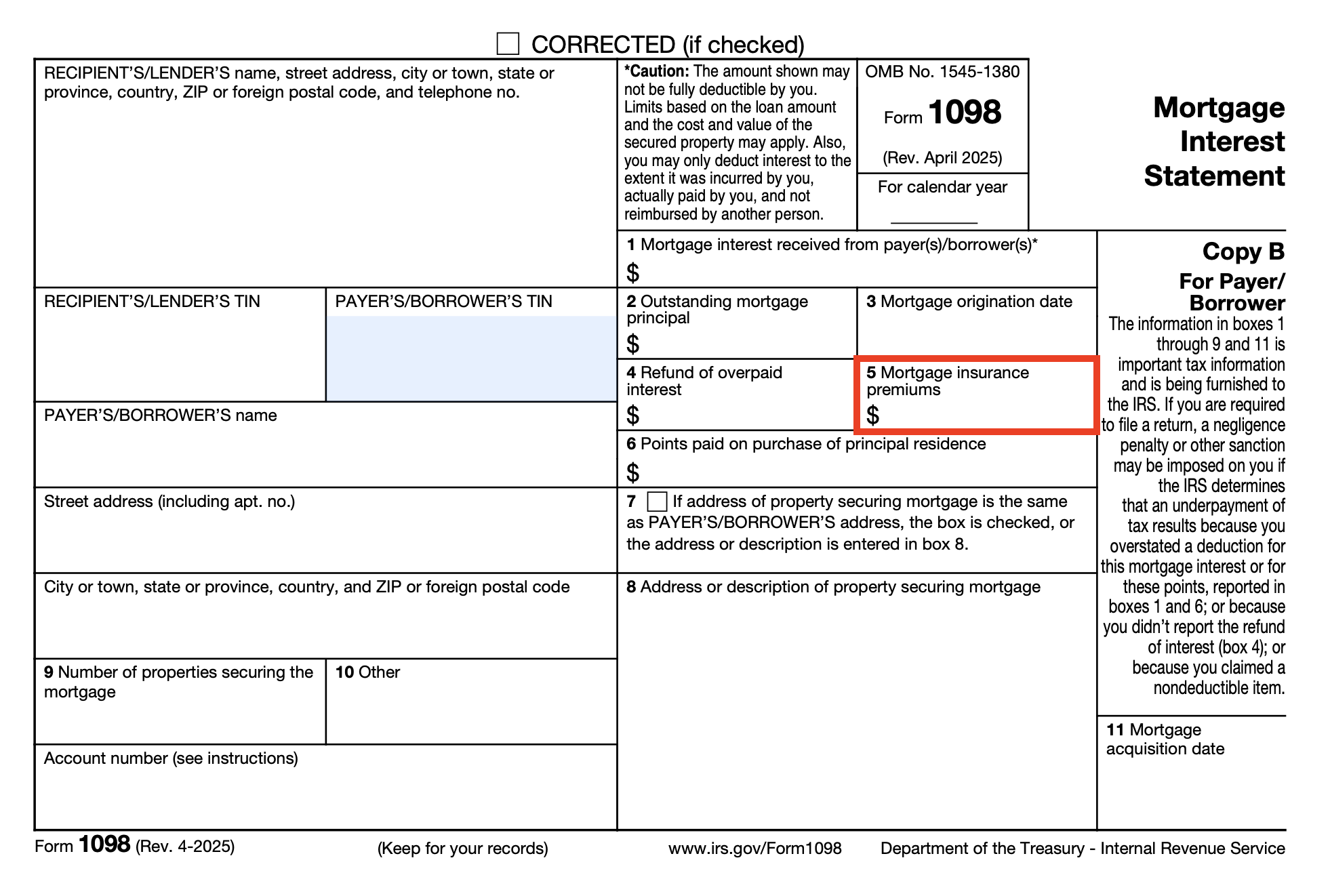
Mortgage insurance isn't the same thing as homeowners insurance: It's the PMI or FHA premium that protects your lender if you stop paying, and it usually shows up as a separate line in your escrow.
The deduction for it expired after 2021, and the 2025 tax law brought it back starting with the 2026 tax year. Your lender reports premiums of $600 or more in Box 5 of Form 1098.
If you have both, your homeowners insurance still isn't deductible, and your mortgage insurance is, if you itemize.
Property taxes
You may be able to claim property taxes as an itemized deduction. The deduction for state and local income, property, and sales taxes combined is capped at $40,400 for the 2026 tax year ($20,200 if you're married filing separately). That cap shrinks if your modified adjusted gross income tops $505,000 ($252,500 married filing separately), but it never drops below $10,000. It covers all your state and local taxes together, not just property tax.
Points paid on a mortgage
Points are prepaid interest, and the default is that you deduct them a little at a time over the life of the loan. You can deduct the whole amount in the year you paid it if:
- The loan was to buy, build, or improve the home you live in
- That home secures the loan
- Points are standard practice where you borrowed
- You didn't pay more than the going rate
- You paid for them out of your own funds rather than borrowing from the lender
- They're itemized as points on your settlement statement.
Points on a refinance get spread over the term even if each of the above is true.
Read more >> Are Mortgage Points Worth It?
You don't have to pay for tax help. The IRS runs Free File for most filers and VITA, which offers free in-person help for people under certain income thresholds, people with disabilities, and limited-English speakers. TCE covers anyone 60 or older. Reach out to 800-906-9887 to find a site, or call AARP Tax-Aide, which runs most TCE sites, at 888-227-7669.
If your situation is more complicated, talk with a CPA or enrolled agent for guidance specific to your situation. Enrolled agents are licensed by the IRS and generally cost less.
How to claim a home office deduction for insurance
If you want to claim a homeowners insurance tax deduction based on the space you use as your home office, you need to calculate the percentage of your home you use. There are two ways to do the math, and only one counts your insurance. You can switch between the two from year to year.
Bottom line
For the home you live in, homeowners insurance isn't deductible. It doesn’t matter whether you itemize or not. What's deductible is your mortgage interest (including points), your property taxes, and, starting in 2026, your mortgage insurance premiums. If part of your home is a real workspace for a business you own, or you rent the place out, your insurance comes into play for that share only.
Notice what all of those have in common: They hand back a slice of interest you've already paid. Your credit score, however, sets the rate that applies to the whole balance for as long as you hold the loan. On a 30-year mortgage that gap is worth far more than the deduction.
If you’re planning to refinance, apply for a HELOC, or buy your next house soon, you’ll want to work on your score first. The Kikoff Credit Account reports to Equifax, Experian, and TransUnion, with no credit check to sign up and plans starting at $5 a month.
Frequently Asked Questions
Article Sources
Disclaimer: The information provided in this blog post is meant for informational purposes only and does not constitute financial advice.