



If you've ever hit a score in the high 700s or 800s and wondered whether you could push it all the way to 900, you're not alone.
The short answer is: it depends on the scoring model. In this post, we'll break down exactly what the credit score ceiling looks like across different scoring systems, what it takes to get there, and whether shooting for a perfect score is actually worth your time.
Let's jump in.
No, a 900 credit score is not possible with FICO
The FICO score range tops out at 850, which means a 900 credit score is effectively impossible under the standard scoring model that most lenders use.
FICO scores are the single most widely used credit scores in lending decisions, be it mortgages, auto loans, or credit cards. The scale runs from 300 at the low end to 850 at the high end, and 850 is the ceiling, not a milestone on the way to 900.
This is a common point of confusion because people hear the phrase "perfect credit" and assume there might be room beyond what they've seen. There isn't, at least not with FICO.
That said, there are other scoring models that do extend beyond 850, and that's where the number 900 becomes relevant.
Which scoring models go up to 900?
While FICO caps at 850, a few other credit scoring models use a different scale that extends higher.
FICO Auto Score and FICO Bankcard Score are industry-specific scoring models, which are primarily used when you apply for an auto loan or credit card, respectively.
These models extend up to 900, so technically, a 900 credit score is possible in those specific contexts.
This means the answer to "is a 900 credit score possible" is really "yes, but only in certain scoring models, and it's extremely rare."
What does a perfect credit score look like in practice?
For most scoring purposes, a perfect credit score is 850 under both FICO and VantageScore 3.0.
Getting to 850 is genuinely rare. According to Experian, only about 1.31% of Americans have a perfect 850 FICO score.
What's interesting is that perfect-score holders don't necessarily have more accounts or a longer history than people in the 800 to 849 range. The difference is usually just the consistency of their behavior across all five credit factors over a long period of time.
In practice, a score of 800 or above already unlocks every meaningful benefit that a perfect score would. Lenders generally treat anyone in the "exceptional" range (800 and above) the same way, so the marginal value of going from 820 to 850 is largely symbolic.
What factors matter most when pushing toward a perfect score?
Reaching the upper end of any credit score range requires near-perfect performance across all five credit scoring factors, with two factors carrying the most weight.
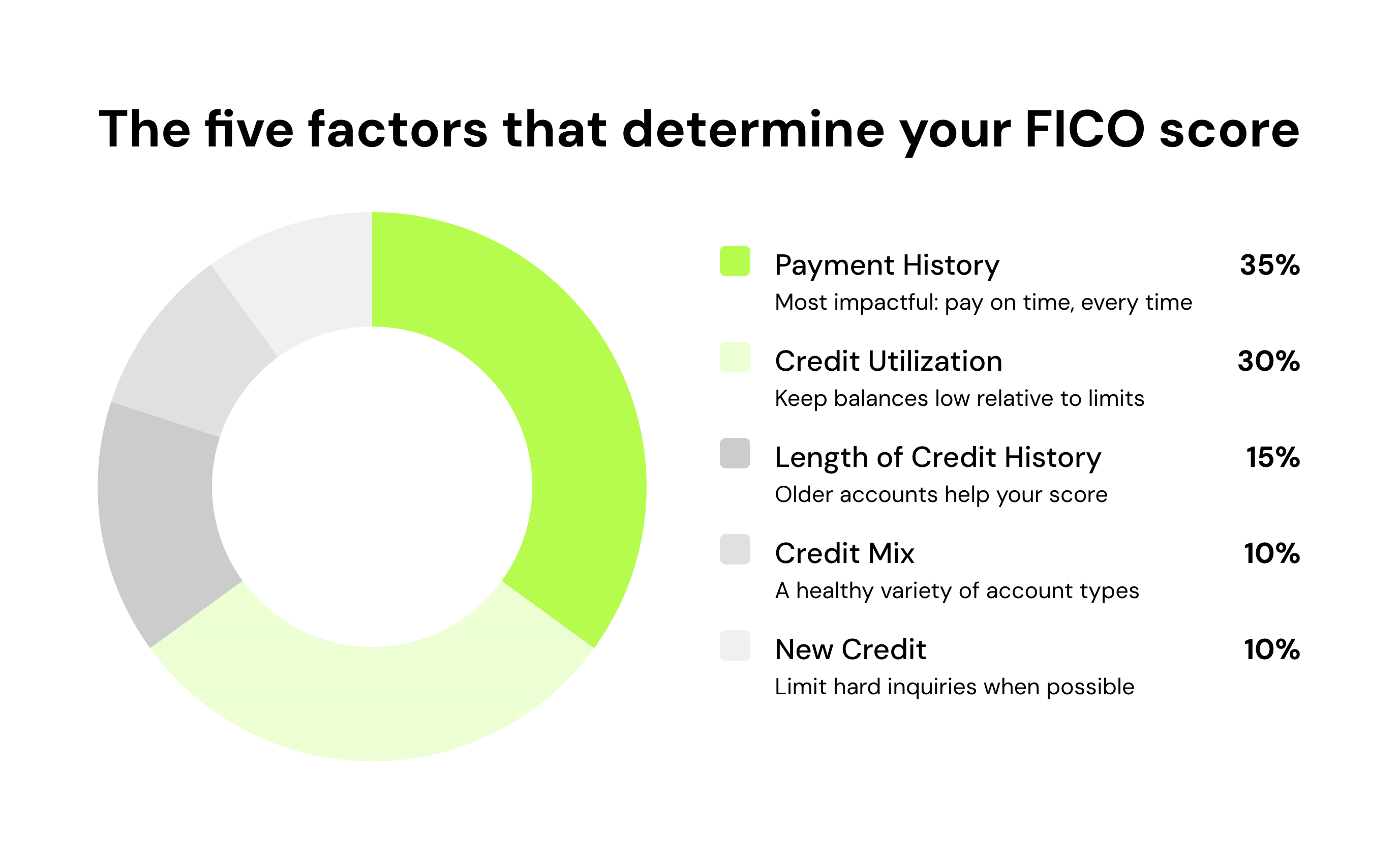
Payment history (35%)
Payment history is the single most important factor in your credit score.
Every on-time payment adds to a track record that signals reliability to lenders. People with 850 FICO scores typically have zero missed or late payments across all of their accounts, sometimes going back a decade or more.
Even one 30-day late payment can drop a high score significantly. Just make sure autopay is set up for at least the minimum due on all accounts to protect this factor.
Credit utilization (30%)
Credit utilization measures how much of your available revolving credit you're using at any given time.
People with perfect scores generally keep their utilization well below 10%, not just below the commonly cited 30% threshold. Basically, the lower your utilization is relative to your credit limits, the better this factor looks to the scoring model.
A Kikoff Credit Account can help here by adding a reported revolving tradeline to your credit profile, which affects both your payment history and your overall credit utilization simultaneously. Unlike credit-builder loans, which only build payment history and lock up your funds for the loan term, a credit account works across both of the two highest-weighted scoring factors at once.
Length of credit history (15%)
Length of credit history rewards individuals who have been managing credit responsibly for a long time.
This factor looks at the age of your oldest account, your newest account, and the average age across all accounts. This means opening a lot of new accounts in a short period of time will lower your average account age and drag this factor down, even if everything else looks great.
People who score near 850 usually have their oldest account well into the 10 to 25 year range. Keeping old accounts open, even if you rarely use them, is a no-brainer strategy for maintaining a strong credit history length.
Credit mix (10%)
Credit mix is effectively a measure of how many different types of credit you've managed successfully.
Having experience across revolving credit (like credit cards) and installment credit (like auto loans or mortgages) paints a picture to lenders that you're capable of managing different types of financial obligations. This said, it's a smaller factor, and you shouldn't take on debt you don't need just to improve your mix.
New credit inquiries (10%)
New credit inquiries make up the smallest slice of your score and reflect how often you've applied for new credit recently.
Hard inquiries generally stay on your report for two years and can ding your score for about one year. People with perfect scores usually apply for new credit sparingly and space out applications by several months at minimum.
Is chasing a perfect score worth it?
For most people, chasing a perfect score past 800 is not worth optimizing for.
Lenders generally offer their best rates and terms to anyone in the 760 and above range. Going from 810 to 850 will not lower your mortgage rate, get you a better credit card offer, or improve your approval odds in any meaningful way.
The smarter goal is to get into the "exceptional" tier and stay there by maintaining healthy credit habits consistently. That means paying on time every month, keeping utilization low, and avoiding unnecessary hard inquiries.
If you're still in the early stages of building credit, tools like Kikoff can help establish that foundation by reporting on-time payments to all three credit bureaus across both payment history and credit utilization, which are the two factors that matter most.
Conclusion
A 900 credit score is technically possible, but only under industry-specific FICO models like FICO Auto Score and FICO Bankcard Score, which extend up to 900.
Under the standard FICO model that most lenders use, the ceiling is 850. For VantageScore, it's also 850. Reaching either of those maximums is extremely rare and requires spotless credit behavior maintained over many years.
The good news is that you don't need a perfect score to unlock the best financial products and rates. Getting above 760 generally gets you there, and the habits that build toward a perfect score are the same habits that get you to 760 in the first place.
If you're looking to build credit efficiently and affect the factors that matter most, Kikoff is a simple, low-cost way to get started. Plans start at $5 a month and report to all three credit bureaus.
Frequently Asked Questions
About the editor

Disclaimer: The information provided in this blog post is meant for informational purposes only and does not constitute financial advice.