.jpg)
.jpg)



A tax refund can support stronger credit by helping you catch up on overdue accounts, reduce credit card balances, or build savings that makes future missed payments less likely. It will not automatically change your credit score, and the effect of any payment depends on what is reported and which scoring model is used.
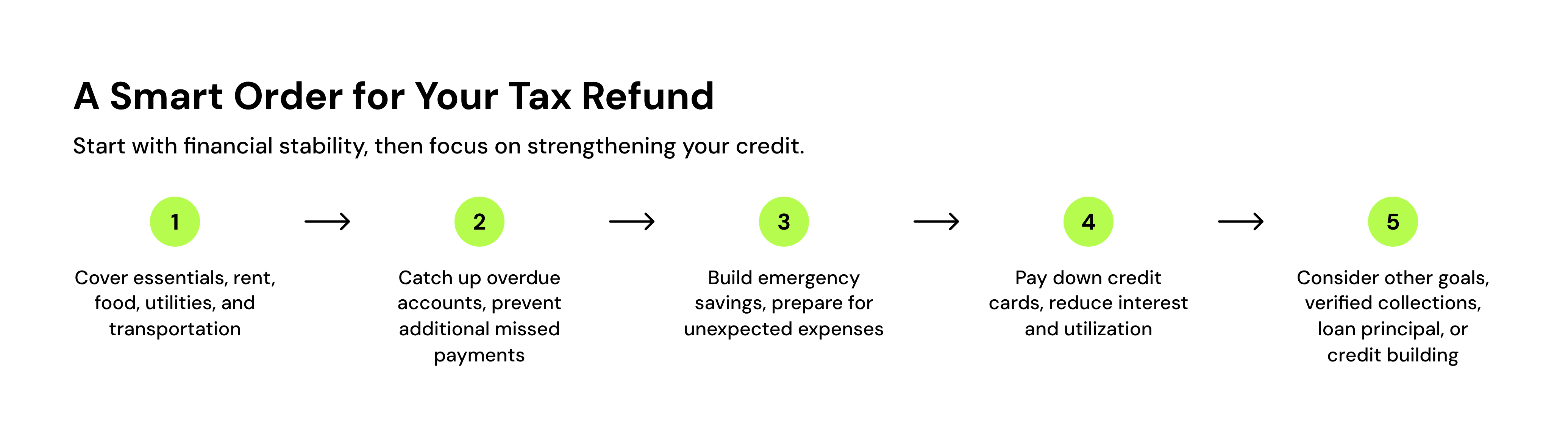
Before spending the refund, cover immediate necessities and upcoming bills. Once those are secure, choose the use that addresses the biggest risk or cost in your financial life.
Ways to use your tax refund to strengthen your credit
You do not need to spread a modest refund across every goal. In many cases, focusing on one urgent account or dividing the money between debt and savings will be more useful.
1. Catch up on past-due accounts.
If an account is currently overdue, bringing it current may be the most urgent use of your refund. Payment history is the largest FICO scoring category, and additional missed payments can deepen the damage.
Contact the creditor before paying if you cannot bring the account fully current. Ask whether it offers a hardship plan, a revised due date, or another arrangement you can afford. Confirm how much you need to pay and what the account’s status will be afterward.
Getting current does not erase accurate late payments already reported, but it can prevent the account from falling further behind.
2. Pay down credit card balances.
Paying down credit cards can reduce interest charges and lower your credit utilization, which is the percentage of available revolving credit you are using. Lower reported utilization may help your score, but there is no universal point increase.
Suppose a card has a $5,000 limit and a $3,000 balance. Its utilization is 60%. Applying $2,000 of your refund would reduce the balance to $1,000 and the utilization to 20%, assuming the limit does not change and you make no new purchases.
The change usually will not appear in a credit score until the issuer reports the lower balance. The Consumer Financial Protection Bureau notes that credit scores can be calculated at different times, so the timing of any score change varies.
If you have several cards, paying the highest-interest balance first generally saves the most money. Bringing a nearly maxed-out card down may also reduce high utilization on that individual account.
3. Address verified collection accounts carefully.
Paying or settling a collection can resolve the debt, but it does not necessarily increase your score or result in immediate removal from your credit report. Most accurate negative information can generally remain for up to seven years, although some newer scoring models treat paid third-party collections differently.
Before paying, confirm that the debt is yours, verify the amount, and make sure the collector has the right to collect it. If you negotiate a settlement, the CFPB recommends getting the agreement and the collector’s promises in writing before sending payment.
4. Start or replenish an emergency fund.
An emergency fund does not appear on your credit report, but it can protect your credit indirectly. Savings can help you cover a car repair, medical bill, or income interruption without missing payments or relying entirely on new debt.
There is no single emergency-savings target that fits everyone. The CFPB recommends choosing an amount based on your circumstances and the unexpected expenses you are most likely to face. Even a modest starter fund can create useful breathing room.
Keep emergency savings somewhere safe and accessible, such as a separate bank or credit union savings account.
5. Make an extra payment on an installment loan.
If your bills are current, you have emergency savings, and you do not have higher-interest debt, you could put part of the refund toward an auto, personal, or other installment loan.
An extra principal payment may reduce future interest and shorten the payoff period, but check the contract first. Some loans may have prepayment penalties, and lenders differ in how they apply extra payments. The CFPB advises auto-loan borrowers to review their contracts and applicable state law.
Ask the lender how to designate an additional principal payment and confirm afterward that it was applied as intended. Paying down an installment loan may not affect a score as quickly or predictably as lowering revolving utilization.
6. Review and dispute credit-report errors.
You do not need to spend any of your refund to dispute inaccurate information. Request your reports from Equifax, Experian, and TransUnion at AnnualCreditReport.com and compare them carefully.
If you find an account that is not yours, an incorrect balance, or another error, dispute it with the credit bureau and the company that supplied the information. Accurate negative information generally cannot be removed simply because it hurts your credit, but the CFPB explains that disputing genuine inaccuracies is a free legal right.
Read more >> How to Dispute Credit Report Errors
How to decide where your refund should go
Start with the consequence you most need to prevent:
- You are behind on an active account: Ask what it takes to bring the account current and prevent another missed payment.
- You have no emergency savings: Set aside a starter cushion, especially if one unexpected bill would force you to borrow.
- You carry high-interest credit card debt: Compare cards by APR and balance, then make a targeted payment.
- A debt collector is contacting you: Verify the debt and get any settlement agreement in writing before paying.
- Your bills are current and savings are established: Consider extra principal on a loan or another long-term financial goal.
You can also split the refund. For example, part could bring an overdue account current while the remainder creates a small emergency reserve. The right choice is the one that improves your financial stability without leaving you short for necessities.
Avoid these tax-refund mistakes
Try not to:
- Spend the full refund on debt if doing so leaves you unable to cover rent, food, utilities, or transportation
- Open several new credit accounts solely to chase a score change
- Assume paying a collection will remove it from your reports
- Pay a collector before confirming the debt and the settlement terms
- Make an extra loan payment without checking for penalties and payment instructions
- Pay a company to dispute credit-report errors you can dispute yourself for free
A tax refund can help you act on a financial plan, but no single payment produces a predictable credit-score result.
Read more >> How to Remove Collections From Your Credit Report
Bottom line
The strongest use of your tax refund depends on where you are most financially vulnerable. Catch up overdue accounts first, consider a starter emergency fund, and then look at high-interest credit card balances or other verified debts.
If you are already current and want to establish more reported payment history, Kikoff offers credit-building plans that report your balance and repayments to Equifax, Experian, and TransUnion. You can sign up without a credit check, but choose a plan only if its ongoing payments fit your budget.
Frequently Asked Questions
Article Sources
Disclaimer: The information provided in this blog post is meant for informational purposes only and does not constitute financial advice.