.jpg)
.jpg)



A divorce or breakup does not appear on your credit report. The financial changes that follow, however, can affect your credit if you share loans or credit cards, miss payments, or discover accounts you did not authorize.
The most important first step is to identify every account connected to your name and understand your role on each one. A divorce decree or separation agreement may assign a debt to one person, but it does not automatically change the agreement with the creditor.
How a divorce or breakup can affect your credit
Credit reports track accounts and payment activity, not relationship status. Your credit may be affected when:
- A payment on a joint account is late
- A former partner continues using a shared account
- Credit card balances increase and raise your credit utilization
- A jointly held loan remains in both names after one person keeps the asset
- Someone uses your personal information to apply for credit without permission
Your responsibility depends on how the account is held. Joint borrowers are generally responsible for the debt, while an authorized user on a credit card is generally not responsible for the balance. The Consumer Financial Protection Bureau explains that a creditor may still collect from a borrower named on a joint debt even when a divorce decree assigns payment responsibility to the other spouse.
A divorce decree may determine responsibility between former spouses, but only the creditor can release a borrower from the original credit agreement.
Read more >> How to Build Credit After Divorce
Steps to protect your credit during a separation
The right steps depend on your accounts, your separation agreement, and state law. If you are married, consult a family-law attorney before transferring jointly owned money or property. If direct communication with your former partner is unsafe, work through an attorney, mediator, or advocate instead.
Read more >> How to Freeze Your Credit
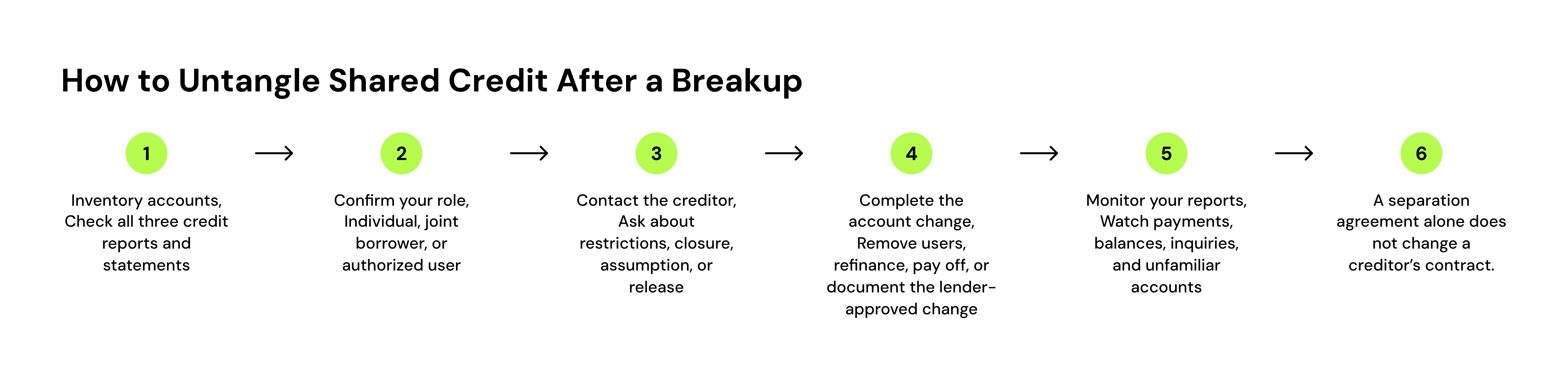
1. Review your credit reports and account statements
Get your credit reports from AnnualCreditReport.com, the federally authorized source for free reports from Equifax, Experian, and TransUnion. Review all three because the information may differ among bureaus.
Make a list of every:
- Individual account in your name
- Joint credit card or loan
- Account on which you are an authorized user
- Account with an unfamiliar balance, payment, or inquiry
Also review bank, utility, insurance, and subscription accounts. These may not normally appear on your credit reports, but unpaid balances may eventually be sent to collections.
2. Secure your individual financial access
Change passwords and PINs for accounts that belong solely to you. Update your recovery email address and phone number, enable multifactor authentication, and make sure statements go to a secure mailing or email address.
Do not withdraw or transfer jointly owned funds solely to keep the other person from accessing them without first getting legal advice. Ownership rules and court orders vary.
3. Contact creditors about joint credit accounts
Ask each creditor what options are available to prevent new charges and separate the account. Depending on the account and creditor, that may mean restricting new activity, closing the account to future purchases, paying off the balance, or applying for separate accounts.
Closing a joint credit card does not erase its balance or release either joint account holder from repayment. The CFPB notes that each holder of a joint credit card can be responsible for the full balance. Closing a card may also affect credit utilization, so ask how the creditor will report the account before deciding.
4. Remove authorized users
If your former partner is an authorized user on your credit card, ask the issuer to remove them and request a replacement card number if appropriate. If you are an authorized user on their account, ask the issuer whether you can remove yourself.
An authorized user is generally not responsible for the balance, but the account may still appear on the user’s credit report. Check your reports after removal and dispute inaccurate information if necessary.
5. Address mortgages, auto loans, and other shared debts
Deciding who keeps a home or vehicle does not by itself change who owes the loan. Removing a name from a title also does not remove that person from the mortgage or auto loan.
Ask the lender whether it allows refinancing, loan assumption, or a release of liability. Availability depends on the lender’s requirements and the remaining borrower’s qualifications. Refinancing removes a former borrower only when the joint loan is paid off and replaced with a new loan held solely by the qualifying borrower.
Graphic placement: Insert the process-flow graphic here, after the shared-debts section.
6. Prevent missed payments while responsibility is being resolved
If your name remains on an account, monitor its due dates and payment status even when your former partner agreed to pay it. A creditor can report a late payment on a joint account to both borrowers.
If a payment may be missed, contact the creditor promptly about hardship options or other arrangements. If you believe a charge is fraudulent, a bill contains an error, or a debt is not yours, use the appropriate dispute process instead of ignoring it. Ask an attorney how to handle a former partner’s failure to follow a court order or separation agreement.
7. Monitor your credit and consider a credit freeze
Continue reviewing account alerts, statements, and credit reports. If you are concerned that someone may use your information to open new accounts, consider placing a credit freeze.
A freeze restricts prospective creditors’ access to your credit file. It is free to place and lift, but you must contact Equifax, Experian, and TransUnion separately, according to the CFPB’s credit-freeze guidance.
If you find an account or transaction caused by identity theft, contact the company involved and visit IdentityTheft.gov to create an FTC Identity Theft Report and recovery plan.
How to strengthen your credit after a breakup
Separating your finances may take time. Once you know which accounts remain your responsibility, focus on habits that support your credit profile:
- Pay at least the required amount by each due date
- Keep revolving balances low relative to credit limits
- Avoid unnecessary credit applications
- Review all three credit reports for inaccurate information
- Maintain positive payment history over time
If separation-related payment problems have already affected your credit, accurate negative information generally cannot be removed simply because it resulted from a breakup. You can still make progress by bringing accounts current when possible, addressing errors, and adding consistent positive activity.
Read more >> How to Report Identity Theft
Bottom line
Protecting your credit during a divorce or breakup starts with knowing which accounts legally include your name. Review all three credit reports, secure your personal access, contact creditors about joint accounts, and confirm that any refinance, assumption, or release has been completed before treating a shared debt as separated.
After your accounts are under control, Kikoff can help you add positive payment history. Plans start at $5 per month, report account activity to Equifax, Experian, and TransUnion, and do not require a credit check to sign up. Individual results vary.
Frequently Asked Questions
Article Sources
Disclaimer: The information provided in this blog post is meant for informational purposes only and does not constitute financial advice.