



If you've ever received a postcard or email saying you may be entitled to money from a lawsuit, you've likely encountered a class action lawsuit.
Every year, billions of dollars are recovered through class action lawsuits and settlements, yet millions of eligible people never file a claim.
In this post, we'll walk you through everything you need to know to find and claim class action settlements, so you can claim every dollar you're owed.
How to find class action settlements
Traditionally, to find a class action lawsuit, you would be directly contacted, assuming the issuing company had your contact information. Several methods of contact might include:
- A postcard notice
- A formal letter explaining the settlement
- An email notice
- A claim form, or instructions on how to file one
These contact methods both require the company to have your contact information on file, and they require you to pay attention to what may look like junk mail.
Additionally, if you wanted to seek out a class action settlement, you would have to manually check official court and settlement websites, or just hear about them via word of mouth.
PACER (Public Access to Court Electronic Records) is a government portal for browsing federal court records electronically, which includes class action lawsuits. While registration is free, accessing documents costs $0.10 per page, and the site is more geared towards use by attorneys.
The FTC will also occasionally announce settlements and refunds, which you can find by searching the database.
Nowadays, apps exist that let you easily link your transaction history, and show you every class action settlement you might be owed.
For a completely free option, check out Catch, which we found was the simplest solution. Other apps, such as Sparrow and Settlemate, offer similar services but either charge a subscription, or take a cut of successful claims.
How to claim class action settlements
Once you've picked an option for finding class action settlements you're owed, you'll want to claim them.
When using an app like Catch, you simply click on the class action settlement you're eligible for, and the settlement's form will pop up. Then, you just fill out your details, hit submit, and the submission will be processed, and you'll be notified if you're approved.
Now that this process is accessible completely for free in apps like Catch, it just takes these few steps to quickly claim money from class action lawsuits you're owed.
Best class action finder apps
The "settlement finder app" space is pretty crowded, but we've done the research of going through all of the options to help you find the best one. Here's our ranking based on what we found.
1. Catch
We found Catch to be the #1 class action finder app on the market.
Most of the apps on our list do generally the same thing. They let you link your bank information (most do at least), and they show you a list of settlements that you might be owed based on your transaction history.
However, Catch is completely free. Unlike the other apps on this list, there is no subscription fee, and no percent cut on successful claims.
2. Sparrow
Sparrow is a good option for those looking for a broader "found money" experience.
It's a very modern and sleek app, and expands its offerings to include other types of claims, such as missed refunds, state funds, etc, in addition to class action lawsuits.
3. Settlemate
Settlemate is a great candidate as a standalone app for finding class action lawsuits.
It's similar to Catch, and looks and feels super intuitive, but unlike Catch, which is completely free, Settlemate charges a subscription fee to operate it.
Check out this post for a more detailed look at these options, as well as a review of other settlement finder apps.
Class action lawsuits vs settlements: What's the difference?
Understanding this distinction helps you know what stage a case is in, and whether you can claim money yet.
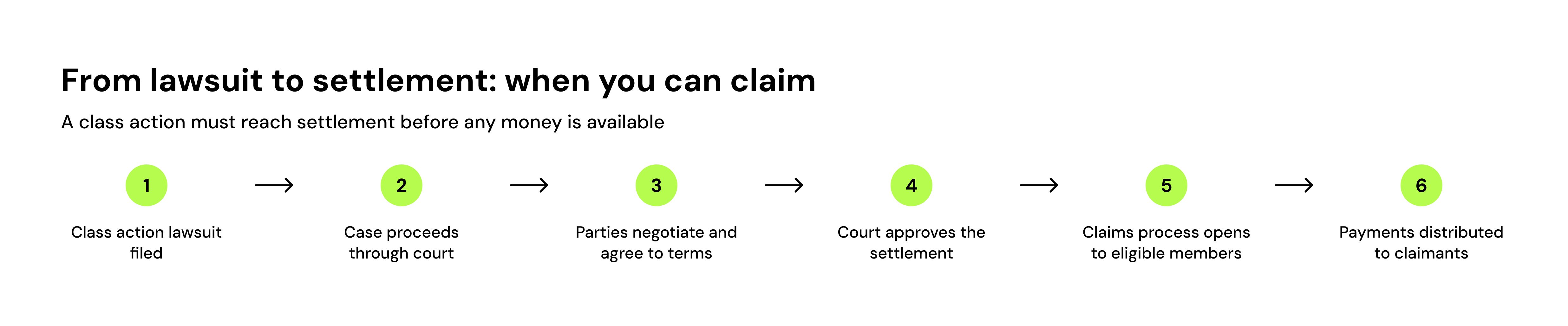
A class action lawsuit is the legal case itself. It begins when one or more plaintiffs file on behalf of a larger group.
At this stage, the following applies:
- The case may still be in court
- No money is available yet
- The defendant may deny wrongdoing
- You cannot usually claim compensation during active litigation.
A settlement, on the other hand, occurs when the parties agree to resolve the case.
In this case,
- The court must approve the agreement
- A claims process is established
- Deadlines are announced
- Payments are distributed after final approval
You can only file a claim once a settlement has been approved (or preliminarily approved with instructions).
How to avoid class action scams
Now that you know the legit ways to find and claim class action lawsuits, be sure to know how to avoid scams.
Class action lawsuits involve money, so you can be sure that bad players will try to find a way to scam innocent people. If you come across a settlement/class action lawsuit promotion, look out for these red flags:
- Requests for large upfront payments
- No official court information
- No mailing address
- Poorly designed website
For green flags, look out for these:
- No participation fees
- Court handling the case is listed
- Toll free administration number is provided
- Allows free claim submission
However, if you stick to a class action finder app like Catch, you don't have to bother with any of this information.
Conclusion
Nowadays, finding and claiming class action lawsuits is straightforward, and completely un-gatekept.
For the best class action finder app, definitely give Catch a try. The reason? Because it's 100% free. Catch doesn't have any subscription fees, nor does it take a percentage of your cut.
Frequently Asked Questions
About the editor

Disclaimer: The information provided in this blog post is meant for informational purposes only and does not constitute financial advice.