.jpg)




Opening a new bank account usually takes a few minutes, and moving your money over takes one to five business days. The slow part is everything still connected to the old account. Rerouting direct deposits and automatic payments can take one or two billing or pay cycles.
How long does it take to switch banks?
It usually takes minutes to open a new account, online or at a branch, and one to five business days to move your money.
Switching banks: Steps and timeline
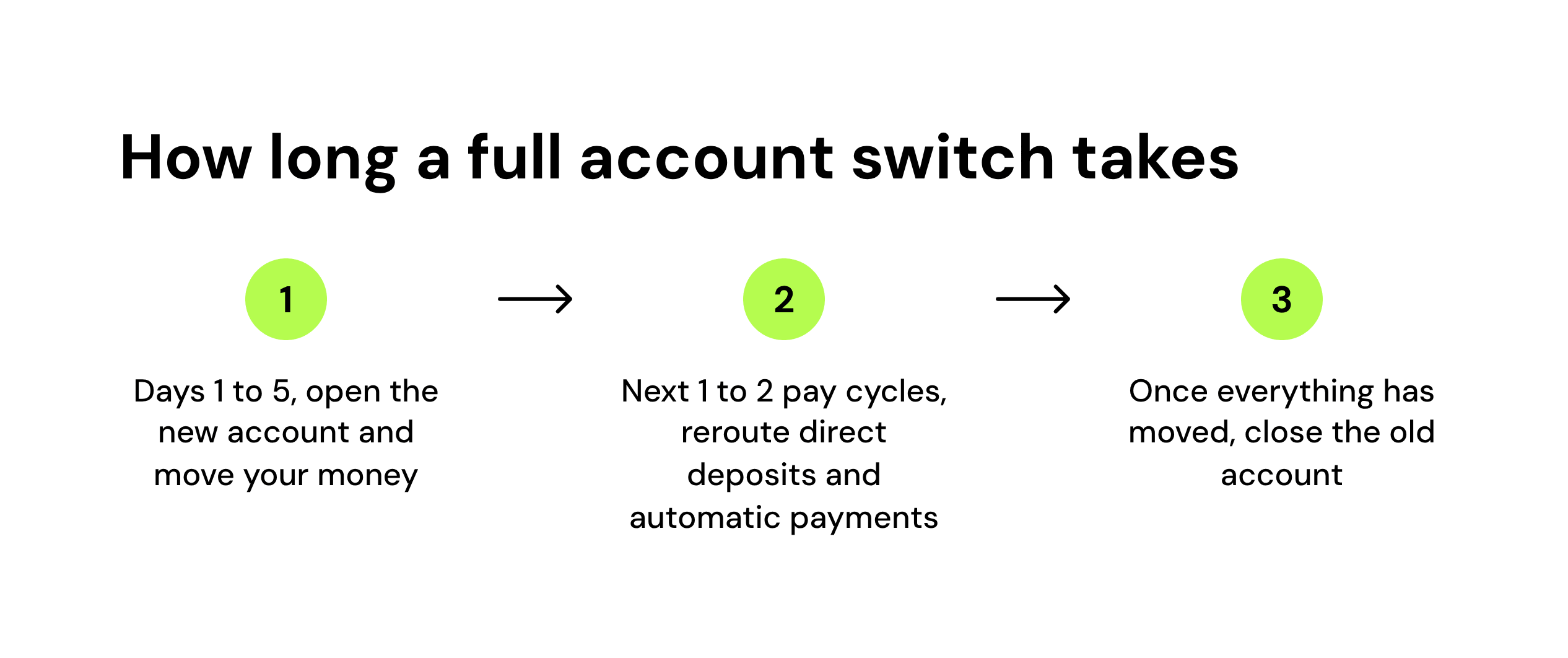
Days 1 to 5: Open the new account and move your money
You can open a new bank account online in minutes or in person, which can take longer. The new bank may need a day or so to review your application, and they may ask you for additional information if there's an issue.
One common snag is an old account that a bank closed with a negative balance. Banks report closures like this to checking account reporting companies like ChexSystems and Early Warning Services. Other banks use these reports to help determine whether to offer you a checking account.
After you’ve opened the new account, allow up to five business days to transfer money from your old bank. In some cases, it takes only a day for money to move from one bank to another, but bank cutoffs and processing can vary, and holidays can further slow things.
Turned down for a checking account? Usually it’s an old account that a bank closed with a negative balance, reported to ChexSystems or Early Warning Services. Request your free annual report from each and dispute anything that's wrong. While most records drop off after five years, second-chance checking accounts are available in the meantime.
Next 1 to 2 pay cycles: Reroute direct deposits and automatic payments
This is where most switches slow down. Many people get their paychecks by direct deposit, and most employers allow you to update your direct deposit information through a portal or directly with HR. But it can sometimes take a pay cycle or two before your paycheck is routed to the right account.
If you have one or more bills on autopay, you might need to wait one to two billing cycles for the change to take place.
Once everything has moved: Close the old account
Closing your old bank account can give you a sense of finality, but it’s not something you should rush to do. Wait until you’ve received your direct deposit in your new account and verified that all automatic payments have switched over as well.
If you have any outstanding paper checks written from your old account, you should also wait until these have cleared. Once you’re confident that the changeover is complete, you can close the old account for good.
Read more >> Does Closing a Bank Account Hurt Your Credit Score?
What can slow down the process
The switching banks timeline above is a good general guide. However, there are several situations that might make the process take longer than expected:
Pending transactions
It can take a few days for a pending transaction to post to your bank account. You should generally wait to close the account until those transactions have posted.
Linked services and subscriptions
The process of transferring subscriptions and services from one bank account to another can be time-consuming in itself. And once you’ve updated your banking information with each service provider, it can take additional time for the change to go into effect.
Paper checks still outstanding
If a paper check you sent still hasn’t cleared in a week or two, ask the person or company you sent it to whether they still have it.
Waiting periods for direct deposit changes
Ask if your employer allows instant changes to direct deposit. Employers and payroll processors may require more time, and if you’re required to manually submit paperwork, that can slow things down even more.
Read more >> Does Opening a Checking Account Affect Your Credit Score?
Tips to make switching banks faster
Three ways to speed things up:
- Review bank statements ahead of time so you know what automatic payments and subscriptions to update.
- Update direct deposit details as soon as you have the new account.
- Switch automatic payments once your first direct deposit posts so there’s money in the new account to cover them.
Leave enough in the old account to cover a month or so of recurring payments until everything has moved. And check whether the old bank charges a monthly fee if your balance drops below a minimum.
Bottom line
Opening a new account is fast. The wait is for direct deposits and automatic payments to reroute, so keep the old account open, with some money in it, until your first paycheck and every autopay have landed in the new one.
Moving all those payments is also a reminder of what they don't do. Your checking account, and most of the bills it pays, don't report to the credit bureaus, so years of on-time payments leave no mark on your credit report. A Kikoff Credit Account reports your payments to Equifax, Experian, and TransUnion, with no credit check to sign up. Plans start at $5 a month.
Frequently Asked Questions
Disclaimer: The information provided in this blog post is meant for informational purposes only and does not constitute financial advice.