


Voluntary repossession can feel like the responsible choice when you can no longer afford a loan, but it still leaves a serious mark on your credit.
Understanding exactly what that mark looks like, how long it lasts, and what you can do next is one of the most important things you can do for your financial health after a repossession.
Let's jump in.
What is voluntary repossession?
Voluntary repossession is when you proactively return a financed asset, usually a vehicle, to the lender because you can no longer afford the payments.
While it is technically "voluntary," meaning you chose to return the asset rather than wait for the lender to come take it, the credit impact is largely the same as an involuntary repossession.
The lender will report the account as a repossession to the major credit bureaus, and that entry can stay on your credit report for up to seven years.
The repossession itself is not the only thing that damages your credit in this situation. In most cases, there is a series of missed or late payments that preceded the repossession, and each of those is reported separately and also harms your credit profile.
Every individual who has gone through a voluntary repossession will notice the damage primarily in two scoring factors: payment history and, depending on whether a deficiency balance is reported, amounts owed.
Does voluntary repossession hurt your credit less than involuntary repossession?
This is one of the most common questions people have, and the short answer is: not significantly.
Both a voluntary and involuntary repossession are reported to the credit bureaus in basically the same way, and both will cause a major drop in your credit score.
The lender may note whether the repossession was voluntary, but credit scoring models like FICO and VantageScore generally treat both the same when calculating your score.
Where voluntary repossession can offer a small advantage is in your relationship with the lender. Because you cooperated, some lenders may be slightly more willing to negotiate on the deficiency balance, which is the remaining amount you owe if the vehicle sells for less than the outstanding loan balance.
This said, that negotiation happens outside the credit reporting system and does not reduce the damage to your credit report.
Luckily, understanding this distinction early lets you focus your energy on what actually helps: rebuilding from where you are.
How much does a voluntary repossession damage your credit score?
A voluntary repossession will generally cause a significant drop in your credit score, though the exact amount depends on where your score was before the event.
For someone with a strong credit profile, the drop can be dramatic, sometimes 100 points or more. For someone who was already dealing with late payments and a lower score, the drop may be less dramatic because there is less room to fall.
Here is a rough picture of what gets reported and how long it stays:
- The repossession itself: up to seven years
- Missed payments prior to repossession: up to seven years from the date of each missed payment
- Any deficiency balance sent to collections: up to seven years from the date of first delinquency
The combined weight of these entries is what makes a repossession so "costly" from a credit standpoint.
The good news is that as these entries age, their impact on your score gradually decreases, even before they fall off entirely.
How long does a voluntary repossession stay on your credit report?
A voluntary repossession stays on your credit report for seven years from the date of first delinquency on the account, which is effectively the date you first missed a payment.
Because repossessions are almost always preceded by missed payments, the clock usually starts ticking before the repossession itself was reported.
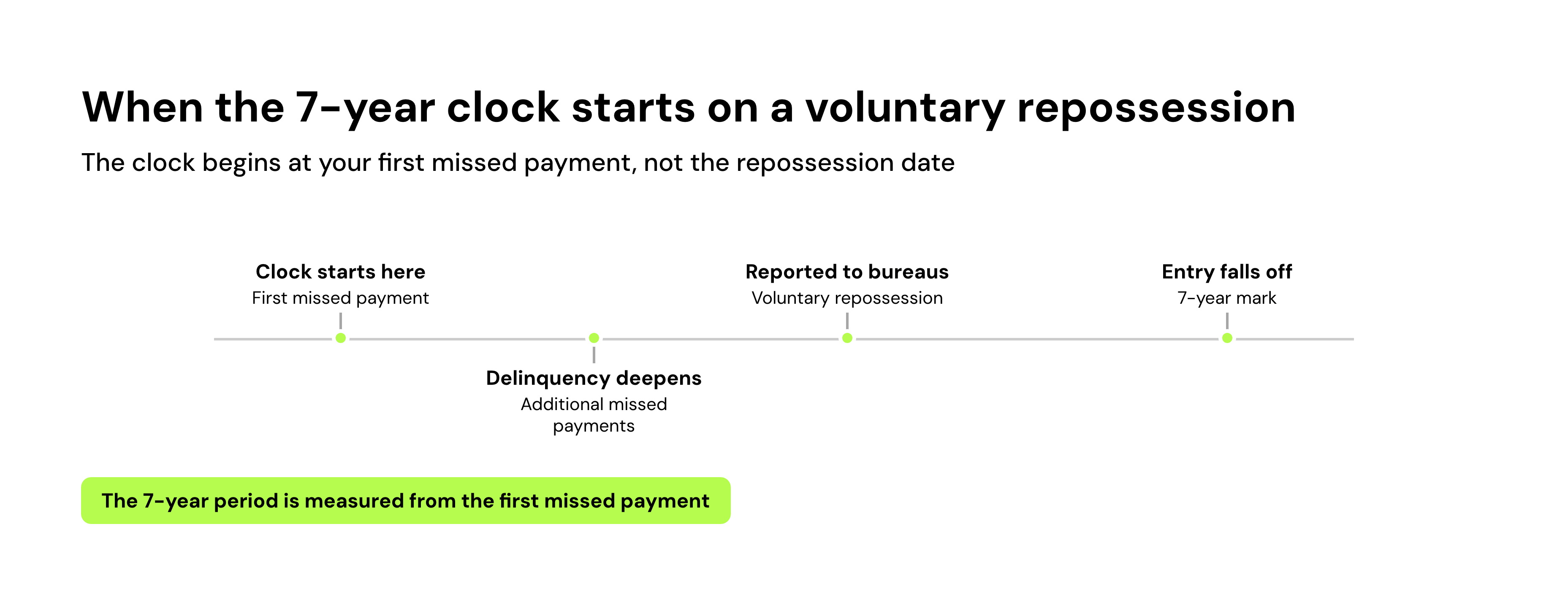
This is actually a detail worth knowing: your credit report should not show a repossession lingering longer than seven years from that first missed payment date, even if the repossession happened months later.
Every individual who wants to track this timeline should pull their full credit reports from all three bureaus at AnnualCreditReport.com and look at the "date of first delinquency" listed for the repossession account.
If the repossession has been on your report past that seven-year window and is still showing up, that is an inaccurate item you can dispute a voluntary repossession.
Kikoff offers free dispute tools that let you generate dispute letters and file electronically with TransUnion, so you are not paying to clean up what is rightfully yours to correct.
Steps to rebuild credit after a voluntary repossession
Recovering from a voluntary repossession takes time, but it is absolutely possible, and the steps are straightforward.
The process is mainly about consistently adding positive information to your credit file so that over time the repossession becomes a smaller and smaller portion of your overall credit history.
Here is a breakdown of the most impactful actions to take:
- Bring any other accounts that are past due current immediately
- Make every remaining payment on all open accounts on time
- Open a new positive tradeline to generate fresh payment history
- Keep utilization low on any revolving accounts you have or open
- Dispute any inaccurate information on your credit report
On that last point, a credit account is generally a better starting tool than a credit-builder loan only addresses payment history for rebuilding credit after a repossession.
A credit account, like the Kikoff Credit Account, reports to the major credit bureaus and builds both your payment history and your credit utilization simultaneously.
A credit-builder loan only addresses payment history, locks up your funds for the duration of the loan, and charges interest on top of that. Unless you specifically need to add an installment account to your credit mix, a credit account is the more efficient and flexible tool when you are rebuilding.
Can you dispute a voluntary repossession?
You can dispute a voluntary repossession if the information reported is inaccurate or if the repossession has stayed on your report past the seven-year limit.
What you cannot dispute is a repossession simply because it happened. The credit bureaus are allowed to report accurate negative information, and a valid repossession falls squarely in that category.
Disputes work when there are actual errors: the wrong date of first delinquency, an incorrect balance reported, duplicate entries for the same account, or the entry simply aging past the legal reporting window.
If you do find an inaccuracy, the dispute process involves notifying the credit bureau in writing, providing documentation to support your claim, and allowing them the required time to investigate.
Kikoff's free dispute tools can help you generate dispute letters and file directly with TransUnion, which removes a lot of the friction from the process.
Just make sure you are disputing based on an actual error, not just because the entry is hurting your score. Disputing accurate information without a valid basis will not result in removal.
Conclusion
Voluntary repossession is one of the more damaging events that can appear on a credit report, but it is not permanent, and it does not define your credit future.
The impact is real and it can last up to seven years, but every month of positive payment activity you add after a repossession works to gradually offset the damage.
The path forward is basically the same for every individual recovering from a major credit event: keep your existing accounts in good standing, dispute any inaccurate items, and rebuild credit with new positive tradelines to your file.
If you are looking to start fresh and build a positive credit history without a hard credit check, Kikoff can help you get started.
Frequently Asked Questions
About the editor
Disclaimer: The information provided in this blog post is meant for informational purposes only and does not constitute financial advice.