


Credit builder apps are effectively tools that create positive, reported credit activity on your behalf, helping you establish or strengthen your credit profile over time.
In this post, we'll break down how these apps work under the hood, the different types available, what to look for when choosing one, and how to get the most out of whichever one you pick.
Let's jump in.
How credit builder apps work
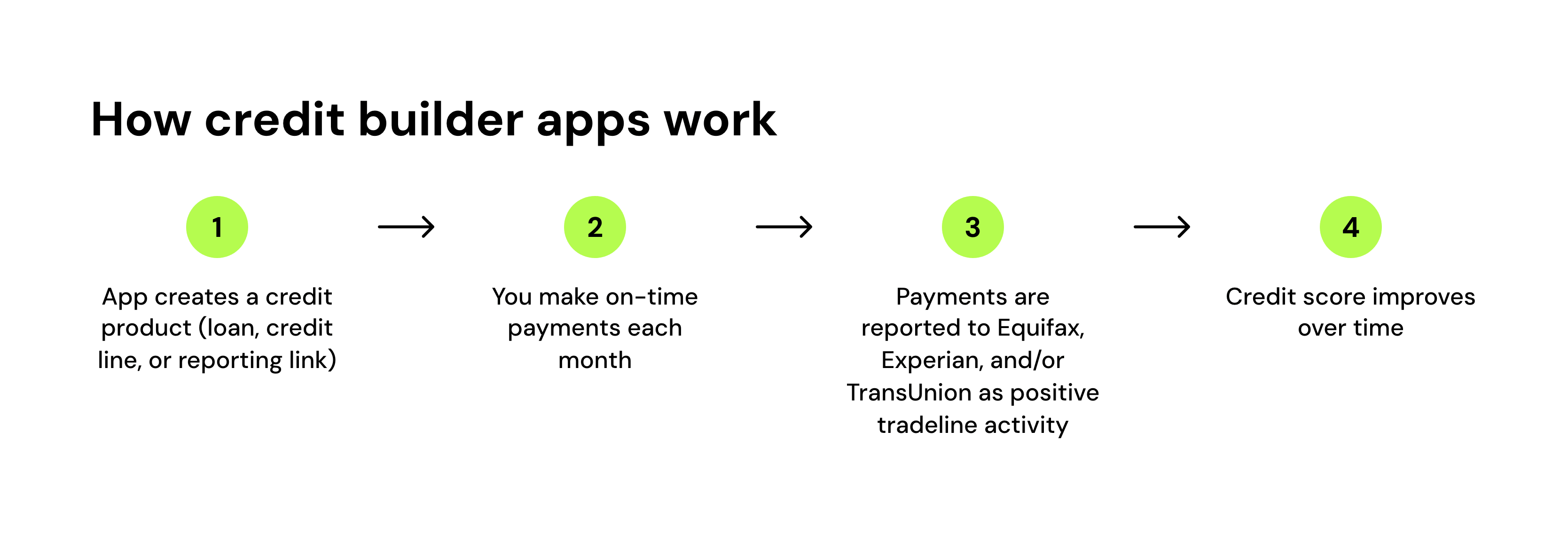
Credit builder apps work by giving you access to a financial product, be it a credit account, a loan, a secured card, or a rent reporting tool, that generates payment history and other credit activity that gets sent to the major credit bureaus.
The three major credit bureaus are Equifax, Experian, and TransUnion.
Every individual who has used any form of credit has a file at one or more of these bureaus, and lenders use that file to calculate your credit score.
When you make a payment through a credit builder app, that payment is reported to one or more bureaus as a tradeline entry, which effectively becomes part of your credit history.
Over time, consistent on-time payments build up a track record that lenders can evaluate, which is the entire goal of using a credit builder app.
The core mechanism is simple: the app gives you something to pay, you pay it on time, and those payments show up on your credit report as positive activity.
The main types of credit builder apps
Not all credit builder apps work the same way, and understanding the differences matters a lot when it comes to choosing the right one.
Here's a breakdown of the main categories.
Credit account apps
Credit account apps give you access to an open-ended line of credit, usually tied to a store or platform, that you use to make small purchases and pay back monthly.
Because credit accounts are revolving lines of credit, they affect two of the most important scoring factors simultaneously: payment history (35% of your score) and credit utilization (30% of your score).
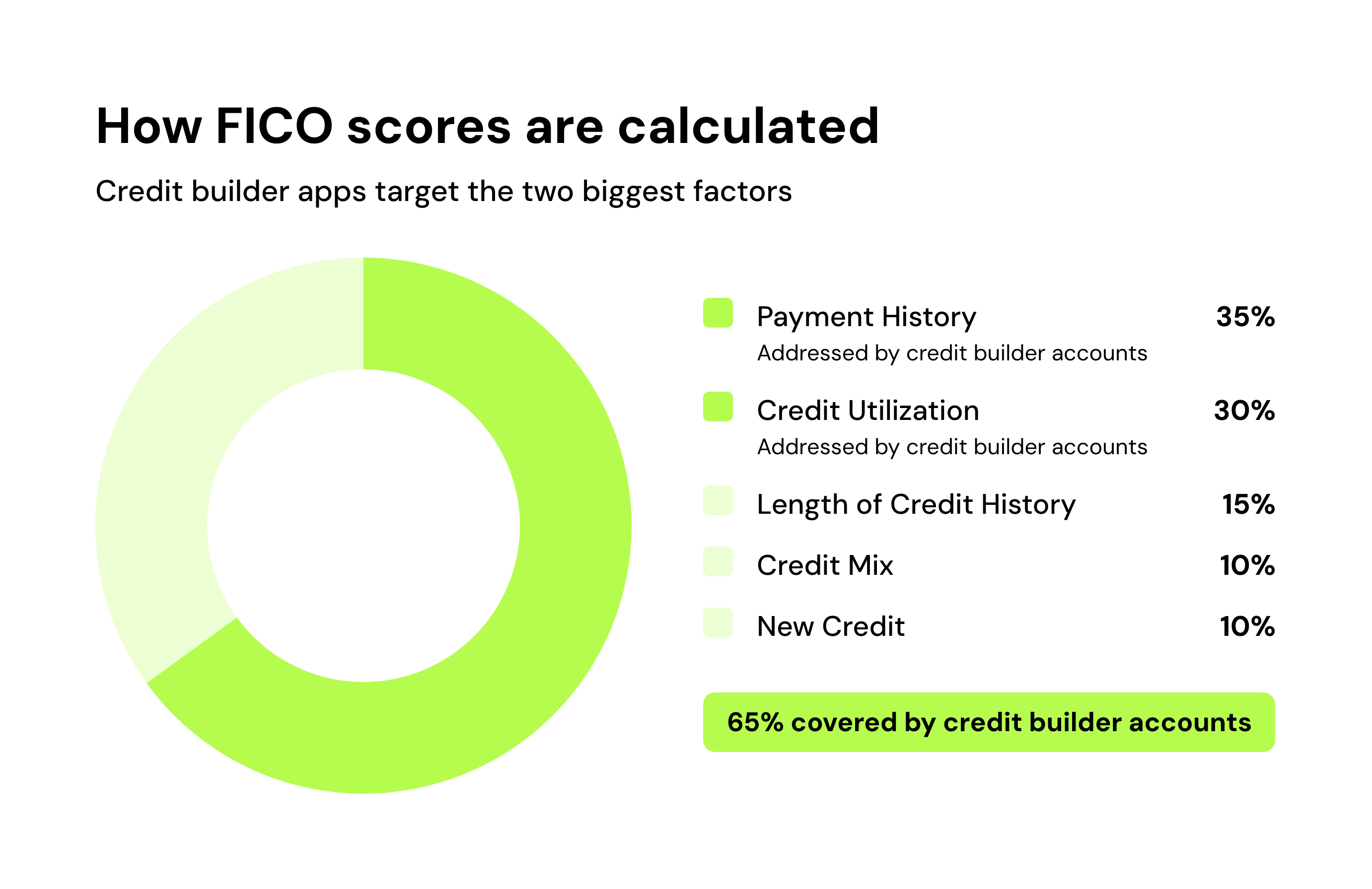
This means a single credit account is working on 65% of your total credit score formula at once.
Kikoff is a great example of this, giving users access to a Kikoff Credit Account that reports monthly payments to all three major credit bureaus, with no hard credit check to sign up and no interest charges.
That combination of payment history and utilization impact is why credit accounts are generally the most efficient starting point for anyone building or rebuilding credit.
Credit-builder loan apps
Credit-builder loans (CBLs) are small installment loans where your "loan" amount is held in a locked savings account while you make payments.
Once you complete all payments, you receive the saved funds back, and each payment along the way was reported to the bureaus as on-time payment history.
The key limitation here is that CBLs only affect payment history, which is just one of the five credit scoring factors.
They also lock up your cash for the duration of the loan term and typically charge interest, making them a less efficient and more costly tool compared to a credit account.
Unless you specifically need to add an installment account to your credit mix, a credit account is basically a smarter option.
Secured credit card apps
Secured credit cards work like regular credit cards, except you fund the card with a cash deposit upfront, and that deposit becomes your credit limit.
You make purchases on the card, pay the bill each month, and those payments get reported to the bureaus.
Secured cards affect both payment history and credit utilization, similar to credit accounts, and are a solid option for people who want a card they can use for everyday spending.
Just make sure you keep your utilization well below 30% and pay the statement balance in full each month to avoid interest.
Rent and bill reporting apps
Rent reporting apps connect to your payment history with your landlord and report those payments to one or more credit bureaus.
Since rent is usually the single most significant recurring expense for lots of people, this can be a meaningful way to add payment history without opening a new credit product.
Kikoff's rent reporting feature reports verified rent payments monthly to Equifax, and higher plan tiers even allow you to report past rent payments to establish a longer history.
Bill reporting tools work similarly, pulling in utility and subscription payments, though the credit impact tends to be more limited depending on the bureau and scoring model used.
Authorized user and tradeline apps
Some apps or services help you become an authorized user on someone else's established credit account.
When added as an authorized user, the primary account holder's payment history, credit limit, and account age can appear on your own credit report, which paints a stronger picture to lenders even if you never use the card yourself.
This strategy works best when the account being shared has a long history, low utilization, and no missed payments.
What to look for in a credit builder app
Choosing the right app comes down to a few key factors.
Bureau reporting
The most important thing to verify is which credit bureaus the app reports to.
Ideally, the app reports to all three: Equifax, Experian, and TransUnion, since different lenders pull from different bureaus and you want your positive activity to show up everywhere.
Some apps only report to one or two bureaus, which limits how much impact your effort has.
Which credit factors it targets
As discussed above, the more credit scoring factors an app addresses, the more efficient it is.
Credit accounts and secured cards affect both payment history and utilization, while CBLs and rent reporting mainly affect payment history only.
If you are just starting out, you generally want a product that covers as many factors as possible.
Fees and costs
Credit builder apps vary a lot in their pricing models.
Some charge monthly subscription fees, some charge interest, some charge express delivery fees, and some are free.
It's worth calculating the total annual cost and weighing it against what you're getting, since a low-cost option that reports to all three bureaus will often outperform a pricier option that only hits one.
No hard credit check
Most credit builder apps are specifically designed for people with thin or no credit history, so a hard credit check requirement would defeat the purpose.
Look for apps that use a soft inquiry or no inquiry at all during sign-up, since a hard inquiry will temporarily ding the very credit score you're trying to build.
Kikoff, for example, does not require a hard credit check to get started.
Dispute tools and other credit features
Some credit builder apps go beyond just reporting payments and offer additional tools like credit dispute features, credit monitoring, debt negotiation, or identity protection.
These features can be super useful, especially if there are errors on your credit report that are dragging your score down without you knowing.
Kikoff offers free dispute letter generation for all users, which means every individual who signs up can send disputes to the credit bureaus without paying extra.
How long does it take to see results?
Most credit builder apps begin reporting to the bureaus within 30 to 60 days of your first on-time payment.
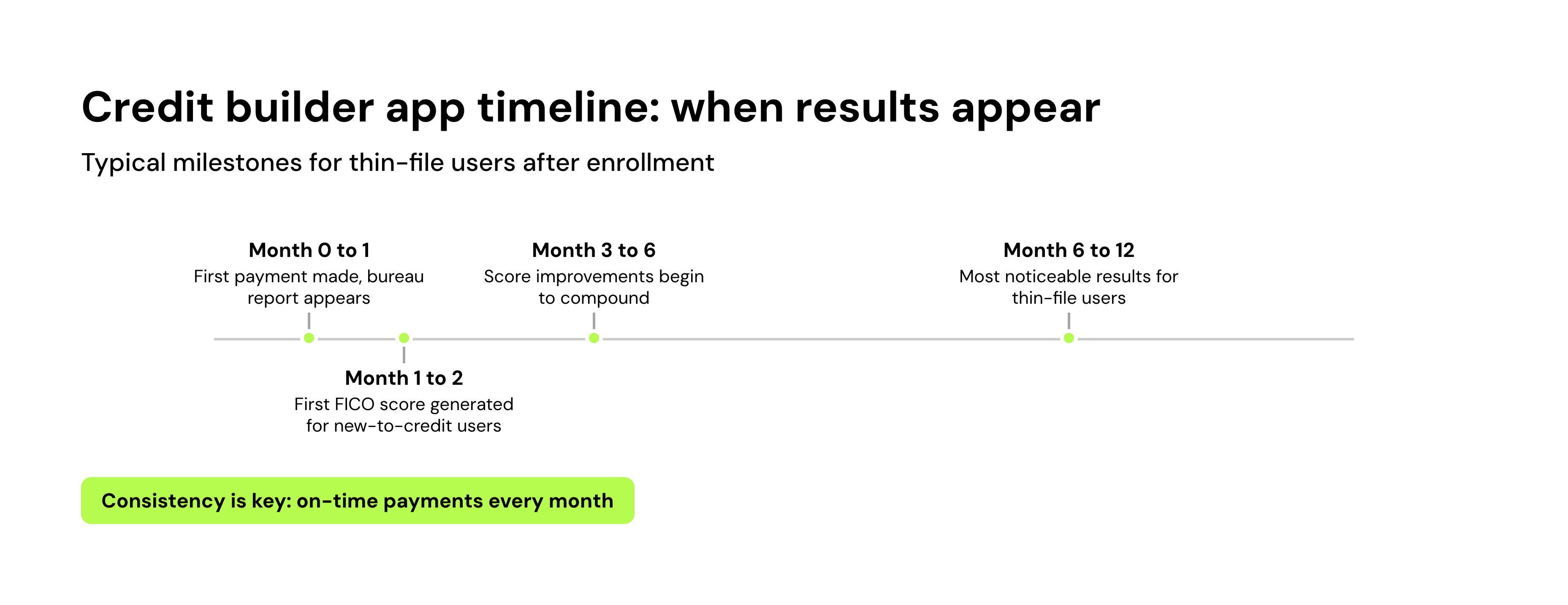
From there, consistent on-time payments over 6 to 12 months generally produce the most noticeable results, especially for users starting with no credit history or a thin file.
Users who start with no score at all usually receive their first FICO score after one to two months of reported activity.
The timeline varies based on your starting point, the number of active accounts you have, and whether your report contains any negative items that slow down progress.
Generally speaking, the faster you open an account and start making on-time payments, the faster your credit history starts building.
Common mistakes to avoid
Even with a great credit builder app, certain habits can slow your progress or cancel it out entirely.
Missing a payment is the single most damaging thing you can do, since payment history makes up 35% of your score and a single late payment can have an outsized negative effect relative to the positive activity you've built.
Opening lots of new credit accounts at the same time triggers multiple hard inquiries and can hurt your score in the short term, so it's better to start with one or two products and focus on consistency.
Closing old accounts once they're paid off can also backfire, since length of credit history is a scoring factor and removing old accounts shortens your average account age.
Luckily, most of these mistakes are easy to avoid once you know what to watch for.
Conclusion
Credit builder apps work by creating positive, reported payment activity that gradually establishes your credit history with the major bureaus.
The most efficient tools are ones that target multiple credit scoring factors at once, report to all three bureaus, and don't require a hard credit check to sign up.
If you're ready to start building credit without interest, no hard credit check, and reporting to all three bureaus, Kikoff is a strong place to start.
Frequently Asked Questions
About the editor

Disclaimer: The information provided in this blog post is meant for informational purposes only and does not constitute financial advice.