





Auto insurance is one of those things most people pay for every month without fully understanding what they're actually buying.
Every individual who owns or drives a car is generally required to carry some form of auto insurance, but the details of how it works can feel confusing.
In this guide, we'll break down how auto insurance actually works, from the coverage types available to how your premium gets calculated in the first place.
Let's jump in.
What is auto insurance and how does it work?
Auto insurance is effectively a contract between you and an insurance company.
You pay a regular premium, and in exchange, the insurer agrees to cover certain financial losses tied to accidents, theft, or damage involving your vehicle.
This means if you get into an accident, your insurer steps in to help cover repair costs, medical bills, or liability claims, depending on the coverage you've chosen.
Insurance works by pooling risk across lots of policyholders, so the cost of any one person's accident is spread across everyone paying into the system. Insurers use data on driving behavior, vehicle type, location, and other risk factors to determine how much each individual should pay for that shared risk pool.
This is why two drivers with the same car can pay very different premiums, since their personal risk profiles paint a picture that insurers use to price the policy.
What are the main types of auto insurance coverage?
Auto insurance isn't just one single product, it's usually a bundle of different coverage types that each protect against a different kind of risk.
Understanding what each type actually covers can help you figure out which coverages make sense for your situation. Here's a breakdown of the coverage types you'll generally come across when shopping for a policy.
Liability coverage
Liability coverage is the single most common type of auto insurance, and it's required in nearly every state.
This coverage pays for injuries or property damage you cause to someone else in an accident that's your fault. Liability coverage is generally split into two parts, bodily injury liability and property damage liability.
Bodily injury liability covers medical costs and lost wages for the other party, while property damage liability covers repairs to their vehicle or property.
Liability coverage does not pay for your own injuries or your own vehicle's damage, which is why many drivers pair it with additional coverage types.
Collision coverage
Collision coverage pays to repair or replace your own vehicle after an accident, regardless of who caused it.
This applies whether you hit another car, a fence, or even a tree. Collision coverage is usually optional, though lenders often require it if you're still financing or leasing your vehicle.
Just make sure you weigh the cost of this coverage against your car's actual value, since it may not make sense on an older vehicle worth very little.
Comprehensive coverage
Comprehensive coverage protects your vehicle against damage that isn't related to a collision.
This includes things like theft, vandalism, fire, hail, flooding, or hitting an animal. Comprehensive coverage is mainly purchased alongside collision coverage, since together they cover most of the ways a vehicle can be damaged.
Like collision coverage, comprehensive is usually required by lenders on financed or leased vehicles.
Uninsured and underinsured motorist coverage
Uninsured motorist coverage protects you if you're hit by a driver who doesn't carry insurance at all.
Underinsured motorist coverage kicks in when the at-fault driver has insurance, but not enough to cover your full damages. This coverage is a no-brainer in states with a high number of uninsured drivers on the road.
Luckily, this coverage is often inexpensive relative to the protection it provides.
Personal injury protection and medical payments coverage
Personal injury protection, often called PIP, covers medical expenses for you and your passengers after an accident, regardless of fault.
Medical payments coverage, sometimes called MedPay, works similarly, though it's generally more limited in scope. PIP is required in some states and optional in others, so availability depends on where you live.
This said, both coverages can be especially valuable if you don't have strong health insurance of your own.
How are auto insurance premiums calculated?
Your premium is basically the price you pay for your policy, and it's calculated using a mix of personal and vehicle-related risk factors.
Insurers run these factors through pricing models to estimate how likely you are to file a claim, and how expensive that claim might be. A simplified version of the formula insurers use looks something like this:
Premium = Base rate x (driving record factor x location factor x vehicle factor x age factor x credit-based insurance score factor x coverage level factor)
Each factor either raises or lowers your final premium relative to the base rate, which is primarily set at the state level based on average claim costs.
Driving record
Your driving record is generally the single most influential factor in your premium.
Accidents, speeding tickets, and other violations signal higher risk to insurers, which usually raises your rate. A clean driving record over several years can meaningfully lower what you pay.
Location
Where you live and park your car affects your premium, since some areas have higher rates of accidents, theft, or severe weather.
Urban areas with dense traffic generally see higher premiums than rural areas with less congestion. This is why the same driver can see a different quote just by changing their zip code.
Vehicle type
The make, model, and age of your vehicle all factor into your premium.
Vehicles that are expensive to repair, more likely to be stolen, or have higher horsepower usually cost more to insure. Safety features like automatic braking or lane assist can sometimes lower your premium, since they reduce the likelihood or severity of an accident.
Age and experience
Younger, less experienced drivers generally pay more, since statistically they're involved in more accidents.
Premiums usually decrease as drivers age and build a longer track record behind the wheel. Experienced drivers with no violations tend to see the most favorable rates over time.
Credit-based insurance score
In most states, insurers are allowed to use a credit-based insurance score as one factor in setting your premium.
This score is different from your traditional credit score, though it's generally built using similar underlying credit data, like payment history and credit utilization. This means that having stronger credit can, in many states, translate into a more favorable insurance premium, while a thinner or riskier credit profile can raise it.
A handful of states, including California, Massachusetts, and Hawaii, don't allow credit-based insurance scoring at all, so this factor's impact depends heavily on where you live.
This is one more reason building strong credit habits, be it paying bills on time or keeping credit utilization low, can pay off in areas of your financial life beyond just loan approvals. Apps like Kikoff are designed to help customers build credit through an affordable credit account that reports payments to all three credit bureaus.
Coverage level and deductible
The amount of coverage you choose, along with your deductible, directly affects your premium.
Higher coverage limits generally mean a higher premium, since the insurer is on the hook for more in the event of a claim. Choosing a higher deductible usually lowers your premium, since you're agreeing to cover more of the cost out of pocket before insurance kicks in.
How does the auto insurance claims process work?
Filing a claim is usually the part of auto insurance that feels the most unfamiliar until you actually have to do it.
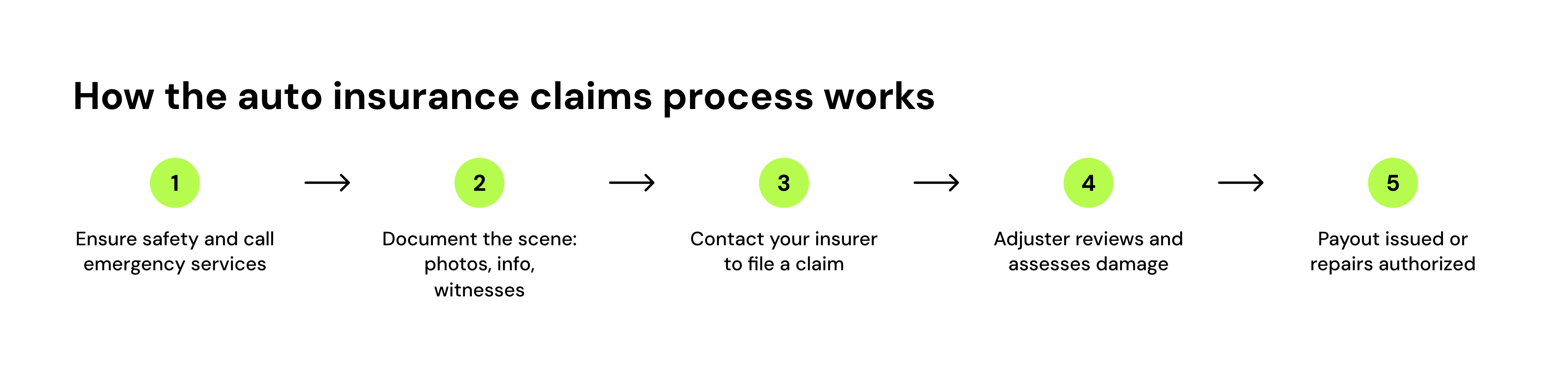
Knowing the general steps ahead of time can make the process much less stressful if you're ever in an accident. First, you'll want to make sure everyone is safe and, if needed, contact emergency services.
Next, document the scene by taking photos, gathering the other driver's information, and noting any witnesses nearby.
After that, you'll contact your insurer to officially file the claim, usually through their app, website, or a claims phone line. An adjuster will then review the claim, assess the damage, and determine what your policy covers, before issuing a payout or authorizing repairs.
What affects how long a claim takes?
Claims involving clear fault and straightforward damage usually move faster than claims with disputed fault or complex injuries.
The responsiveness of both drivers and the availability of repair shops can also affect the overall timeline. This said, most straightforward claims are resolved within a few weeks.
How much auto insurance do you need?
Every state sets its own minimum auto insurance requirements, which usually include some level of liability coverage.
These minimums are designed to make sure drivers can cover at least a baseline amount of damage they cause to others. This said, state minimums are often not enough to fully protect your finances in a serious accident.
Many drivers choose to carry higher liability limits, along with collision and comprehensive coverage, especially if they have significant assets to protect or a newer vehicle.
Just make sure you review your state's specific minimum requirements, since they vary widely and can change over time.
How can you lower your auto insurance premium?
Luckily, there are several ways to bring your premium down without sacrificing meaningful protection.
Bundling auto insurance with other policies, like renters or homeowners insurance, is a common way to unlock a discount. Raising your deductible, maintaining a clean driving record, and asking about discounts for safety features or low mileage can also help.
Since credit-based insurance scores factor into pricing in most states, working on your broader credit profile is another lever worth considering.
Building credit with a tool like Kikoff, which reports on-time payments to all three credit bureaus, is one way to work toward a stronger credit profile over time. This won't guarantee a lower insurance premium, since insurers weigh several other factors too, but it's a genuinely useful habit that can support your finances in more ways than one.
Conclusion
Auto insurance can feel complicated, but at its core, it's simply a way to protect yourself financially from the risks that come with driving.
Understanding the different coverage types, how premiums are calculated, and how claims work can help you make smarter decisions about your policy. This said, your broader financial health, including your credit, plays a bigger role in your insurance costs than most people realize.
Building stronger credit habits with a service like Kikoff is one small step that can support your finances well beyond just your next insurance renewal.
Ready to start building credit? Sign up for Kikoff and take the first step toward a stronger credit profile.
Frequently Asked Questions
About the editor

Disclaimer: The information provided in this blog post is meant for informational purposes only and does not constitute financial advice.