


.jpg)




Most mortgage servicers, the companies that collect your payment, don't take credit cards. Workarounds exist, but they add fees of about 3% before any interest, and many cards can't be used for a mortgage at all. If you're short this month, there are usually cheaper options, starting with a call to your servicer before the due date.
Workarounds for paying a mortgage with a credit card
Even though they can’t directly use a credit card to make a mortgage payment, some people find indirect ways to do so.
Third-party payment services
Some online third-party payment services make it possible to pay with a credit card even if your recipient doesn’t accept credit cards. You pay the third-party service with a credit card (and include processing fees), and the service then sends an electronic payment, paper check, or wire transfer.
Cash advances
Some credit cards let you access a certain amount of cash for a fee. If you get a cash advance and have the cash delivered as a bank transfer (instead of taking it out of an ATM), you can then use it to cover your mortgage payment.
Read more >> How To Lower Your Monthly Mortgage Payment
Why paying your mortgage with a credit card can be a bad idea
Processing fees
Third-party services like Plastiq charge your card and then send your servicer a check or electronic payment. It charges 2.99% plus a delivery fee starting at $0.99. On a $2,900 monthly payment including taxes and insurance, the fee runs about $88 a month, or more than $1,050 a year. And the payment can take several business days to reach your servicer, so a card payment made on the due date can still arrive late.
Many cards, depending on the network and the issuer, can't be used for mortgage payments even through a service like this.
High interest rates
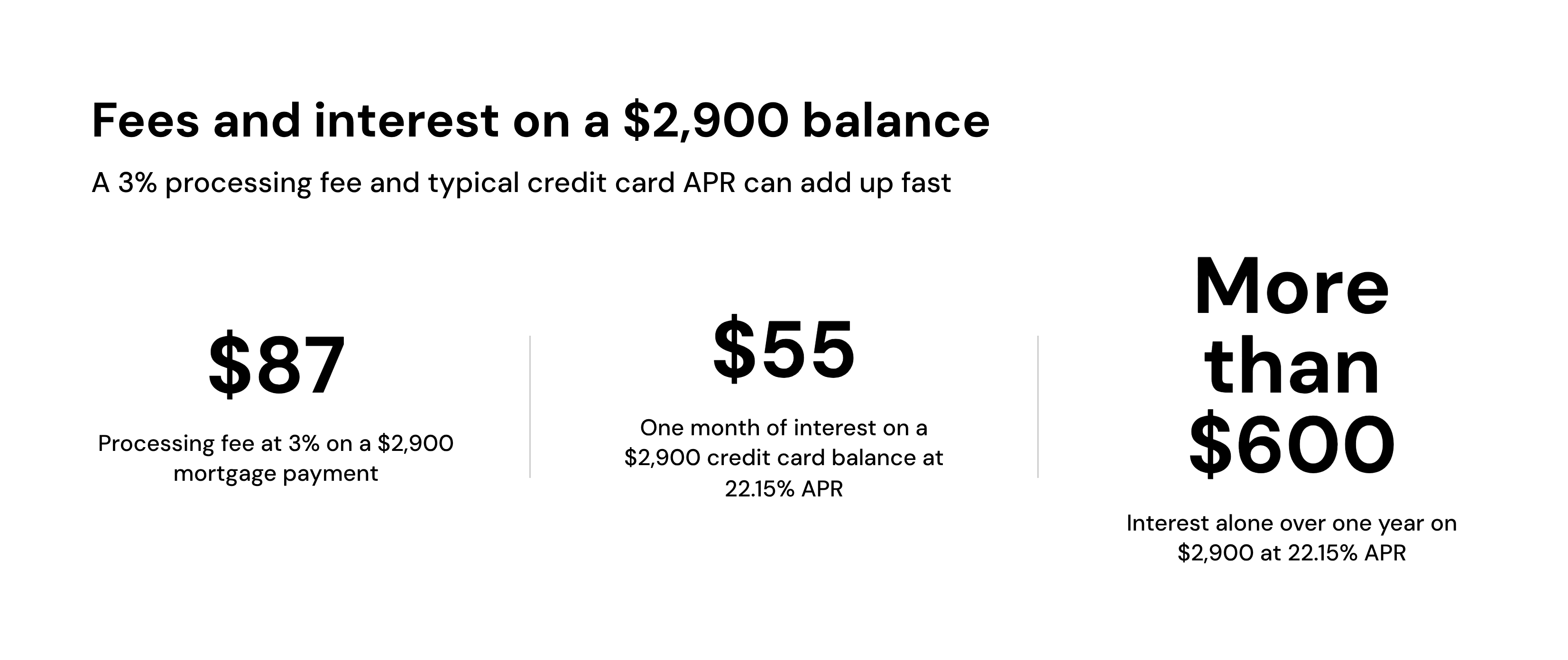
A processing fee of about 3% is only the upfront cost. On a $2,900 mortgage payment, that fee is roughly $87, and it's charged before your card issuer adds any interest. The real risk starts if you can't pay the card off in full by the statement due date.
Credit card interest runs several times higher than a typical mortgage rate. The average APR on an interest-bearing credit card is 22.15%, according to the Federal Reserve. At that rate, carrying a $2,900 balance for one month adds about $55 in interest. If the balance went unpaid for a year, interest alone would come to more than $600. That’s on top of the fee, and it applies to a bill you still owe again the following month.
A balance that size also increases your credit utilization, which is how much of your available credit you're using. Higher utilization can lower your score right before you might want to apply to refinance.
Cash advance fees and limits
Cash advances cost more than regular purchases in three key ways:
- They usually start at a higher APR than purchases.
- Interest accrues from the day you take the advance, no grace period.
- Advances come with a separate upfront fee, typically 3% to 5% of the advance or a flat minimum.
Many credit card companies set fairly low limits for cash advances, so you might not get access to enough cash to cover your payment.
Reaching for a card because the payment is due? A card costs you a processing fee of around 3%, then interest on top. If you can't clear the balance, you've turned a mortgage payment into revolving debt at your credit card’s interest rate. And the mortgage still comes due next month.
Call your servicer first. It may offer forbearance, a repayment plan, or a modification, which cost nothing to ask about. If you're already behind, a HUD-approved housing counselor can work with your servicer on your behalf. Connect to one at 800-569-4287. For everything else, the NFCC connects people to free or low-cost counseling at 800-388-2227.
Better alternatives for managing mortgage payments
Call your servicer before the due date
Call the servicer listed on your statement and ask what hardship options they offer. Calling before you miss a payment usually gives you more options than calling after. If you do fall behind, federal rules require your servicer to try to reach you by the 36th day, and in general a foreclosure can't start until you're more than 120 days behind.
Ask about forbearance
Forbearance lets you pause your payments or make smaller ones for a set time, often after a job loss, medical bills, or a financial emergency. For loans backed by Fannie Mae, forbearance periods can run up to three months with a 12-month limit.
It won’t reduce what you owe, and interest can keep adding up while in forbearance. Before you agree, ask whether you’re required to pay it all back in a lump sum at the end of your forbearance period, spread across future payments, or moved to the end of your loan.
Build an emergency fund
An emergency fund is money set aside for unexpected costs, like a car repair, a medical bill, or a gap in income. It’s the difference between a tight month and turning a mortgage payment into a line on your credit card statement.
You don’t need much to start. Setting aside $20 from each paycheck adds up to $520 in a year if you’re paid twice a month. And you can automate it, scheduling a transfer to savings with each payday so the money moves before you have a chance to spend it. You can add to it faster by putting part of a tax refund, bonus, or other windfall into your fund.
Keep the money in a high-yield savings account, instead of your checking. That way, it’s earning a high rate of return while making it less tempting to dip into.
Look into refinancing
Refinancing your mortgage can lower your monthly payment in two situations:
- When interest rates have dropped since you took out your loan.
- When your credit has improved since then, which can qualify you for a better rate.
Refinancing comes with closing costs, and if you’re already behind on payments, you may not qualify until you’re caught up.
Once you’re caught up, set up autopay
Autopay from checking means the payment goes out on time every month, as long as the money is there. If your balance runs close, set the withdrawal for a day or two after payday.
Read more >> 10 Essential Categories to Include in Your Budget
Bottom line
A credit card can technically cover a mortgage payment, but the fees and interest usually make a short month more expensive. Your servicer and a free housing counselor are the better first calls.
If refinancing is on your list for later, your credit decides not just whether you qualify but also the rate you pay on the entire balance. Kikoff's Credit Account reports on-time payments to Equifax, Experian, and TransUnion, with no credit check to sign up. Plans start at $5 a month.
Frequently Asked Questions
Article Sources
Disclaimer: The information provided in this blog post is meant for informational purposes only and does not constitute financial advice.