.jpg)



Credit reporting errors are more common than you'd expect. In the FTC's national study of credit report accuracy, 1 in 4 consumers found an error that might affect their score, and 1 in 5 had something corrected after they disputed it. For 5%, the mistake was serious enough to mean worse terms on a loan or insurance policy.
Disputing an error on your credit report is free. Each of the three major credit bureaus takes disputes online, by phone, or by mail at no charge, and you can pull reports free every week at AnnualCreditReport.com.
These disputing apps help with the parts that are tedious rather than expensive: spotting the error, drafting the letter, and tracking the answer over the 30- to 45-day clock. But most of these apps can only submit to one or two bureaus, so the right one depends on which report the error is on.
Best apps for disputing credit errors
1. Kikoff
Kikoff is the only option on this list that treats disputes as one part of building credit rather than the whole job.
The dispute tool drafts a personalized letter in a few taps and tracks it through the bureau's response, which is the part that gets tedious once you're working through several items at once. You can mail the letters yourself for free or let Kikoff handle postage and paperwork on Kikoff Premium.
The credit-building side is what separates Kikoff from single-purpose dispute tools. Kikoff's Credit Account reports your on-time payments to Equifax, Experian, and TransUnion, and rent reporting to Equifax and TransUnion comes with every plan at no extra cost. (Adding up to two years of past rent is a one-time $50 fee.) Running both at once means you're adding positive history to your credit while you clean it up, rather than doing one and waiting on the other.
Kikoff's debt negotiation is free for all users and contacts collectors on your behalf. Settling for less than the full balance can affect your credit and is a different decision from disputing an error, so it's worth being clear which one you're doing.
2. Dovly AI
Dovly AI is the closest thing on this list to Kikoff's approach: automated disputes paired with credit-building tools, rather than disputes alone. It also works with TransUnion only, which is the thing to settle before you pay.
The free plan gives you a monthly TransUnion report and score, plus a manual dispute tool that files with TransUnion. It's enough to challenge a single error or see how the process works before paying for anything.
Premium runs $39.99 a month, upgrading the manual tool to unlimited AI-generated disputes and adding weekly TransUnion report access, $1 million in ID theft insurance, and a TransUnion credit lock.
Dovly's engine decides how many disputes to submit each month rather than filing everything at once. (The site describes it as submitting "the optimal number of disputes each month based on a combination of factors unique to your credit report.") That's different from tools that let you send whatever you want whenever. If your error sits on your Equifax or Experian file, this isn't the one.
3. Experian
Experian is the only one of the three major credit bureaus that allows you to file a dispute directly within its app. (TransUnion's dispute FAQ says it doesn't offer this, and Equifax doesn't publish whether its app supports disputes.)
The free Basic tier includes your Experian credit report, updated daily, change alerts, and a FICO Score 8 tracker. Paid tiers start at $24.99 a month and add three-bureau credit monitoring, ID theft monitoring, up to $1M in ID theft insurance, and monthly privacy scans with help removing your information from covered people-finder services.
Experian also accepts disputes for free through its online Dispute Center, by phone, and by mail.
4. Credit Karma
Credit Karma pairs free credit monitoring with dispute assistance, allowing you to file disputes directly with TransUnion from inside its free Intuit Credit Karma app. (You can start an Equifax dispute through Credit Karma too, but its help center is explicit that you can't submit that one in the app.)
The free account also includes:
- VantageScore 3.0 and a credit report from both Equifax and TransUnion
- Alerts when something changes — a new account, a hard inquiry you don't recognize, a balance paid off
- Identity monitoring that flags your information turning up in a data breach or a compromised password list
Credit Karma also matches you with personalized offers for credit cards and personal loans that evolve as your credit improves.
Why DoNotPay isn't on this list. In January 2025, the FTC finalized an order requiring DoNotPay to pay $193,000 and stop advertising that its service performs like a real lawyer without evidence to back it up. The order also requires the company to notify everyone who subscribed between 2021 and 2023 about the limits of its law-related features.
How to compare credit dispute apps
Three things separate these apps that are worth comparing among them:
- Which bureau it can submit to. An error on your Experian report needs a tool that reaches Experian. Most of these reach one bureau, and it's usually TransUnion.
- Whether it tracks the response. Three bureaus mean three separate clocks. Watching them is most of the work an app saves you.
- Whether it drafts the documents. Look for letter generation plus somewhere to upload proof, like a bank statement or a payoff letter.
How to dispute a credit error using an app
The legal process is the same either way. What changes is how much of it you handle yourself.
- Pull your credit reports. All three are free each week at AnnualCreditReport.com. Bureaus don't share files, so it's worth it to read each one for common errors worth disputing.
- Connect your report to the app. Link the app to a bureau, or allow it to pull a report on your behalf. Most dispute apps work with one or two bureaus only, so check which one before you pay. If the problem is with Experian, you'll need an app that covers that bureau.
- Let the app flag potential errors. The app scans the report, flagging items that look incorrect, like duplicate accounts or balances that don't match. This is where an app's worth the money, since it can speed up reading three reports line by line on your own.
- Select the item and add your details. Pick what to challenge, and tell the app what's wrong with it. Maybe the account isn't yours, or the balance isn't reflecting payments. The more specific you are, the better. Most apps let you upload documentation for this step, like bank statements or a payoff letter.
- Review the generated letter. The app drafts a dispute letter focused on the item and your explanation. Generated letters can overstate the claim or even bundle items you didn't mean to include, so read it carefully before your name goes on it.
- Submit and let the app track it. The app files with the bureau and watches for a response. Bureaus generally have 30 days to investigate, and with three bureaus and separate timelines, tracking is the other place these tools earn their fee. Results can come by email or by mail, so watch both.
Your dashboard will show one of three outcomes: a corrected file, a denied change, or a request for more information. If it's the last one, respond through the app as fast as you can. Sending more information extends the investigation by up to 15 days, but it doesn't stop the clock.
Read more >> How to Dispute Credit Report Errors
How long does a credit dispute take?
A credit bureau generally must investigate your dispute within 30 days of receiving it, and it has five business days after finishing to tell you the outcome. Two things stretch that. If you submit additional information during the 30-day window, the bureau can take 15 more days. And according to the CFPB, a dispute you file after pulling your free annual credit report gets 45 days instead of 30.
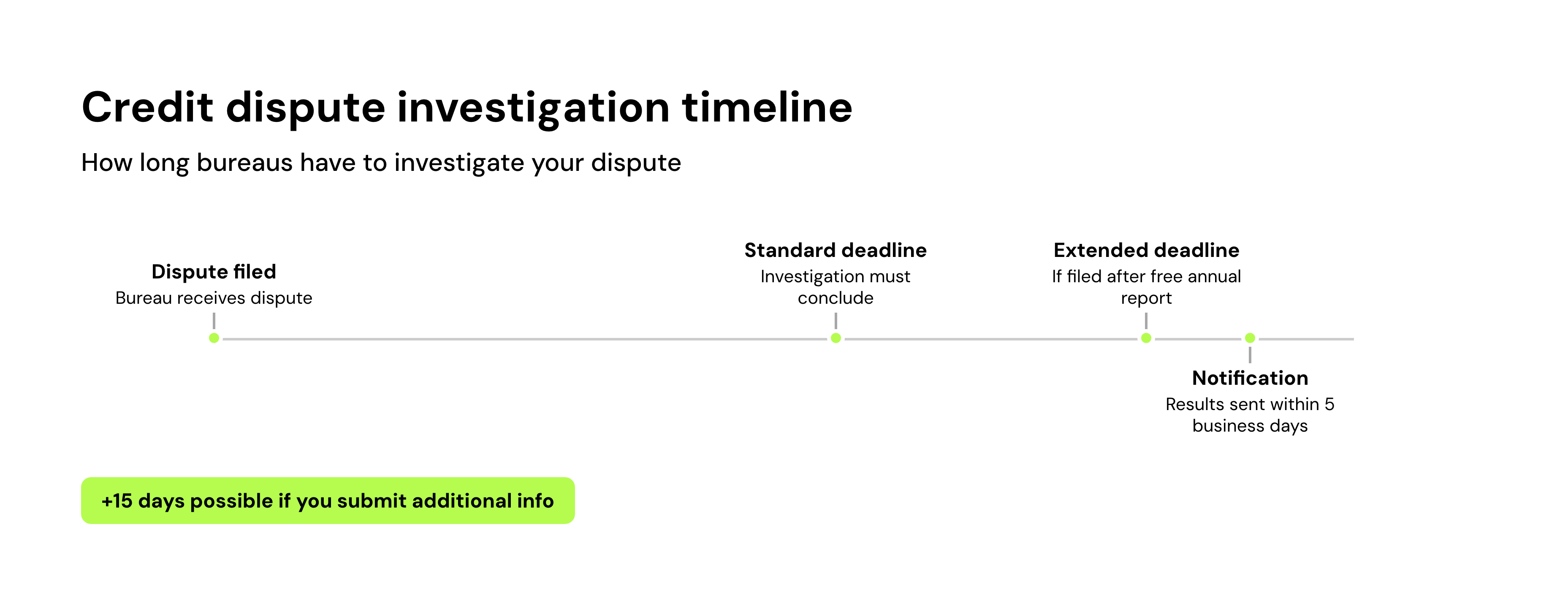
If you haven't heard anything by the sixth business day after the window closes, follow up with the bureau using the confirmation number from your filing. You can also submit a complaint online with the CFPB.
What none of these apps can do for you
The limits here aren't about which app you pick. They're built into how credit reporting works, so no service can get around them:
- Remove accurate information. If that late payment is legitimate, no dispute filed by you or an app will take it off. Anything promising otherwise is either misunderstanding the process or selling you something that doesn't exist. You'll have to wait for it to come off on its own, generally within seven years.
- Guarantee an outcome. Filing a dispute triggers an investigation, not a removal. The bureau contacts the creditor who provided the information, and if it's verified, the entry stays. A well-written letter improves your odds when you have a real case, but it won't change the answer when you don't.
- Do anything you can't do for free. Under the Fair Credit Reporting Act, you can dispute directly with any bureau at no cost. While these services offer real convenience, especially if you're working through several items, a letter you write yourself carries the same weight.
- Fix the underlying problem. If your report is accurate and your score is low, disputes aren't the tool. What moves the number is new positive history and time.
- Speed up the timeline. Bureaus generally have 30 days to investigate. Sending additional information within the investigation window can add up to 15 more days.
It doesn't mean these apps aren't useful. Each one can help you find issues worth disputing, challenge them, and keep track of what happens next. Done well, that's worth real money. A single corrected error can be the difference between a denial and an approval, or between one rate and a better one.
Bottom line
If an entry on your report is inaccurate, disputing it is free, and the bureau has 30 to 45 days to answer. These dispute apps mostly differ on one thing: which bureaus they can actually reach. Credit Karma submits to TransUnion, Dovly AI files with TransUnion, Experian's app covers your Experian report, and an error sitting on more than one file means more than one filing. So pick based on where the error shows up.
Kikoff's AI Credit Disputes drafts the letter for you — you pick the item, review what it says, and track the bureau's response.
Removing a bad entry can get your report back to accurate, but it doesn't add anything positive to raise your score. Kikoff's Credit Account reports on-time payments to all three bureaus while your dispute works through. No credit check, and plans start at $5 a month.
Methodology: How we chose these apps
We started with the dispute tools a reader is most likely to encounter, including the free ones and the bureaus' own apps, since disputing is free by law and any paid tool has to be worth more than the letter you can write yourself. We left out services that advertise removing accurate information, and DoNotPay, which the FTC ordered in 2025 to stop claiming its product performs like a lawyer.
For each, we checked which bureaus it can actually submit to, whether it files for you or hands you a letter to mail, whether it tracks the bureau's response, and the cost. Bureau reach decides more than price does: Most of these tools reach TransUnion only, so an error on your Experian file needs a different one. Every figure comes from the provider's own pricing or help pages, confirmed in September 2026.
Kikoff publishes this site, and Kikoff products appear in this article. We include Kikoff on the same terms as everything else: the same criteria, the same published sources, and the same limitations. Where a competitor does something Kikoff doesn't, we include that too.
Prices, bureau coverage, and features change. Check the app's current terms before you sign up.
Frequently Asked Questions
Article Sources
Disclaimer: The information provided in this blog post is meant for informational purposes only and does not constitute financial advice.