.jpg)
.jpg)



5 Ways to Get Emergency Grocery Money
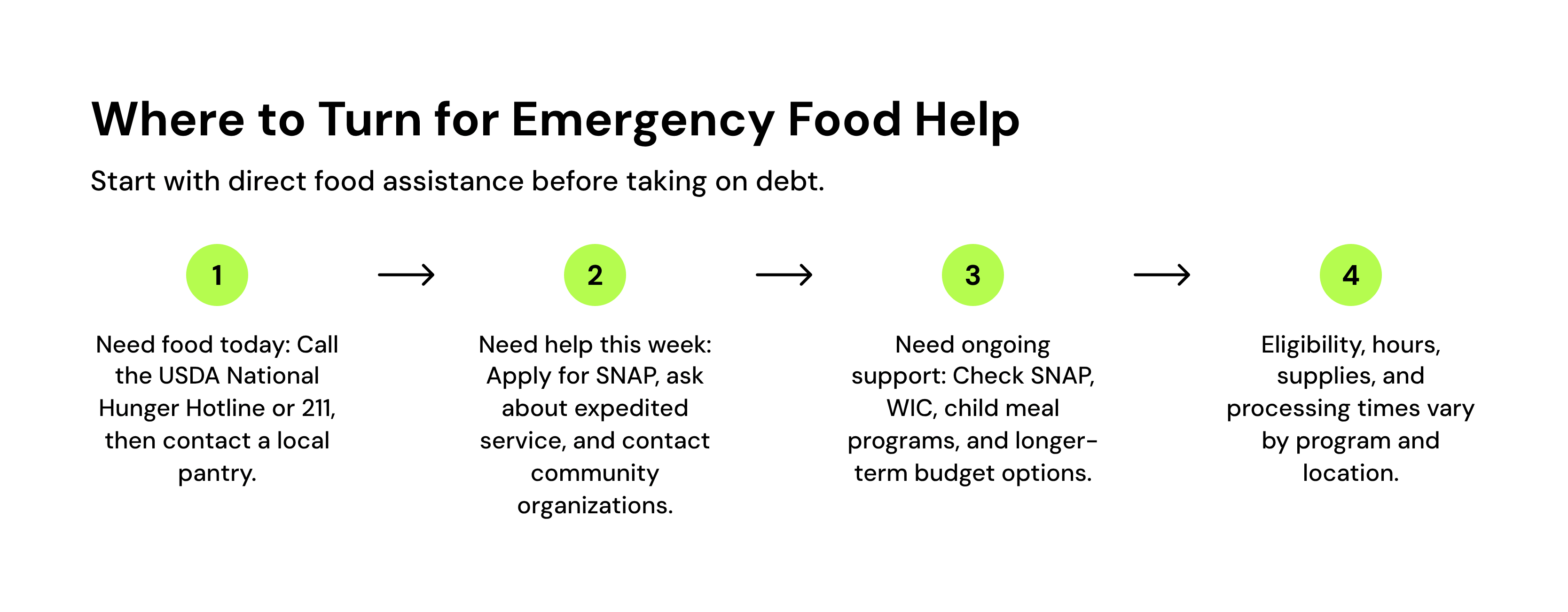
If you need food today, start with a local food pantry, the USDA National Hunger Hotline, or 211. These resources may connect you with groceries or prepared meals without creating another bill. SNAP, WIC, and other benefit programs can provide longer-term help if you qualify.
Borrowing may cover a one-time gap, but repayment can leave less money for groceries on your next payday. Check direct food assistance first.
5 ways to get emergency grocery help
The fastest option depends on whether you need food today, help for the next few weeks, or ongoing support.
Read more >> How to Pay Bills With No Money
1. Find a food pantry or emergency food provider
If you need food immediately, call the USDA National Hunger Hotline at 1-866-3-HUNGRY (1-866-348-6479). The hotline provides information in English and Spanish and can help you locate nearby food resources.
You can also use USA.gov’s emergency food assistance guide to find food pantries, The Emergency Food Assistance Program, community organizations, and other local help. Calling 211 is another way to look for services near you.
Hours, inventory, service areas, and documentation requirements vary. Call before traveling if possible, especially if transportation is limited.
2. Apply for SNAP and ask about expedited service
The Supplemental Nutrition Assistance Program, or SNAP, provides eligible households with benefits on an electronic benefit transfer card that can be used for qualifying food purchases.
Eligibility and benefit amounts depend on your state’s rules and your household circumstances. Use USA.gov’s SNAP guide to find your state or local SNAP office and apply.
If your household has very little income or money available, ask the SNAP office whether you qualify for expedited service. Regular applications may take time, so do not wait for approval before contacting an emergency food provider if you need food now.
3. Check WIC and child nutrition programs
The Special Supplemental Nutrition Program for Women, Infants, and Children, or WIC, provides eligible families with food benefits, nutrition counseling, and referrals.
You may qualify if you are pregnant, breastfeeding, recently gave birth, or are applying for a child under age five and meet the program’s other requirements. USA.gov explains WIC eligibility and how to contact your state agency.
If you have school-age children, ask their school district about free or reduced-price meals, summer meal sites, and food available during school breaks. Rules and availability vary by program and location.
4. Contact community and mutual-aid organizations
Community action agencies, local nonprofits, religious organizations, and mutual-aid groups may offer groceries, prepared meals, store gift cards, or referrals. Available help changes frequently, so ask what is currently offered and whether you need an appointment.
If one organization cannot help, ask where it refers people for emergency food. Local groups often know which nearby programs have current supplies or funding.
5. Ask about early wages or a short-term personal arrangement
Your employer may offer a paycheck advance or earned-wage access program. Ask whether there is a fee, how quickly the money arrives, how repayment works, and how much smaller your next paycheck will be.
You can also ask a trusted friend or family member for help. Agree on the amount and repayment date in writing, and do not promise repayment from money already needed for next month’s food, rent, utilities, or transportation.
An advance or personal loan may help with a small, one-time gap, but neither fixes a recurring shortage. Calculate what will remain after repayment before accepting the money.
What to do if you need groceries today
Focus on resources that can provide food directly:
- Call the USDA National Hunger Hotline or 211.
- Contact nearby food pantries and confirm their hours.
- Ask local community or religious organizations about groceries, meals, or gift cards.
- Tell the organization if you lack transportation, cooking equipment, or a safe place to store food.
- Apply for SNAP, WIC, or other ongoing assistance while using emergency resources.
Do not assume you have to wait until your kitchen is completely empty. Food programs exist to help people through shortages, and using one may preserve cash for housing, medication, utilities, or transportation.
Be careful when borrowing for groceries
A cash advance app or other short-term product may provide money quickly, but it should not be treated as automatically free or low-cost.
Before accepting an advance, check:
- Subscription or membership fees
- Expedited-transfer fees
- Optional tips
- The exact repayment date
- Whether repayment is taken automatically
- Possible overdraft or nonsufficient-funds fees
- How much of your next paycheck will remain
The Consumer Financial Protection Bureau found that fees for expedited access and repeated use can make paycheck-advance products more expensive than they first appear.
If groceries are short every month, an advance may move the problem to your next paycheck. Look for ongoing food assistance and a longer-term budget solution before making advances part of your routine.
Read more >> How to Get Your Paycheck Early
How to make grocery money stretch further
When you have some money for food but need it to last, focus on choices that lower cost without sacrificing enough food to eat.
Read more >> How to Save Money Fast on a Low Income
Plan around what you already have
Check your refrigerator, freezer, and pantry before shopping. Build meals around food that needs to be used soon, then buy only what completes those meals.
Compare unit prices
The lowest shelf price is not always the lowest price per ounce or pound. Use the unit price when it is displayed, but choose a size you can afford and realistically use before it spoils.
Choose flexible staples
Rice, beans, oats, pasta, eggs, frozen vegetables, canned fish, and other staples can work across several meals. Choose foods that fit your household’s dietary and cooking needs.
Use store discounts carefully
Store brands, loyalty discounts, coupons, and marked-down items may reduce the bill. A discount only saves money if the item is something you will use and the final price fits your budget.
Reduce avoidable waste
Freeze food you will not use in time, store leftovers safely, and plan a meal around remaining ingredients before buying more. Food safety comes first, so discard food that is no longer safe to eat.
Bottom line
If you need groceries today, contact a food pantry, the USDA National Hunger Hotline, or 211 before taking on debt. Apply for SNAP, WIC, and other ongoing programs if food shortages happen repeatedly.
A paycheck advance or cash advance may cover a one-time gap, but fees and repayment can make the next paycheck harder to stretch. Review every cost and calculate what will remain after repayment.
Meeting your immediate food needs comes first. When your budget is stable enough to look ahead, Kikoff’s free Credit Account reports on-time payments to Equifax, Experian, and TransUnion with no hard credit check to sign up. Start only when the payment fits comfortably in your budget.
Frequently Asked Questions
Article Sources
Disclaimer: The information provided in this blog post is meant for informational purposes only and does not constitute financial advice.