


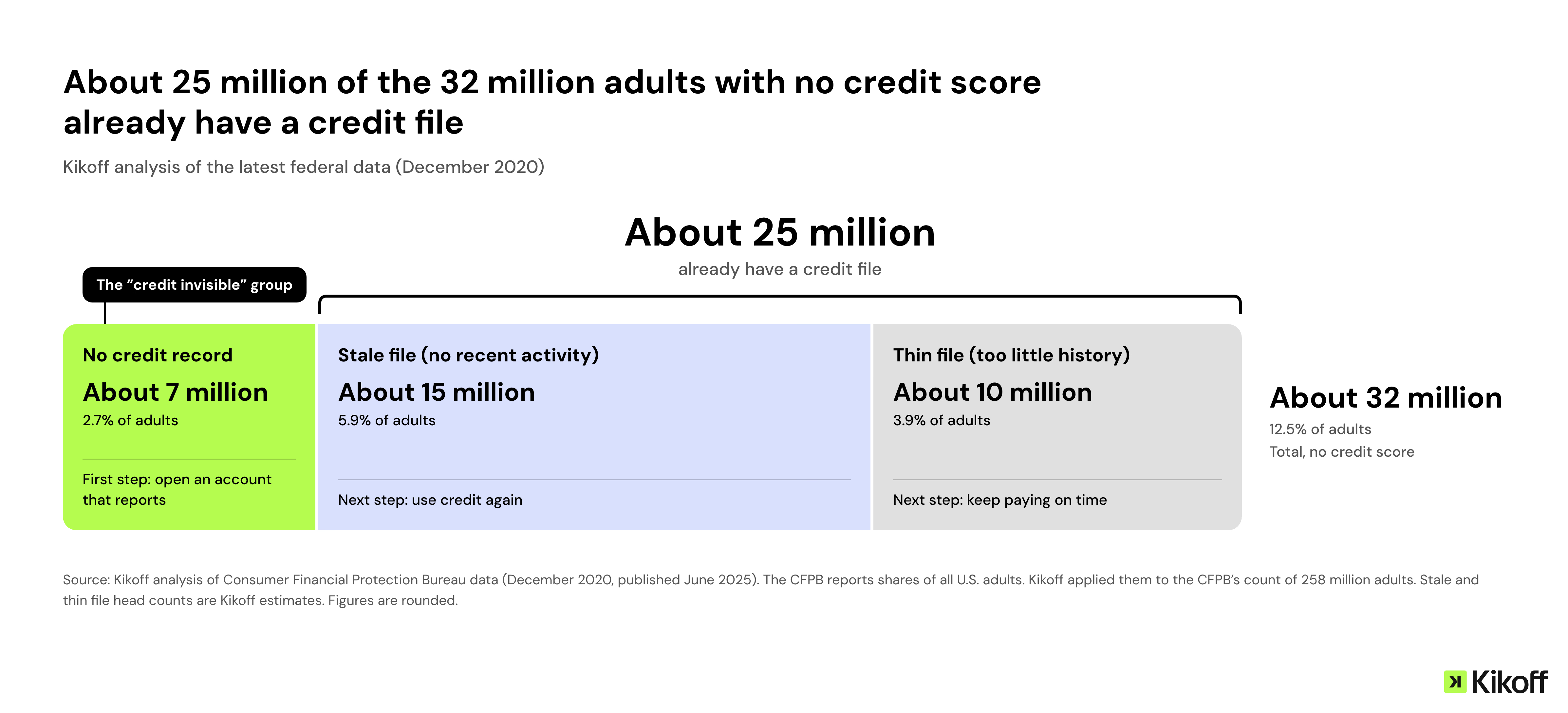
About 32 million U.S. adults had no credit score as of December 2020, the latest federal estimate, according to a Kikoff analysis of Consumer Financial Protection Bureau data. Only about 7 million had no credit record at all. The rest, about 25 million, had a credit history that was too thin or too inactive to score.
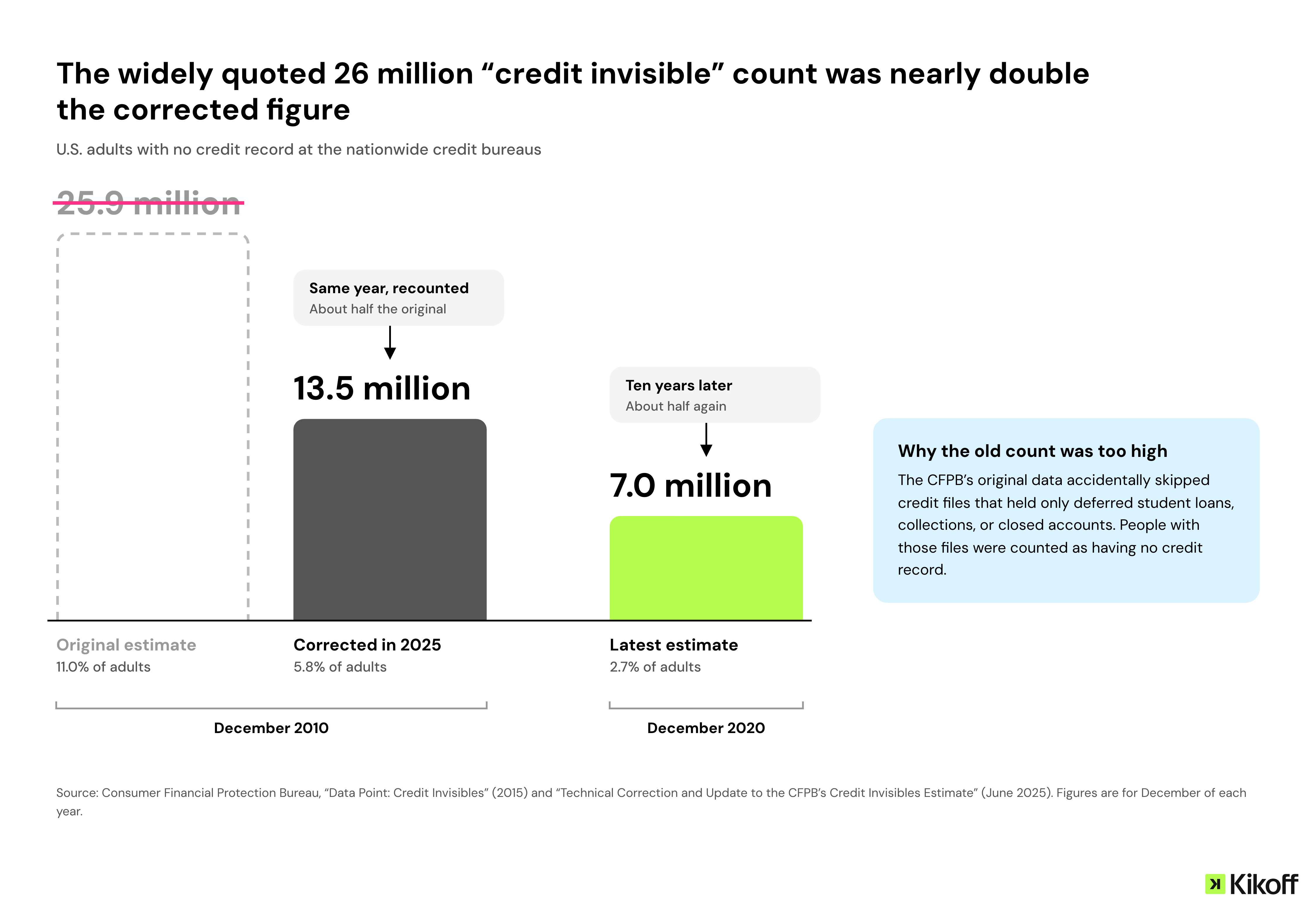
That 7 million is far below the number you’ve probably seen. For a decade, the most-quoted figure was 26 million “credit invisible” Americans, from a CFPB estimate for 2010. In 2025, the CFPB corrected it to 13.5 million, about half the original. By December 2020, the share of adults with no credit record had fallen to 2.7%, from 5.8% in 2010.
But a smaller “credit invisible” count doesn’t mean the problem went away. Most adults without a score aren’t invisible at all. Their files just aren’t getting scored. So having “no credit score” turns out to be more than one problem. It’s three.
What the old “credit invisible” count missed
Being “credit invisible” means having no credit record at the nationwide credit bureaus. If you’ve ever looked into it, you may have run into a much bigger number than today’s: 26 million. That was the CFPB’s 2015 estimate, and it got quoted all across the internet. It also turned out to be too high.
In 2025, the CFPB published a correction: Its original data had accidentally skipped credit files that held only deferred student loans, collections, or closed accounts. So, some people who did have a credit record were counted as having none.
That means the real story is better than the old number suggests. If you’ve assumed you’re “credit invisible” because you haven’t used credit in years, you may not be. An old closed card or a student loan in deferment may mean the bureaus have a record of you after all.
Read more >> How to Build Credit From Scratch
Why 32 million adults have no credit score
Most adults with no credit score do have a credit file, but it’s too thin or too inactive to score. Having no credit record at all is actually the smallest of the three groups. And each group has a different next step.
Here’s the full picture on the 32 million:
1. No credit record (roughly 7 million)
If you’ve never had a credit card or loan, the credit bureaus likely don’t have a file on you yet. That can happen if you’re young, new to the country, or have always paid cash.
Applying for credit doesn’t fix that on its own, even if you’ve applied and been turned down. An application can leave an inquiry behind, but the CFPB counts a file with only inquiries as no credit record, because it shows no history of using credit.
Your next step here would be to open an account that reports to the bureaus, like a secured credit card, a credit-builder loan, or a credit building app. That first reported account is often what starts your file.
2. A stale credit file (about 15 million)
A stale credit file is one that has no recent activity. Maybe it holds a card that’s since been closed or a loan you paid off years ago, so nothing’s been reported lately. Stale files are the largest of the three groups, according to the CFPB’s data.
However, you may not have to start over, because your old history may still be on your report. What’s missing is recent activity, so your next step is to start using credit again, whether that’s a card you still have open, a secured credit card, or a credit building app.
3. A thin credit file (about 10 million)
A thin credit file has some history in it, just not quite enough for a score yet. Maybe it holds only one or two accounts, or a first account that’s still pretty new. It can be the stage right after having no file at all, so if you’ve just opened your first account, this is likely where you are.
A thin file often just needs time. So your next step is to keep making on-time payments and, in many cases, add another account that reports. If you rent, rent reporting can add payments you already make to your file.
Read more >> The Average Credit Score Is 714. Millions of Americans Don’t Have One at All
Has the number gotten smaller?
Yes. The share of adults with a credit score climbed to 87.5% in December 2020, up from 81.6% in 2010 (corrected estimate), according to the CFPB. Over that same stretch, the share with no credit record dropped to 2.7%, down from 5.8%.
In head counts, about 32 million U.S. adults had no credit score in December 2020, down from about 43 million in 2010, according to a Kikoff analysis of CFPB data. That drop came even as the adult population grew by about 23 million.
One caveat: The newest federal data is from December 2020, so today’s picture may look different.
Read more >> How Many Americans Have an 800 Credit Score?
Which group are you in?
If collections or other debt are part of your picture, talk with a nonprofit credit counselor for guidance specific to your situation. The National Foundation for Credit Counseling (NFCC) can connect you with free or low-cost debt counseling at 800-388-2227.
Bottom line
Having no credit score usually doesn’t mean you’re starting from a blank page. For most of the 32 million with no score as of December 2020, a file already existed. Whichever group you’re in, what’s missing is often the same thing: recent, on-time payments that get reported.
The Kikoff Credit Account reports your on-time payments to all three credit bureaus, with no credit check to sign up. Every month you pay on time adds to the payment history the bureaus track. Plans start at $5 a month.
Methodology
Our figures come from the Consumer Financial Protection Bureau’s June 2025 technical correction to its credit invisibles estimate, Tables 1 and 2. The CFPB used a sample of deidentified credit records from one nationwide credit bureau, plus Census Bureau population estimates. The correction added back files that held only deferred student loans, collections, or closed accounts. It also moved files with only credit inquiries into the “no record” group. The CFPB found that the added files more than offset that change. Its newest data is from December 2020, so today’s numbers may look different.
For 2020, the CFPB gives head counts for adults with no credit record (roughly 7 million) and with a scored record (225.3 million), but not for stale or thin files. For those groups, Kikoff applied the CFPB’s December 2020 percentages to the CFPB’s count of 258 million adults, rounded to the nearest million. We use the CFPB’s adult count, rather than a newer Census figure, so our head counts and the CFPB’s shares describe the same year. For 2010, we added the CFPB’s counts of adults with no credit record (13.5 million) and with an unscored record (29.7 million) to get about 43 million. Between the two years, the adult population grew by about 23 million, from 235 million to 258 million. Scoring models define “stale” and “insufficient” files differently, so we describe them in plain terms rather than citing a specific cutoff. All figures were confirmed in November 2026.
Kikoff publishes this site, and Kikoff products appear in this article, but this analysis uses only public data from the CFPB. It doesn’t use any Kikoff customer data.
Article Sources
Disclaimer: The information provided in this blog post is meant for informational purposes only and does not constitute financial advice.