


.jpg)
.jpg)


You’re getting paid next week, but you’re a couple hundred dollars short on rent. Your friends can’t lend you money, and you don’t qualify for a bank loan. Is a payday loan the next step?
Usually, no. Payday loans can provide cash quickly, but their high fees and short repayment windows can leave you with a bigger shortage on your next payday. Before borrowing, ask your landlord or service provider about a payment arrangement, look for local assistance, and compare lower-cost credit options.
What is a payday loan?
A payday loan is a small, short-term loan that is usually due in one payment on your next payday. The due date is typically two to four weeks after you borrow, although terms and availability vary by state.
Payday lenders generally ask for proof of income and access to a bank, credit union, or prepaid card account. You may need to provide a postdated check or authorize an electronic withdrawal for the loan amount plus fees. Unlike many traditional lenders, payday lenders generally do not check whether you can repay the loan while also covering your other bills.
Why you shouldn’t pursue payday loans
The speed is appealing when a bill is due now. The problem is what the loan can do to an already tight budget.
The fees make a small loan expensive
Payday lenders commonly charge a fee for every $100 borrowed. According to the Consumer Financial Protection Bureau, fees may range from $10 to $30 per $100, depending on state law. A common $15 fee on a two-week loan works out to an annual percentage rate, or APR, of nearly 400%.
For example, borrowing $300 with a $15 fee per $100 means repaying $345 in about two weeks. If your budget was already $300 short, finding an extra $45 at the same time can be difficult.
A $15 fee may not sound large, but it does not reduce the amount you borrowed. Compare the total repayment amount and due date, not just the advertised fee.
The repayment window can create another shortage
Most payday loans require one lump-sum payment. When that payment comes out of your next paycheck, you still need to cover rent, groceries, utilities, transportation, and other regular expenses.
If repayment leaves you short again, you may feel pushed to delay another bill or borrow again. That is how a one-time cash gap can turn into repeated debt.
Rollovers can add fees without reducing the balance
Some states permit payday loan rollovers or renewals. A rollover lets you pay another fee to extend the due date, but you still owe the original balance.
Using the $300 example above, one $45 rollover fee would bring your total fees to $90 after about four weeks, while the original $300 would still be due. State rules differ, and some states ban or limit rollovers.
They usually are not a reliable way to build credit
Do not assume a payday loan will help you establish positive credit history. A lender may not report your on-time payments to the three major credit bureaus. However, an unpaid balance that is sent to collections may appear on a consumer report and may affect future credit decisions.
Automatic withdrawals can trigger other costs
If the lender tries to withdraw repayment when your account does not have enough money, you may face a returned-payment or nonsufficient funds fee from the lender, your bank, or both, depending on the agreement and applicable law.
Read more >> Best Alternatives to Payday Loans in 2026
How payday loans work
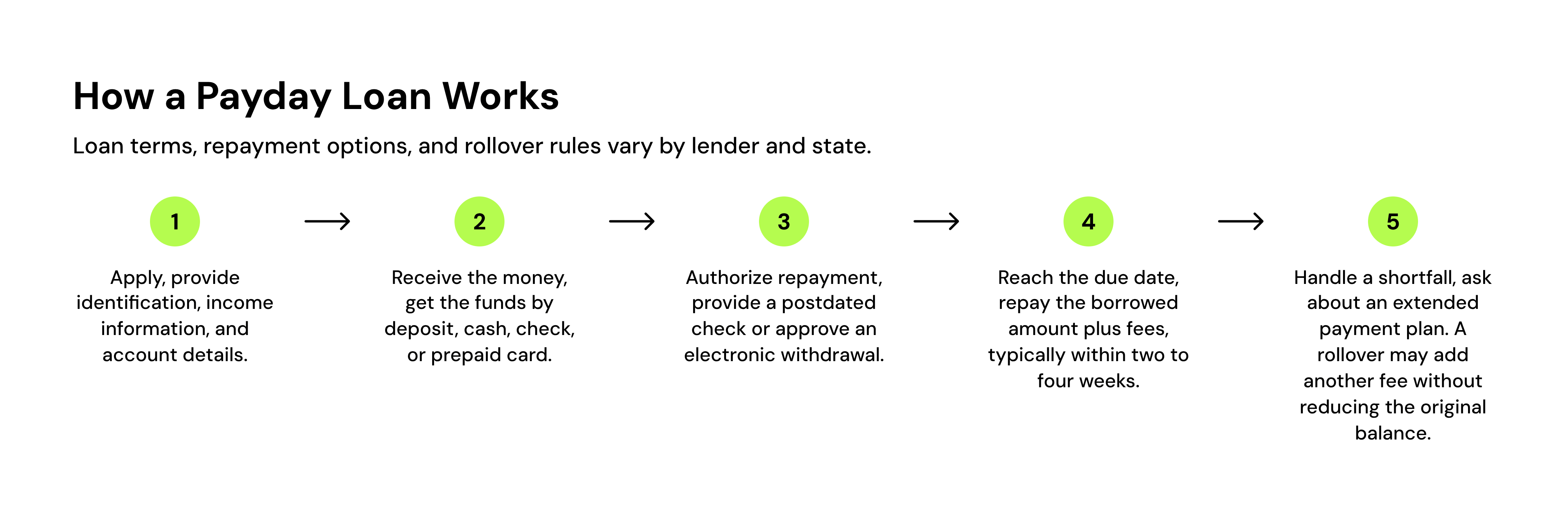
The details vary by lender and state, but the process often looks like this:
- You apply online or at a storefront and provide identification, income information, and account details.
- The lender gives you cash, deposits the money, or loads it onto a prepaid card.
- You authorize repayment, often with a postdated check or an electronic debit.
- On the due date, the lender collects the borrowed amount plus fees.
- If you cannot repay, your options depend on your agreement and state law. You may be offered a rollover, renewal, or extended payment plan.
Before signing, check the total dollar cost, the APR, the exact due date, how repayment will be collected, and what happens if you cannot pay on time. Also confirm that the lender is licensed where required by contacting your state regulator or attorney general.
Alternatives to payday loans
No alternative is right for every situation, and some still involve borrowing. Start with options that do not add a new debt payment.
Ask for more time or a payment plan
Contact the landlord, utility company, medical provider, or other business before the due date. Explain what you can pay now and when you expect to pay the rest. Some creditors may waive a late fee, move a due date, or offer a short-term payment plan, but they are not required to agree.
If rent or utilities are at risk, USAGov recommends calling 211 or searching for state and local emergency assistance. Help varies by location and funding.
Check with a credit union
Some federal credit unions offer payday alternative loans, or PALs. PALs have federal limits on loan size, term, fees, and rollovers, but you must meet the credit union’s membership and approval requirements. Ask for the full cost and monthly payment before applying.
The National Credit Union Administration says PALs II loans can be as large as $2,000 and must have terms of one to 12 months. Not every credit union offers them.
Compare a small personal loan
A bank, credit union, or reputable online lender may offer a small installment loan with more time to repay. Compare the APR, origination fee, monthly payment, late fees, and total repayment amount. Prequalification may let you check estimated terms with a soft credit inquiry, but confirm how the lender handles credit checks before you proceed.
Treat cash advance apps carefully
Some paycheck advance or cash advance apps offer a free transfer option, but others charge subscription fees, expedited transfer fees, or optional tips. The CFPB found that repeat use and expedited fees can make these products more expensive than they first appear.
Before using an app, add up every required and optional cost, check when repayment will be taken, and consider whether the advance will leave your next paycheck short. Avoid treating one app or advance as a standing part of your monthly budget.
Talk with a nonprofit credit counselor
If you are repeatedly short or juggling several debts, a nonprofit credit counselor can help you review your budget and options. The National Foundation for Credit Counseling can connect you with free or low-cost counseling at 800-388-2227. A counselor cannot erase legitimate debt, so ask about fees and services before enrolling.
Read more >> How to Get a Personal Loan With Bad Credit
What to do if you already have a payday loan
If you cannot repay the loan on time, contact the lender before the due date. Ask whether an extended payment plan is available and whether it adds fees. Some states require lenders to offer these plans.
Avoid taking out another payday loan just to pay the first one if you can. Review which bills carry the most immediate consequences, contact creditors about short-term arrangements, and consider speaking with a nonprofit credit counselor for guidance specific to your situation.
If you believe a lender has charged unauthorized fees, made unauthorized withdrawals, or violated your agreement, contact your state regulator or attorney general. You can also submit a complaint to the CFPB.
Bottom line
Payday loans solve today’s cash shortage by taking money and fees from a paycheck that may already be fully committed. A payment arrangement, local assistance, credit union loan, or carefully compared small loan may give you more room at a lower cost.
Building credit will not solve an emergency today, but it may help you qualify for more options in the future. Kikoff reports your on-time payments to all three credit bureaus, with no hard credit check to join. Get started when the payment fits comfortably in your budget.
Frequently Asked Questions
Article Sources
Disclaimer: The information provided in this blog post is meant for informational purposes only and does not constitute financial advice.