.jpg)



If you don’t want to commit to buying a vehicle, but you want the perks of a new car, leasing can be a viable option. However, leasing a car can feel confusing, especially when you come across terms that aren’t used in traditional vehicle loans. One such term is the money factor.
If you’ve ever wondered what the money factor is, you’re not alone. The number influences how much you’ll pay each month, but it’s rarely explained in clear terms at the dealership.
Our guide unpacks the question, “What is the money factor in car leasing?” so that you can make an informed decision when leasing a car.
What is the money factor in car leasing?
The money factor is the equivalent of the interest rate, but for a car lease. It’s expressed in a different format, which is why the money factor can be confusing to many consumers.
Traditional auto loans express the interest rate and APR as percentages. Leasing companies use a small decimal number, such as:
- 0.00125
- 0.00200
- 0.00310
The number determines how much financing cost you pay over the life of the loan. Lenders sometimes refer to the financing cost as a rent charge on a lease. So the money factor is the lease equivalent of an interest rate. Lenders use it to calculate how much you pay to borrow the vehicle.
How the money factor works
To fully answer the question, “What is the money factor in car leasing?” It's important to consider how the money factor works. Here’s a simple breakdown:
- The higher the money factor, the more you pay each month
- The lower the money factor, the cheaper your lease
Your monthly lease payment is made up of two main parts. Depreciation is how much value the car loses, which you pay for. The finance charge is the second component of your payment, and that’s where the money factor comes in. Even a small change in the money factor can have a huge impact on your total monthly cost.
When financing a vehicle, you want the interest rate to be as low as possible, as it will lead to a lower monthly payment and less money paid over the life of the loan. Likewise, you want to negotiate the lowest money factor you can on a lease.
How to convert the money factor to APR
The money factor is a decimal, which is unusual for consumers who typically finance vehicles with a loan. Fortunately, you can convert it into a familiar APR with a simple formula:
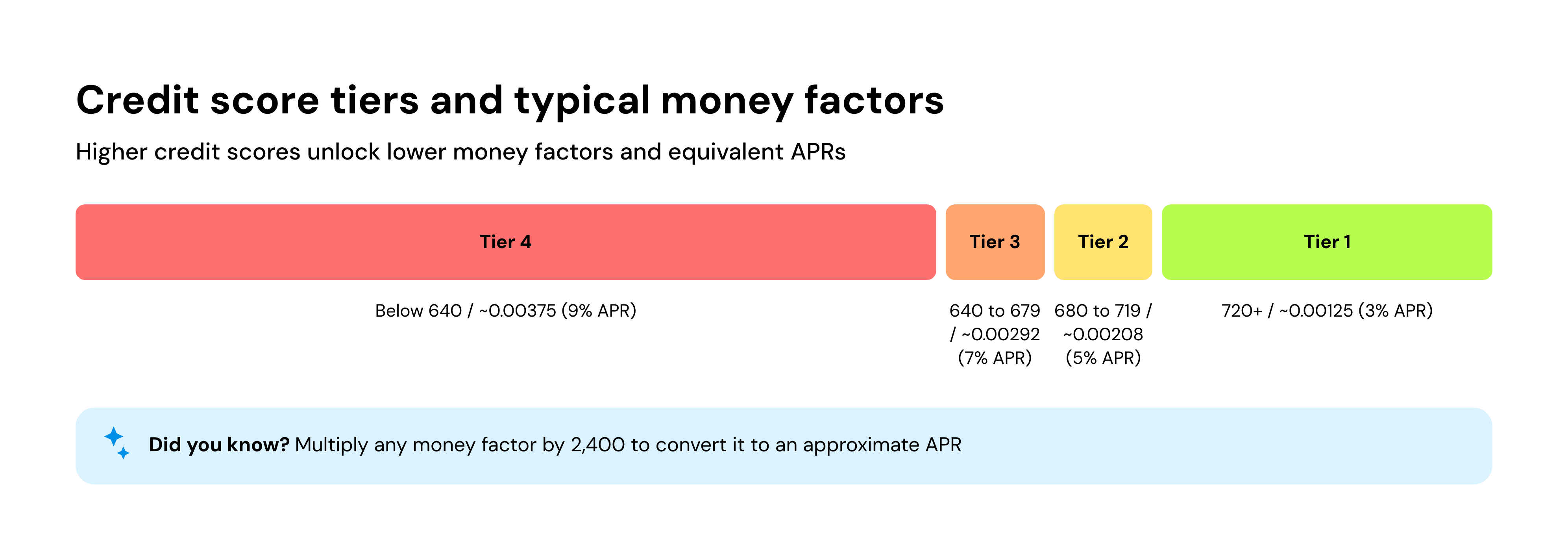
Money Factor x 2,400 = Approximate APR
For example:
- 0.00125 x 2,400 = 3% APR
- 0.00250 x 2,400 = 6% APR
Crunching the numbers yourself can help you compare lease offers with traditional auto loans or evaluate whether a lease deal is competitive. As you can see in the example above, a seemingly small difference in the money factor can translate to a huge gap in APR. A 3% difference in your APR means hundreds of dollars more per month on your lease.
If the lender is advertising the APR but not the money factor, you can reverse the formula. Divide the APR by 2,400 to calculate the money factor.
What is a good money factor?
There is no such thing as a universally “good” money factor. What counts as good depends on your credit score and the current market. If you have excellent credit, meaning a score of 700+, a money factor between 0.00100 and 0.00200 is very competitive. If you have average to low credit, your money factor could be 0.00200 to 0.00300 or higher.
If your money factor seems high, it could be due to:
- Your credit history
- A dealer markup
- Manufacturer incentives, or a lack of them
Improving your credit before shopping for a vehicle lease can help you qualify for a better money factor. Tools like Kikoff empower you to build credit responsibly with on-time payments. Adding positive activity to your credit profile will lead to a stronger score over time. There are no hard credit checks required to get started with Kikoff.
What affects the money factor on a car lease?
Now that you know what a money factor is, it’s important to consider what influences your offer. The lender will base your money factor on the following:
- Credit score
- Manufacturer promotions
- Dealer markups
- Lease term and vehicle type
- Economic conditions
Sometimes, manufacturers want to encourage leases of specific vehicle models and trims. In that scenario, they may offer promotions, such as a lower money factor or reduced down payment requirements.
Unfortunately, deals and promos aren’t always available. If the money factor seems high or the lease payment doesn’t make sense for your financial situation, consider other options. For example, it may be smarter to finance the vehicle or look at other leases.
How to negotiate the money factor on a lease
Many people don’t realize that you can negotiate the money factor. If you want to negotiate the money factor on your lease, start by asking the lender for the buy rate. The buy rate is the lowest money factor the lender offers. Dealers may mark it up, so ask directly: “What is the buy rate for this lease?”
Next, compare a few different offers. Shop around at multiple dealerships. Even a small difference in the money factor can save you hundreds or thousands of dollars over the lease term.
Before you sign on the dotted line, look at the total cost. A salesperson who is trying to close the deal may try to shift your attention to the monthly payment. While that’s an important part of the agreement, you also need to consider the:
- Money factor
- Residual value
- Total lease cost
- Money down
If you want to improve your odds of qualifying for a lower money factor, build your credit before leasing. Make on-time payments, pay down any existing debt, and add positive payment history to your credit profile.
Money factor vs. interest rate: What is the difference?
The money factor and interest rate represent similar concepts, but they are not expressed in the same way. The interest rate is:
- Expressed as a percentage
- Used for loans
- Easier to understand for most consumers
The money factor is:
- Expressed as a decimal
- Used for leases
- Needs to be converted to a percent
Think of the money factor as another way of expressing the interest, which is the cost of borrowing (or leasing).
Conclusion
The money factor is just the interest rate on a lease, expressed as a decimal instead of a percentage.
Convert it whenever you're comparing offers, since multiplying by 2,400 turns it into an approximate APR you can actually evaluate. Ask the dealer for the buy rate too, because the number you're quoted often includes a markup.
Your credit profile drives what you're offered, so it's worth strengthening before you start shopping leases.
Kikoff gives eligible users access to a Kikoff Credit Account with no hard credit check to sign up, with monthly payments reported to all three credit bureaus.
Build credit with Kikoff and take a step toward stronger credit habits.
Frequently Asked Questions
About the editor

Article Sources
Disclaimer: The information provided in this blog post is meant for informational purposes only and does not constitute financial advice.