.jpg)
.jpg)


If you’re preparing to shop for a vehicle and you’re concerned about your credit score, you may be wondering whether you can qualify for financing. There is no universal minimum credit score for an auto loan. Each lender sets its own requirements and considers more than your score, including your income, debts, down payment, and the vehicle you want to buy.
That means a low score does not automatically rule out an auto loan. It does mean you should compare offers carefully: qualifying for a loan and finding one that fits your budget are different things.
What is the minimum credit score for an auto loan?
There is no single number you must reach before applying. A lender may use a different scoring model from the one you see in a credit-monitoring app, and its decision also depends on the rest of your application.
Your credit matters, though. According to the Consumer Financial Protection Bureau (CFPB), auto lenders consider credit scores and history alongside income, debts, loan amount, loan term, down payment, and vehicle type when setting loan terms. A stronger credit profile may give you more options, while a lower score may make borrowing more expensive.
Because requirements vary, the most useful question is not “What score qualifies everywhere?” It’s “Which lenders will consider my application, and what will their offers cost?”
Minimum credit score by lender type
Different lenders serve different borrowers, but you should not treat a score range you find online as a guaranteed approval cutoff.
Banks and credit unions: Both can be worth checking, even if you’re unsure whether you qualify. Their requirements vary, and a credit union may have options that differ from those at a bank. Ask about eligibility and compare any offer with others you receive.
Online lenders: Some offer prequalification tools that let you explore potential terms before submitting a full application. Check whether the process involves a soft or hard credit inquiry, and remember that a prequalification is not a final approval.
Dealership-arranged financing: A dealer may send your application to one or more lenders. That can be convenient, but bring an outside offer if possible so you have something to compare. The CFPB notes that dealer-arranged financing may include a rate above the one quoted to the dealer.
Buy here, pay here (BHPH) dealerships: These dealers typically finance vehicles in-house and often market to borrowers with poor or limited credit. Their interest rates tend to be higher than those from other lenders. Before signing, ask for the full cost of the loan and whether the dealer reports on-time payments to the credit bureaus.
Read more >> What Is a Subprime Auto Loan?
Minimum credit score by loan type
For a purchase loan, the vehicle and the amount you need to borrow matter alongside your credit. A larger down payment reduces the amount financed and may help lower your interest rate. Choosing a less expensive vehicle can also make the payment easier to fit into your budget.
For a refinance loan, you replace an existing auto loan with a new one. Approval still depends on the new lender’s requirements, your finances, and the vehicle. Refinancing may lower your rate or monthly payment, but a lower payment that comes mainly from extending the term can mean paying more interest overall.
Neither loan type has a universal credit-score minimum. Compare the actual terms available to you rather than assuming refinancing is automatically easier to qualify for.
Read more >> How to Refinance a Car Loan
How your credit score affects your auto loan rate
Your score can affect the rate you’re offered, but it does not determine that rate on its own. Lenders also consider factors such as your existing debts, the loan term, your down payment, and whether the vehicle is new or used. In general, a lower credit score makes a higher interest rate more likely.
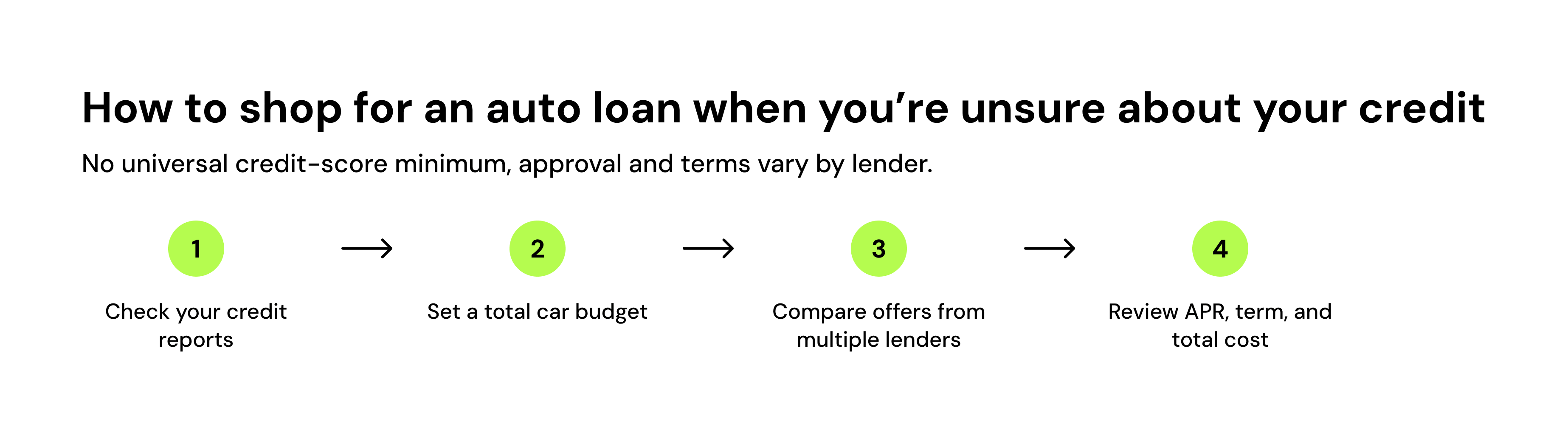
When comparing offers, look beyond the monthly payment. The annual percentage rate, or APR, includes the interest rate and certain mandatory borrowing costs. Compare APR with APR, then check the amount financed, loan term, monthly payment, and total of payments. The CFPB provides a loan-offer comparison guide that explains why a longer term can lower your payment while raising your total interest cost.
A loan also needs to fit the rest of your transportation budget. Insurance, registration, fuel, and maintenance continue after you leave the dealership. An affordable-looking payment may not be affordable once those expenses are included.
Can you get an auto loan with bad credit?
Yes, it may be possible, but approval and terms will depend on the lender and your full application. You could face a higher APR, a larger down-payment requirement, or fewer vehicle choices. A co-signer may help in some situations, but that person becomes responsible for the debt if you cannot pay, so it is a significant commitment.
If you receive an expensive offer, compare it with offers from other lenders before deciding that BHPH financing is your only option. Ask each lender for the APR and total of payments, and review any optional add-ons before agreeing to them.
Be especially careful if a dealer says the loan will help you build credit. The CFPB warns that some BHPH dealers report late payments without reporting on-time payments. Ask the dealer to put its positive-payment reporting policy in writing.
Read more >> How to Get an Auto Loan With Bad Credit
How to strengthen your credit before applying
If you can wait to buy, use that time to review your credit and prepare your budget. A few practical steps are:
- Pay existing accounts on time. Payment history is an important part of a credit profile.
- Reduce credit-card balances if you can. Lower balances can reduce the portion of your available credit you’re using.
- Check your credit reports for errors. Review them before you shop and dispute information that is inaccurate. The CFPB recommends checking your reports before applying for an auto loan.
- Save for a down payment. Borrowing less may reduce your payment and total financing cost.
- Shop for rates within a focused period. Depending on the scoring model, multiple auto-loan inquiries made within roughly 14 to 45 days generally count as one inquiry for scoring purposes.
If you want another way to establish payment history, the Kikoff Credit Account reports account balance and repayments to Equifax, Experian, and TransUnion. Signing up does not require a credit check. It is not an auto loan, and using it does not guarantee a particular credit score, loan approval, or interest rate.
Bottom line
There is no universal minimum credit score for an auto loan, and a number such as 600 or 660 cannot tell you whether every lender will approve you. Your credit, finances, down payment, and chosen vehicle all affect the offers available to you.
Check your credit reports, set a budget that includes the full cost of owning a car, and compare loan offers by APR and total cost. If the available terms are too expensive and your purchase can wait, taking time to strengthen your finances may give you more room to shop later.
Frequently Asked Questions
Article Sources
Disclaimer: The information provided in this blog post is meant for informational purposes only and does not constitute financial advice.