




When you buy a home, your loan-to-value (LTV) ratio is the share of the home's price you're borrowing. Put $40,000 down on a $400,000 house, and you're at 90%.
It's one of the numbers that decides whether you qualify and what rate you're quoted, and crossing certain thresholds changes what you pay every month. At 80%, conventional mortgage insurance drops out of the picture. Below that, lenders treat the loan as lower risk.
What is loan-to-value ratio?
Loan-to-value ratio compares the amount you’re borrowing to the value of the property you’re purchasing. It’s expressed as a percentage, and along with other factors, such as your credit scores, income and debt-to-income ratio, it helps lenders assess your risk as a borrower. Larger down payments result in lower LTVs, giving you more equity, or the difference between what your home is worth and what you still owe on it.
How to calculate loan-to-value ratio
To find your LTV, divide your loan amount by the value of the home, then multiply by 100 to turn it into a percentage.
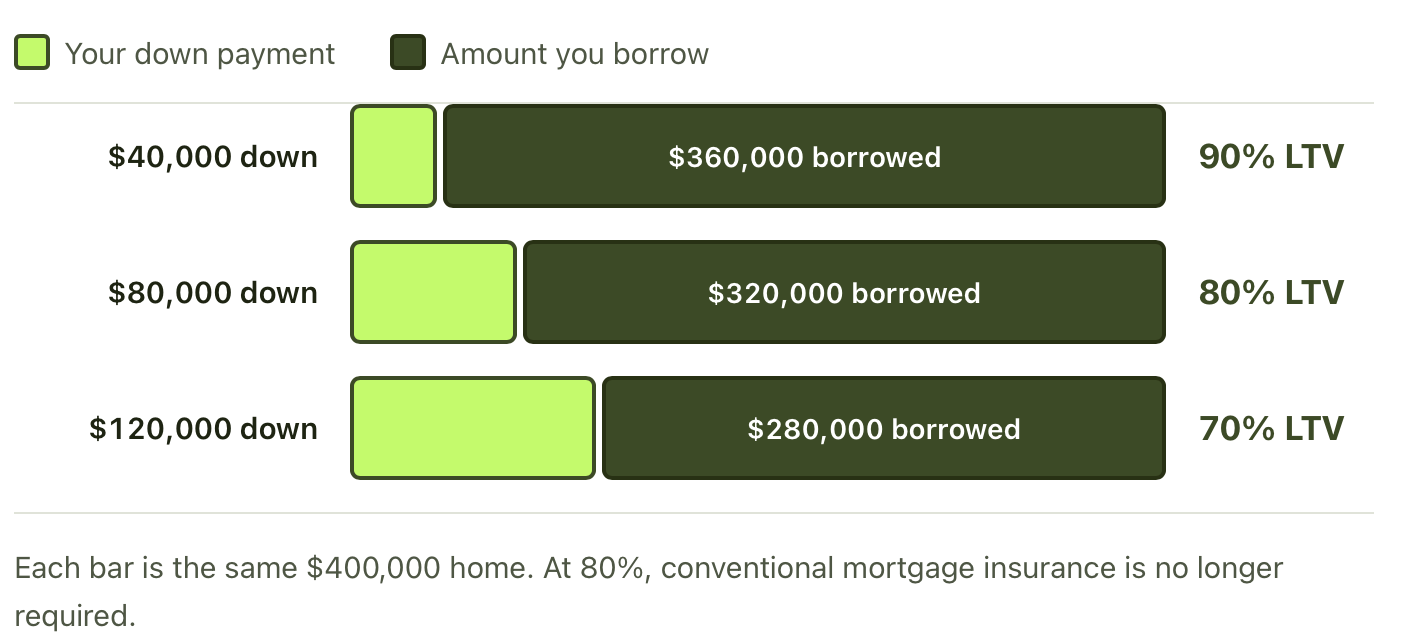
Say you're buying a $400,000 house and putting $40,000 down and borrowing the other $360,000:
$360,000 ÷ $400,000 = 0.90 — or 90% LTV
The more you put down, the lower your LTV. Same house, bigger down payment:
Your LTV isn't locked in for the life of the loan. It drops as you pay down your balance, and it moves with your home's value: down if the market rises, up if it falls. It also goes back up if you borrow against your equity with a home equity loan or line of credit.
One thing to know before you apply: the "value" in the formula isn't just the price on the listing. Your lender will order an appraisal, and they'll use the appraised value or the purchase price, whichever is lower.
What is a good loan-to-value ratio?
There’s no universal definition of what makes a good loan-to-value ratio. Generally the lower your LTV, the better.
The LTV you need to get a mortgage varies based on the lender, loan type, property, and your creditworthiness:
Why LTV matters to lenders
Lenders use LTV to help assess risk. A loan with a higher LTV is considered riskier because it increases the likelihood the borrower will owe more than the property is worth if the home’s value declines after loan closing.
High LTVs also make it more challenging for lenders to recoup their expenses if they have to sell a property after a borrower defaults. Because of the added risk, loans with high LTVs might be more difficult to qualify for.
How LTV affects your mortgage terms
Mortgages with elevated LTVs may have higher interest rates to help offset the lender’s risk. Additionally, conventional mortgages with LTVs above 80% typically require you to pay private mortgage insurance (PMI). Once your balance reaches 80% of the home's original value, you can ask your loan servicer to cancel it. And if you don't, the servicer often drops it automatically once your balance is scheduled to hit 78%.
Borrowers who take out an FHA loan with a down payment of less than 10%, resulting in an LTV above 90%, must pay a monthly mortgage insurance premium for the life of the loan.
How to lower your loan-to-value ratio
Before you close
- Put more down. On a $400,000 home, $40,000 down puts you at 90%. But $80,000 puts you at 80%, where conventional mortgage insurance stops being required.
- Shop a lower price. The same cash goes further against a smaller number: $40,000 is 10% of a $400,000 home and 12.5% of a $320,000 one.
After you close
- Pay extra toward principal. Anything above your required payment shrinks the balance faster, and one extra payment a year adds up.
- Watch the market and the calendar. Your LTV falls as you pay down the loan and as the home gains value. Mortgage insurance is the exception — that clock runs on what the home was worth the day you bought it, not what it's worth now.
- Improve selectively. Exterior replacements return the most. A garage door or steel entry door recoups more than it costs, according to the Journal of Light Construction's Cost vs. Value Report. Kitchen and bath remodels generally return less than you spend.
The steps above are general strategies. Your loan type, lender requirements, and local market may be different. Consider speaking with a HUD-approved housing counselor or a licensed mortgage professional before making decisions based on your LTV.
Bottom line
Your loan-to-value ratio compares what you owe to what the home is worth, and a lower one means less risk to the lender, easier approval, and usually a better rate.
But LTV only moves with cash, and if you're renting while you save, the biggest check you write every month isn't doing anything for the credit file a lender will pull when you're ready to buy your first home.
Kikoff's Rent Reporting adds your rent payments to your Equifax and TransUnion reports, so the check you're already writing every month starts building the payment history lenders look at while you're saving for a down payment. Plans start at $5 a month.
Frequently Asked Questions
Article Sources
Disclaimer: The information provided in this blog post is meant for informational purposes only and does not constitute financial advice.