






If you need cash fast, your credit card can give it to you through a cash advance. It’s one of the most expensive ways to use a card, with a fee up front and interest that starts right away. But it can still cost less than a payday loan.
What is a credit card cash advance?
A cash advance is a withdrawal from your card’s credit line. Instead of buying something, you take cash from an ATM, a bank teller, or a transfer to your bank account.
The amount goes on your card balance and reduces your available credit, just like a purchase.
How does a credit card cash advance work?
Many credit cards allow cash advances. Your card’s fee, APR, and cash advance limit are in your cardholder agreement, and your statement lists the current cash advance rate.
How to get a cash advance
- ATM. Insert your credit card and enter your PIN. If you don’t have a PIN for your credit card, request one from your card issuer.
- Bank teller. Some banks give cash advances at the counter. You won’t need a PIN, but you’ll likely need a photo ID.
- Online transfer. Some issuers let you transfer cash from your credit line to your bank account in their app or website.
- Convenience checks. Your issuer may mail you checks that you can write to yourself and deposit.
Some purchases count as advances even though you never touch cash, like money orders, traveler’s checks, foreign currency, and money sent through a payment app with your credit card. Your cardholder agreement lists which transactions your issuer treats this way.
Cash advance limits
Many cards have a separate, lower limit for cash advances inside your overall credit limit. Once you reach it, you can still make purchases up to your total limit, but you’ll need to pay down the cash advance balance before you withdraw more.
Your statement or online account shows your cash advance limit.
Fees and interest rates
You’ll typically pay three costs for a cash advance:
- A cash advance fee. Credit card issuers typically charge a cash advance fee ranging from 3% to 5% of the withdrawal amount, often with a flat minimum, such as $10.
- A higher APR. Cash advances commonly carry a higher interest rate than purchases.
- An ATM fee, if the machine’s owner charges one.
How a cash advance differs from a regular purchase
Purchases and cash advances come out of the same credit line, but your issuer tracks them as separate balances, often with different rates.
With purchases, you can usually avoid interest by paying your full balance by the due date. Cash advances generally don’t get a grace period, so interest starts right away and adds up daily until you pay it off.
Payments can also work differently too. Your issuer can apply the minimum payment however it chooses. But anything you pay above the minimum goes to the balance with the highest APR first, which is often the cash advance.
What it costs compared to a payday loan
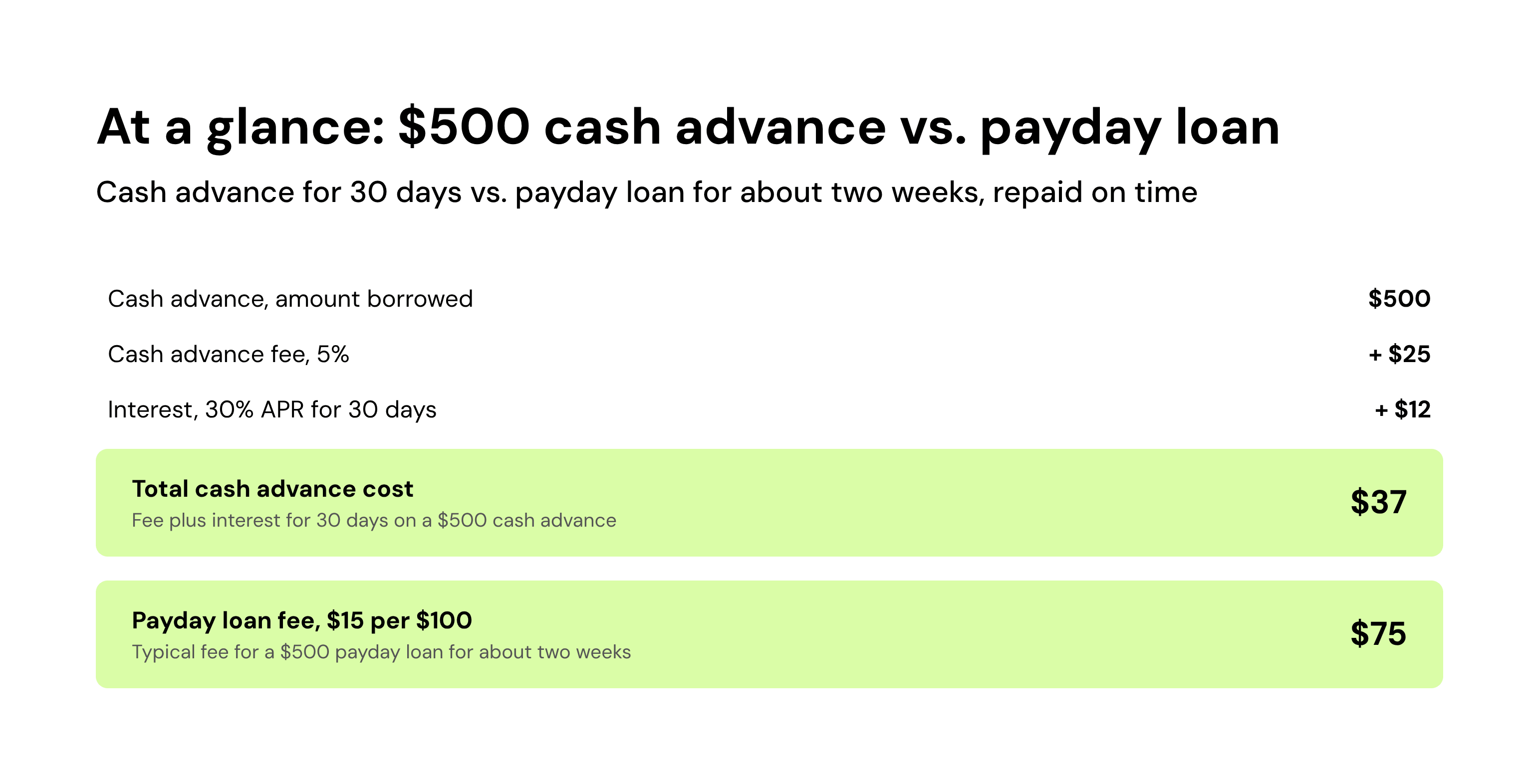
Say you take a $500 cash advance with a 5% fee and a 30% APR, paying it off in 30 days. You’d pay a $25 fee and about $12 in interest, or about $37 total.
A payday loan typically costs $10 to $30 for every $100 borrowed, usually for about two weeks. At $15 per $100, the same $500 costs $75 for half the time.
That's if you repay on time. If you can't, the costs accrue differently:
- Payday loan — the lender collects by withdrawing from your bank account or cashing a postdated check provided when you apply. A failed payment can result in fees from the lender and your bank. Rolling over the loan adds a new fee, and you still owe the full amount.
- Cash advance — if you miss your card's minimum payment, you'll typically owe a late fee, and interest keeps building at the cash advance rate. Your card issuer can't pull the money from your bank account unless you've set up automatic payments.
How a cash advance can affect your credit
A cash advance increases your card balance, which raises your credit utilization, or how much of your available credit you’re using. A higher utilization can lower your score.
It counts based on the balance on your statement, so the effect goes away once you pay the balance down.
Alternatives to a credit card cash advance
A cash advance needs no application or credit check, which is why it’s often the fastest option when your credit limits other choices. These alternatives can cost less.
Ask for more time on the bill
If the cash is for a specific bill, call that company first. Your creditor may agree to a smaller amount or a later payment, which costs nothing.
A payday alternative loan from a credit union
Federal credit unions can offer payday alternative loans (PALs) of up to $2,000 that you repay over up to 12 months. The rate is capped at 28%, and the application fee can’t be more than $20. Some PALs require you to have been a member for at least a month.
Personal loans
A personal loan gives you a lump sum that you repay over a set term of one to seven years. Rates are usually lower than on credit cards. A two-year personal loan at a bank averages 11.90%, according to the Federal Reserve. Credit cards carrying a balance average 22.36% , or nearly double.
You’ll need to apply, usually with a credit check, so the money may not arrive the same day. And if your credit is limited, your rate could be higher than a cash advance APR.
Cash advance apps
A cash advance app offers small advances that you typically repay on your next payday. Some don’t charge a required fee, but many ask for a tip, charge for instant delivery, or require a monthly subscription. Add those up before you compare.
Grant Cash Advance offers $25 to $500 to eligible customers with no interest, no credit check, and no late fees. Standard delivery is free and takes one to three business days, with same-day delivery from $2 to $21. Repayment comes out of your next paycheck automatically, so plan for that check to be smaller.
Borrowing from friends or family
A friend or relative may be able to lend you money for a short-term need. If they do, put the amount and the repayment date in writing so you both know what to expect.
Savings
If you have an emergency fund, using it costs nothing in interest. Once things settle, setting aside even a small amount each month gives you a cheaper option if an emergency comes up again.
If cash advances have become routine
Taking one to cover an emergency is expensive. Taking several in a row usually means there’s more going out each month than coming in, and borrowing won’t help close the gap.
A nonprofit credit counselor can go through your full situation with you for free or at low cost. They can also point you to hardship programs, payment arrangements with the companies you owe, and bills that can be lowered. Call the National Foundation for Credit Counseling at 800-388-2227.
Bottom line
A cash advance can get you cash fast with no application, but you pay a fee and interest from day one. If you use it, pay it off as quickly as you can.
The cheaper options, like a personal loan, are priced on your credit. That won’t change this week, but it’s what sets your rate next time you need to borrow. A Kikoff Credit Account reports your on-time payments to Equifax, Experian, and TransUnion. There’s no credit check to sign up, and plans start at $5 a month.
Frequently Asked Questions
Article Sources
Disclaimer: The information provided in this blog post is meant for informational purposes only and does not constitute financial advice.