

.jpg)



If you're like most people shopping for a new vehicle, you'll need to finance the sale instead of buying the car outright. But did you know that there are several types of auto loans?
Exploring some of the main types of auto loans can help you determine which type is best for you.
What are the different types of auto loans?
There are five main types of auto loans:
- New car loans
- Used car loans
- Private party auto loans
- Refinance auto loans
- Lease buyout loans
Here's a closer look at each type and how it works.
New car loans
Many people don't know that their loan terms may vary depending on whether they're buying a new or used vehicle. New car loans will usually have lower interest rates because they're less risky for lenders.
New cars are often still under warranty, and their resale values are higher. If you stop paying your loan, the lender will probably have an easier time selling the car to get their money back.
Before getting a new car loan, keep in mind that these loan amounts tend to be higher than loans for used cars, and new cars also depreciate faster. As a result, it's much easier to become "upside down" (owe more than the car is worth) on a new car loan than on a used car loan.
Used car loans
Used cars typically have lower and less predictable resale values than new cars, so their interest rates are generally higher. However, monthly payments are usually lower due to the lower loan amount.
If you have below-average credit, you may have an easier time getting approved for a used car loan than a new car loan.
Private party auto loans
If you want to buy a car from an individual seller as opposed to a dealership, you'll likely need a private party auto loan. With a private party loan, a bank or credit union pays a lump sum to the seller, and you make monthly payments on the loan.
Private party auto loans often have higher interest rates than loans for cars purchased at dealerships. Many lenders also place limits on the vehicle's age and total mileage.
Refinance auto loans
If you currently have an auto loan but are dissatisfied with the terms, you might be able to get a loan specifically for refinancing. Here's how the refinancing process typically works:
- You apply and get approved for a new loan with better terms than the old one
- The new lender pays off the old car loan
- You start making payments to the new lender instead
Most people who refinance their car loans do it to get a lower interest rate or a lower monthly payment. This is also a smart course of action if you want to shorten or lengthen the loan term.
Lease buyout loans
If you're leasing a vehicle and want to keep it, you might be able to get a lease buyout loan. This type of loan effectively converts your lease into a purchase. With a lease buyout loan, you buy a car for its "residual value," which is its total value at the end of the lease.
If you've gone over the mileage limit on your lease or have caused major wear-and-tear damage, a lease buyout loan could be preferable to paying the penalties when you return the car.
Secured vs. unsecured auto loans
Most of the time, car loans are secured by the vehicle you're financing. That means if you default, the lender can repossess the car and sell it to get their money back.
Because of the collateral involved, secured loans usually have lower interest rates than unsecured loans. They also tend to be easier to get, and sometimes, the interest you pay on them is tax-deductible.
However, there are some circumstances where you may be able to get an unsecured auto loan, which is a personal loan used to buy a car.
These loans are not secured by the vehicle, so a lender can't repossess it if you stop paying. However, they may report missed payments to credit bureaus, sue you, and possibly even get a court order to garnish your wages or seize your assets.
You might not always be able to get an unsecured loan in all circumstances. Usually, buyers apply for these loans when buying cars from private parties.
Direct lending vs. dealership financing
The various types of auto loans can be divided into two categories based on where the loan is coming from.
Direct lending
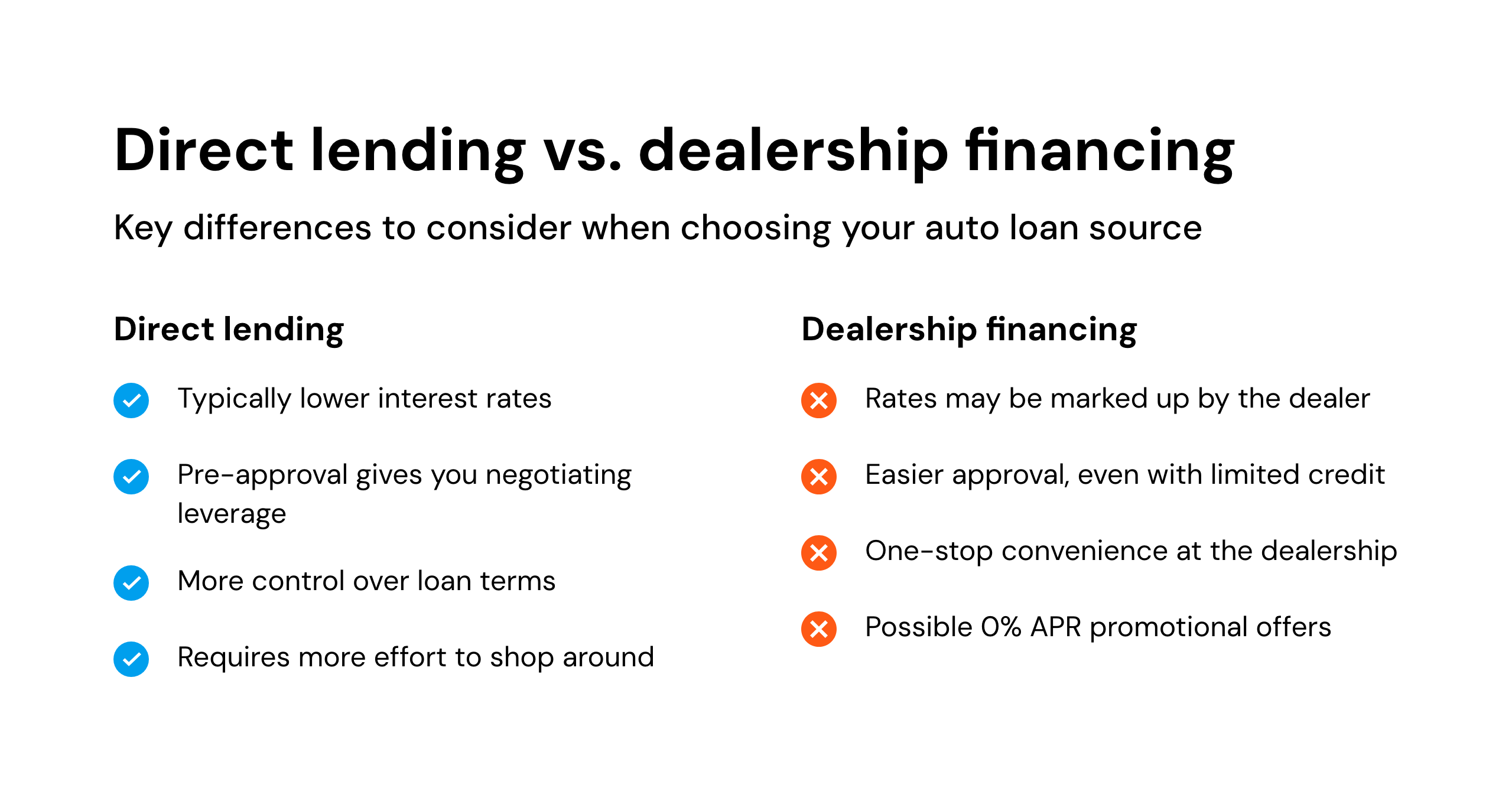
Direct lenders are banks, credit unions, and other financial institutions that lend money directly to you (instead of going through a dealer). Securing financing through direct lending has several advantages:
- Interest rates are usually lower than dealership financing
- You'll know your rate and budget ahead of time
- You can use your pre-approval to negotiate dealer financing rates
Going this route takes more time than going through the dealership would. You also may have trouble getting approved if you don't have good credit.
Dealership financing
With dealership financing, the dealer secures a loan on your behalf. However, they often increase the rate to boost their profits. Despite that, dealership financing does have advantages:
- You might qualify for promotional 0% APR financing
- You don't have to seek out your own funding
- In some cases, it may be easier to get approved with lower credit scores
Many believe that the "best of both worlds" approach to financing a car involves getting pre-approved by a direct lender first. From there, you can use your approval letter to try to negotiate a better interest rate at the dealership.
Hoping for a better rate? Start by boosting your credit
No matter what type of auto loan you're hoping to get, securing a lower interest rate is a good thing. And if you want to increase your chances of getting a lower interest rate, it's a good idea to dedicate some time and effort to improving your credit score.
Kikoff is here to help you do that. When you sign up, you gain access to a credit line that you can use to buy items in our online store. As you pay off your purchases, we report your on-time payments to credit bureaus. Joining is free, and there's no credit check.
Frequently Asked Questions
About the editor

Article Sources
Disclaimer: The information provided in this blog post is meant for informational purposes only and does not constitute financial advice.