



Someone searching for this topic is usually trying to understand the mechanics behind how money moves electronically between bank accounts. They want to know what ACH actually means, how direct deposit fits into that system, whether these transactions are safe, and how long they take. Many are encountering these terms for the first time through a new job, a bill payment setup, or a fintech app asking for bank details. Let's jump in.
What is an ACH payment?
ACH stands for Automated Clearing House, which is effectively the electronic network that processes the vast majority of bank-to-bank transfers in the United States.
Every individual who has ever received a paycheck via direct deposit, paid a bill online, or sent money through a service like Venmo has used the ACH network. The system is managed by Nacha (formerly the National Automated Clearing House Association), which sets the rules and standards for how transactions flow between financial institutions.
ACH payments work by batching transactions together and processing them at scheduled intervals throughout the day, rather than sending each one individually in real time. This batch processing is what makes ACH transfers so cost-effective compared to wire transfers, which are processed individually and usually carry fees of $15 to $50.
There are two main types of ACH transactions: ACH credits and ACH debits. An ACH credit "pushes" money into a recipient's account, be it a payroll deposit or a tax refund. An ACH debit "pulls" money from an account, which is primarily how recurring bill payments work when you authorize a company to withdraw funds.
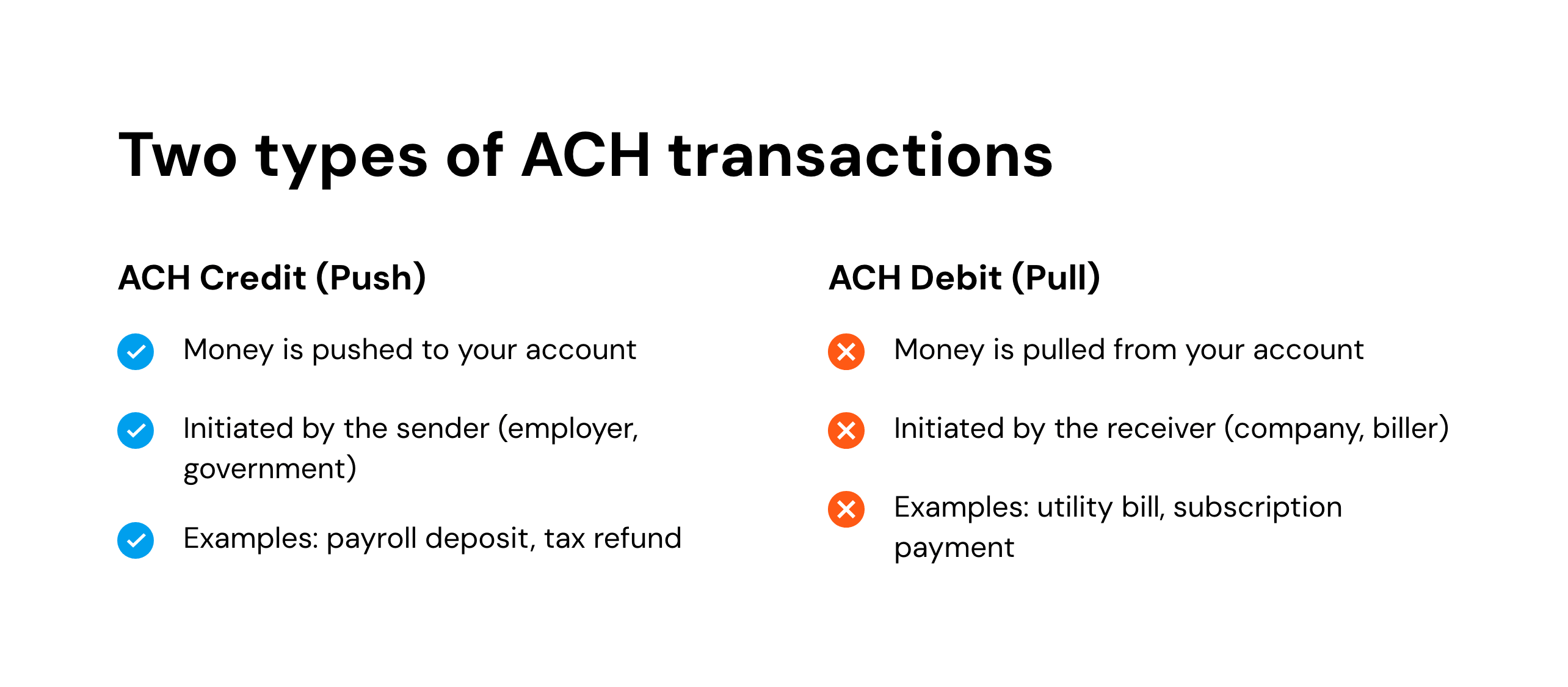
The ACH network processed over 31 billion transactions in 2023 alone, paints a picture of just how central this system is to everyday financial life in the U.S.
How direct deposit works
Direct deposit is basically a specific type of ACH credit transaction where an employer or government agency sends funds directly into your bank account.
When you start a new job, your employer typically asks for your bank routing number and account number. These two pieces of information tell the ACH network exactly where to send your paycheck. The routing number identifies your bank, and the account number identifies your specific account within that bank.
Your employer's payroll system initiates the transfer through their bank (called the Originating Depository Financial Institution, or ODFI). The transaction then moves through the ACH network to your bank (the Receiving Depository Financial Institution, or RDFI), which deposits the funds into your account.
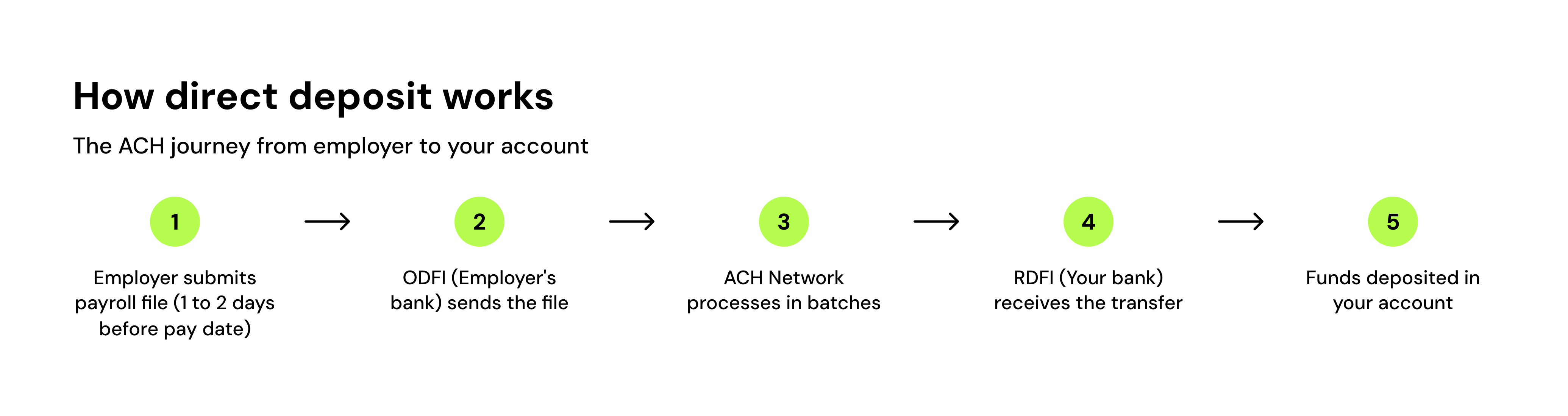
Generally, employers submit payroll files one to two business days before the actual pay date, which is why funds are sometimes available in your account the evening before payday. Some banks and fintech platforms offer "early direct deposit" by making funds available as soon as they receive the ACH file, rather than waiting for the official settlement date.
Direct deposit isn't limited to paychecks. Government benefits like Social Security, tax refunds, unemployment insurance, and stimulus payments all use direct deposit through the ACH network.
Key differences between ACH payments and wire transfers
Many people confuse ACH payments with wire transfers, but they operate quite differently.
ACH payments are processed in batches, usually take one to three business days, and are either free or very low cost. Wire transfers are processed individually and in real time, meaning funds can arrive the same day, but they typically cost between $15 and $50 for domestic transfers and even more for international ones.
Wire transfers are generally used for large, time-sensitive transactions like real estate closings or international business payments. ACH payments are better suited for routine transactions like payroll, bill payments, and person-to-person transfers.
This said, ACH transfers also offer a same-day option. Same-day ACH was introduced in 2016 and has grown rapidly, though it may carry a small fee depending on your bank.
Another important difference involves reversibility. ACH payments can be reversed in certain circumstances, such as an incorrect amount or unauthorized transaction. Wire transfers are much harder to reverse once completed.
How long do ACH payments take?
Standard ACH transfers generally take one to three business days to complete.
The timeline depends on several factors, including when the transaction was initiated, whether it falls on a business day, and the specific policies of the banks involved. ACH transactions are not processed on weekends or federal holidays, so a transfer initiated on a Friday evening might not settle until the following Tuesday or Wednesday.
Same-day ACH is available for transactions submitted before certain cutoff times. Nacha currently supports multiple same-day ACH processing windows, with the latest settlement window closing in the late afternoon Eastern time.
Many banks and fintech platforms now offer faster access to incoming ACH deposits by fronting the funds before official settlement. This is how "early paycheck" features work at many neobanks and financial apps. The money hasn't technically settled yet, but the institution makes it available based on the pending ACH file.
For outgoing ACH payments (like paying a credit card bill), the processing time can similarly vary. Just make sure to account for one to three business days when scheduling bill payments to avoid late fees.
Are ACH payments safe?
ACH transactions are generally considered very safe, thanks to multiple layers of regulation and security.
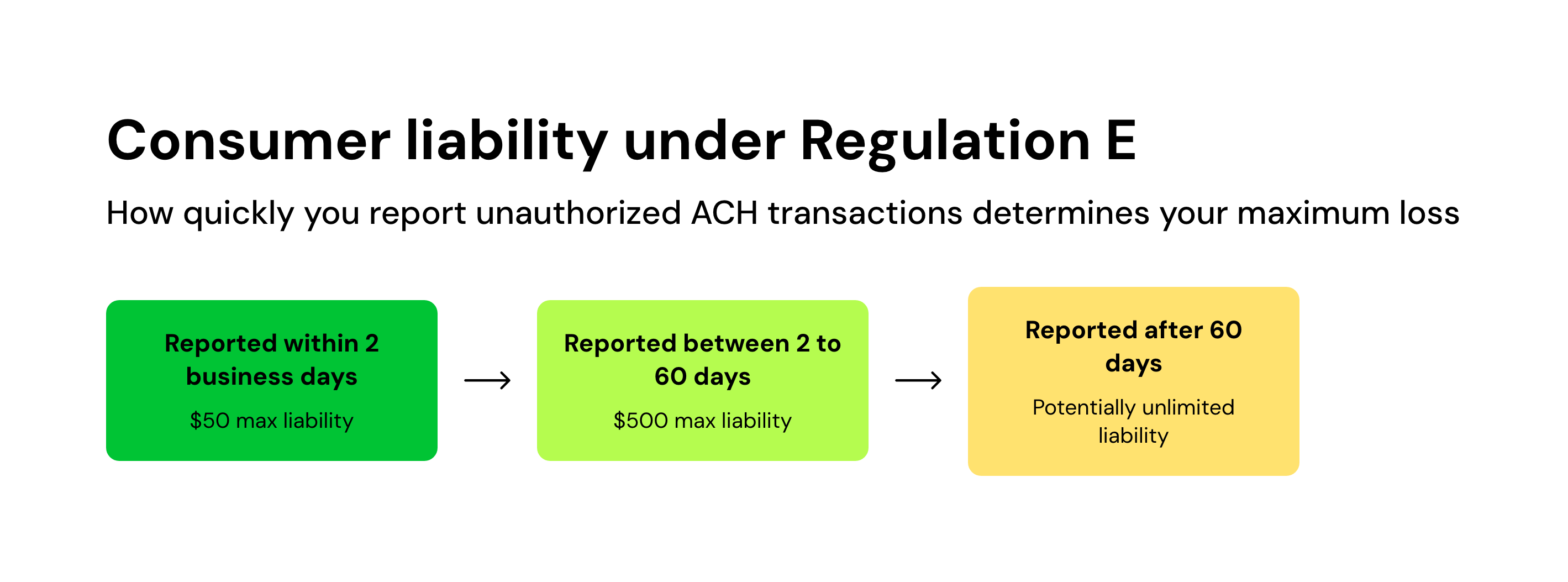
Nacha enforces strict rules about authorization, meaning a company cannot pull money from your account without your explicit consent. Federal regulations under Regulation E also protect consumers from unauthorized electronic transfers, giving you 60 days to report unauthorized ACH debits.
Banks employ encryption, multi-factor authentication, and fraud monitoring to protect ACH transactions. If an unauthorized ACH debit does occur, you're typically not liable for the full amount as long as you report it promptly.
Luckily, the consumer protections around ACH are quite robust. If you notice an unauthorized debit within two business days, your liability is limited to $50. Even between two and 60 days, it's capped at $500.
That said, you should still exercise caution about who you give your bank account and routing numbers to. Only provide this information to trusted employers, established companies, and reputable financial institutions.
How ACH payments connect to credit building
While ACH payments themselves don't directly appear on your credit report, they are the underlying mechanism for many credit-building activities.
When you make a monthly payment on a credit account, that payment usually moves from your bank to the creditor via ACH. The creditor then reports your on-time payment to the credit bureaus. This means the ACH system is effectively the plumbing behind building positive payment history.
Rent reporting services also rely on ACH. When your rent payment is verified and reported to a credit bureau, the verification often happens by confirming the ACH transaction between your bank and your landlord or property manager.
If you're looking to build credit through consistent, reported payments, a platform like Kikoff makes it easy to establish positive payment history that gets reported to the major credit bureaus. Monthly payments on a Kikoff Credit Account are processed and then reported, helping users build the payment history that makes up the single most important factor in credit scoring.
Understanding how money moves through the ACH system helps you plan payments strategically, avoid late fees, and ensure your credit-building payments always arrive on time.
Common ACH payment errors and how to avoid them
Errors in ACH transactions can cause headaches ranging from returned payments to overdraft fees.
The most common error is providing incorrect account or routing numbers. Double-checking these numbers before submitting them for payroll, bill payment, or any other ACH setup can save significant frustration. Even a single digit off can send your money to the wrong account or cause the transaction to fail.
Insufficient funds is another frequent issue. If an ACH debit hits your account and there aren't enough funds to cover it, the transaction will be returned, and you may face overdraft fees from your bank plus returned payment fees from the payee.
Timing issues can also cause problems. Scheduling a payment for a specific date doesn't guarantee it will arrive that day, since ACH processing takes one to three business days. Always initiate payments with enough lead time.
If you authorize a recurring ACH debit and later want to stop it, you have the right to issue a stop payment through your bank. Just make sure to notify both your bank and the company debiting your account to avoid complications.
Conclusion
ACH payments and direct deposits form the backbone of how money moves electronically in the United States. Understanding how these systems work helps you manage your finances more effectively, avoid costly errors, and plan your payments with confidence.
Whether you're setting up direct deposit with a new employer, authorizing automatic bill payments, or building credit through consistent monthly activity, the ACH network is working behind the scenes to make it happen.
For anyone looking to use consistent, on-time payments as a tool for building credit, Kikoff offers a straightforward way to establish positive payment history reported to the major credit bureaus, all without a hard credit check to get started.
Frequently Asked Questions
About the editor

Disclaimer: The information provided in this blog post is meant for informational purposes only and does not constitute financial advice.