.jpg)



It might seem like paying off a loan early is a good thing. After all, the lender gets their money back sooner rather than later, and you can enjoy being free from the debt obligation.
However, when you pay a loan off early, the lender misses out on some of the interest they had expected to recover. To help offset that loss, some lenders charge what's called a prepayment penalty.
If you have a car loan you're hoping to pay off early, you might wonder: Is there a prepayment penalty on auto loans? In this article, we'll take a closer look.
Is there a prepayment penalty on auto loans?
Most auto loans do not have a prepayment penalty, but some do.[2] Prepayment penalties are more common on subprime loans, or those extended to borrowers with poor credit or limited credit histories. Many "buy-here-pay-here" dealerships offer loans with prepayment penalties.[3]
Notably, across 36 different states (and in Washington, D.C.), lenders may only charge prepayment penalties on loans that have terms of 60 months (five years) or less.
How auto loan prepayment penalties work
There are a few different ways that lenders can charge prepayment penalties. These are the three most common types of penalties and how they work:
Flat fee penalties
With a flat fee penalty, you'll be charged a specified fee if you pay off your loan early. Usually, that fee is a few hundred dollars.
Percentage-based penalties
Percentage-based penalties are more common than flat-fee penalties. They're based on the outstanding balance of the loan right before you pay it off, and normally, they're around 2% of that balance.
Here's an example. Imagine that you have $1,000 left on your car loan when you decide you have enough money to pay the remainder in full. If your loan has a 2% prepayment penalty, you'll owe a fee of $20 for paying early.
Rule of 78s
The Rule of 78s is a method of calculating interest that essentially front-loads interest in the earlier months of a loan term. This means that if a borrower pays a loan off early, the lender will lose less interest than they would with a more traditional loan term.
The name "Rule of 78s" is named after the total sum of the digits of each month in a 12-month loan. 1 + 2 + 3 + 4 + 5 + 6 + 7 + 8 + 9 + 10 + 11 + 12 is 78. In the first month of the loan, you'll pay 12/78 on the interest, and in the second month, you'll pay 11/78 (and so on).
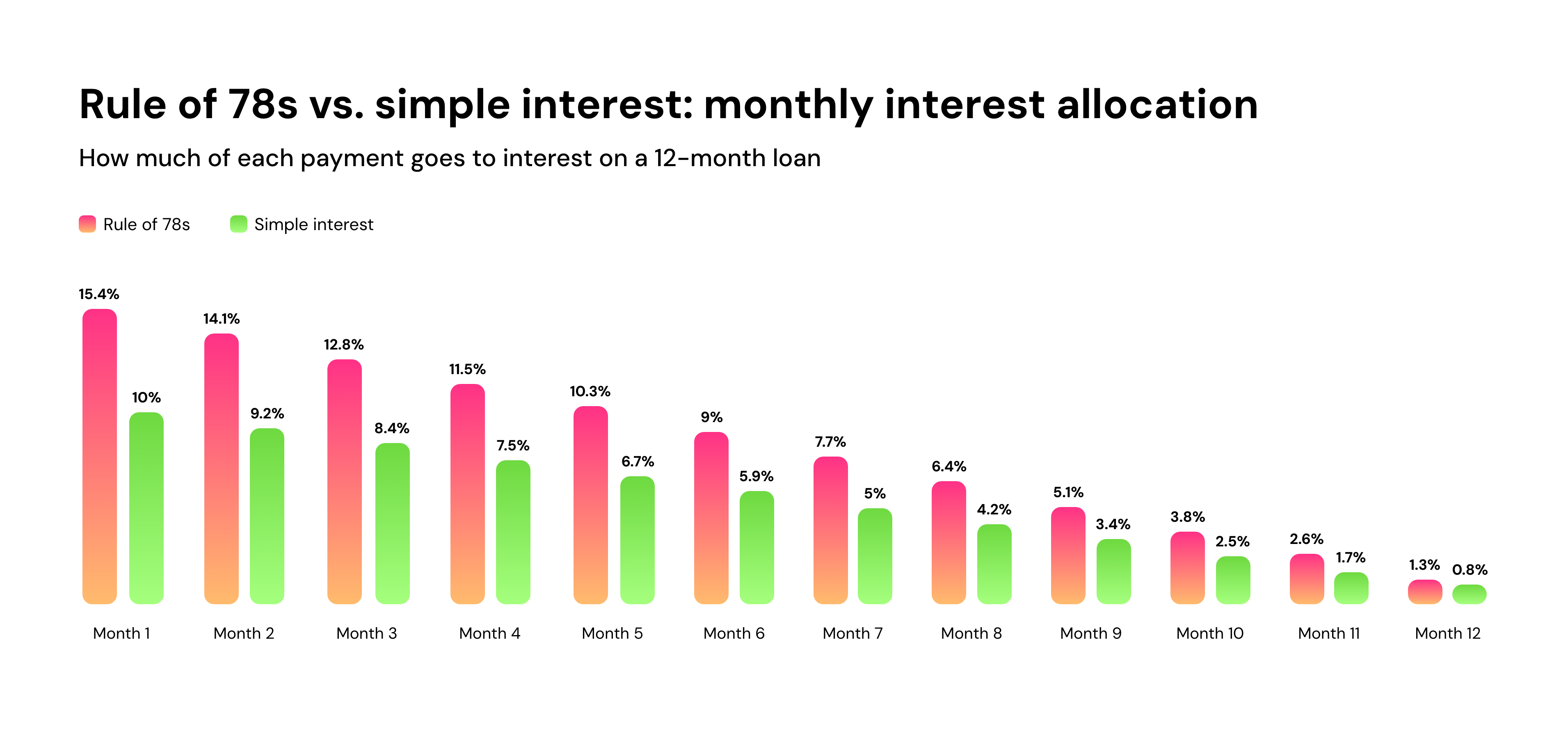
The Rule of 78s is only legal for some loans with terms of 61 months or less. Some states have placed further restrictions on how it's used.
How to find out whether your auto loan has a prepayment penalty
If you have the option, it's often a good idea to avoid auto loans with prepayment penalties. Even if you don't anticipate being able to pay off the loan early, you might unexpectedly get a financial windfall that makes it possible.
But how do you tell if a given loan has a prepayment penalty? Car loan documents are legally required to have a Truth in Lending Act (TILA) disclosure. This clearly outlines the APR, finance charge, payment schedule, and any relevant penalties.[1]
As you read the document, look for a section titled "prepayment" or something similar. It should tell you whether the loan has a prepayment penalty or not.
If the loan mentions "precomputed interest," that may also be a sign that there's a prepayment penalty. Precomputed interest is interest that is calculated ahead of time, so if a loan document mentions it, you might not be able to save on interest by paying the loan off early.
You can also ask your lender to explain whether there's a prepayment penalty and to show you the portion of the loan document that mentions it.
How to avoid a prepayment penalty on auto loans
The best way to avoid prepayment penalties on car loans is to thoroughly review your loan document before signing. If a loan offered by one lender has a prepayment penalty, you should be willing to go somewhere else.
However, that doesn't mean you need to walk away without explanation. It may be worth negotiating with the lender to see if they are willing to remove the prepayment penalty.
If you already have a car loan with a prepayment penalty, you might be able to reduce the amount of the penalty by making several small extra payments instead of one final payoff.
Is it still worth paying off your car loan early if there is a penalty?
In some cases, paying off your car loan early may be a smart choice even with a penalty. These are a few situations where that might be the case:
If it's early in the loan term
Unless the prepayment penalty is very large, you'll probably save much more in interest if you're able to pay off the loan relatively early on. Just in case, it's a good idea to calculate how much interest you'd be saving and verify that it's more than the penalty amount.
If you have a high-interest loan
Most prepayment penalties are around 2% of the loan balance. If your loan has a relatively high interest rate (around 7% or more), paying it off early might be worth the penalty.
If you want the peace of mind
Owning your vehicle outright can offer you a sense of security, and it can also reduce the amount of debt you owe each month. If these things are important to you, early payoff could be the right choice.
Want to improve your credit before applying for an auto loan?
Shopping around for an auto loan can be stressful. And if you have poor credit or a limited credit history, it can be even more so. When your credit needs work, it makes it harder to access the best financing opportunities.
If you think you'll need an auto loan in the near future, taking some time to focus on your credit score now could be helpful. Kikoff is here to help you get started — a credit-builder app designed to make building credit simple. We don't check your credit when you sign up, and it's free to join.
Frequently Asked Questions
About the editor

Article Sources
Disclaimer: The information provided in this blog post is meant for informational purposes only and does not constitute financial advice.