






Every financial decision you make, large or small, either moves you closer to financial stability or further from it.
That's not meant to be intimidating. It's actually liberating, because it means the quality of your financial life is mainly determined by the quality of your decisions over time, not by a single perfect move. Informed financial choices don't require a finance degree or lots of money to start with. They require a clear process, the right information, and an understanding of how the pieces fit together.
Let's jump in.
How to make informed financial choices
Making informed financial choices is effectively about building a decision-making framework you can apply consistently, regardless of what the specific decision is.
Every individual who improves their financial life does so by making better decisions more often, not by getting lucky once. The goal is to get to a place where your default responses to financial situations are sound ones.
Understand your current financial picture
You can't make informed choices without knowing where you're starting from.
This means having a clear view of four things: what you earn, what you spend, what you own, and what you owe. Most people have a rough sense of these numbers, but rough isn't enough when you're trying to make decisions that depend on them.
Start by tracking your income after taxes, your fixed monthly expenses like rent and utilities, and your variable spending like groceries, dining, and subscriptions. Then list every debt you carry, including the balance and interest rate, and every asset of meaningful value.
This complete picture is what makes it possible to evaluate a financial decision in context. A question like "should I take on a car payment?" means something very different depending on whether you have $500 or $5,000 in monthly breathing room after expenses.
Just make sure you revisit this picture regularly, since your financial situation changes and your decisions should reflect the current reality, not a snapshot from a year ago.
Define what you're actually optimizing for
Lots of financial decisions go wrong not because the math was bad, but because the person wasn't clear on what they were trying to achieve.
Optimizing for short-term cash flow looks very different from optimizing for long-term wealth. Optimizing for debt elimination looks different from optimizing for credit building. Neither is universally right, and the best financial choices are the ones aligned with your actual goals, not someone else's.
Before evaluating any financial decision, get specific about what you want it to accomplish. "I want to spend less" is a vague goal. "I want to reduce my monthly fixed expenses by $200 so I can accelerate my credit card payoff" is something you can actually make a decision against.
This said, goals change over time, and that's completely normal. The habit of defining them before deciding is what matters.
Learn the true cost of financial products
Every financial product has a sticker price and a true cost, and they're usually not the same thing.
A credit card with no annual fee can still cost hundreds of dollars a year in interest if you carry a balance. A "no cost" loan might come with origination fees baked into the APR. A subscription service priced at $10 a month is $120 a year, and if you have lots of them, they add up fast.
The true cost of any financial product is basically the total of every dollar you'll pay over the life of using it, including fees, interest, penalties, and any opportunity cost from the cash you're tying up. Getting in the habit of calculating this before signing up for anything is one of the most valuable financial skills you can develop.
For credit products specifically, the APR is generally the most useful single number for comparison, since it captures the annual cost of borrowing including fees. Just make sure you're comparing APRs on products with similar structures, since a credit card APR and a personal loan APR aren't directly equivalent.
Evaluate trade-offs, not just benefits
Every financial choice involves a trade-off, and informed decision-making means acknowledging both sides.
Taking on a new credit card might improve your credit utilization by increasing your available credit, but it also adds a hard inquiry and a new account that lowers your average account age. Paying off a loan early saves interest but might reduce your liquidity if it drains your savings account. Moving money into an investment account grows it over time but means it isn't available for short-term needs.
None of these trade-offs automatically make the decision wrong. They just need to be weighed honestly against what you're trying to accomplish. A useful mental model is to ask: what am I giving up to get this, and is that trade worth it given my current goals?
This is especially important for decisions that feel obviously good on the surface. The single most common financial mistakes come from choices that looked like pure wins but had hidden costs that weren't considered.
Build credit as a foundational financial tool
Your credit profile is effectively the infrastructure that determines the cost of almost every major financial decision you'll make.
A stronger credit profile means lower interest rates on mortgages, car loans, and personal loans. It can mean the difference between qualifying and not qualifying for an apartment. It can affect the deposit required for utilities, the rate on insurance in some states, and even job eligibility in certain industries.
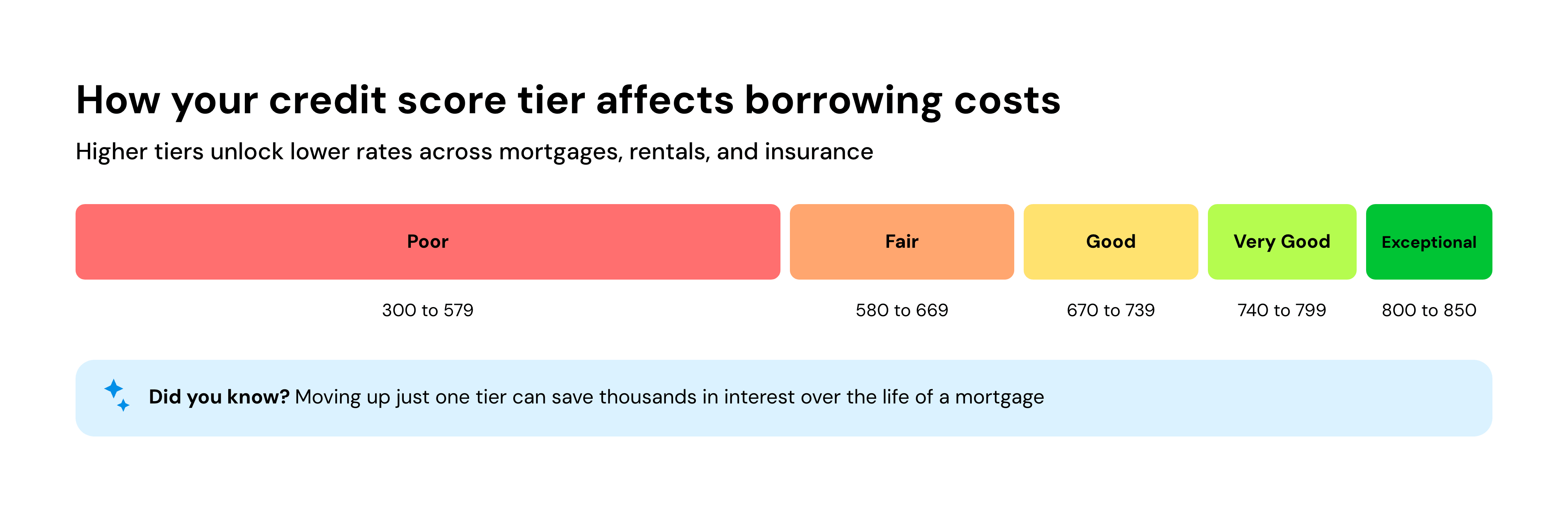
This means building credit isn't just a financial goal on its own. It's a multiplier that makes every other financial choice cheaper and more accessible over time. Every individual who prioritizes their credit profile while managing their finances is effectively lowering the cost of their future.
The most efficient way to build credit is through a revolving credit account that reports to all three bureaus, since it builds both payment history (35% of your score) and credit utilization (30%) simultaneously. Kikoff offers exactly that, with a credit account designed for people building or rebuilding credit, no hard credit check to sign up, and reporting to Equifax, Experian, and TransUnion. Build credit responsibly with Kikoff's plans, starting at $5 a month.
Avoid common decision-making traps
Even people who understand the basics of personal finance fall into predictable traps when making financial decisions.
One of the most common is present bias, which is the tendency to overweight immediate benefits and underweight future costs. This is why "buy now, pay later" products feel painless in the moment and painful three months later. Recognizing this tendency in yourself makes it easier to pause before decisions that have deferred costs attached.
Another common trap is anchoring, where a price or number you see first shapes how you evaluate everything after it. A car salesperson quoting a monthly payment instead of a total price is using anchoring deliberately, since $450 a month sounds manageable in a way that $27,000 over five years doesn't. Always calculate the total cost, not just the monthly figure.
Sunk cost thinking is another trap worth watching for. This is the tendency to continue a financial commitment because you've already put money into it, even when the rational move is to stop. The money already spent doesn't change whether continuing is a good idea.
Use reliable information sources
The quality of your financial decisions is only as good as the quality of the information behind them.
Be skeptical of financial advice from sources that profit from your choices, be it an influencer promoting a product, a salesperson explaining the benefits of what they're selling, or a blog post with affiliate links attached to every recommendation. That doesn't mean the advice is wrong, but it does mean you should verify it independently before acting on it.
For credit and personal finance topics, the Consumer Financial Protection Bureau (CFPB), myFICO, and the three major bureaus themselves are generally reliable primary sources. For investing, the SEC's investor education resources are a solid starting point.
Luckily, the most important financial concepts, budgeting, debt management, credit building, compound interest, aren't complicated. They mainly require reliable information and consistent application over time.
Make decisions at the right pace
One of the most underrated aspects of informed financial decision-making is knowing when to slow down.
High-pressure sales situations are specifically designed to prevent you from thinking clearly. Any financial product or decision that requires you to act right now, before you've had time to review the details, read the terms, or compare alternatives, is a situation that warrants slowing down rather than speeding up. Urgency in financial sales is usually a red flag, not a genuine constraint.
On the flip side, some financial decisions benefit from moving quickly, like locking in a low interest rate, taking advantage of an employer match deadline, or opening a credit account before a promotional offer expires. The difference is that genuinely time-sensitive opportunities come with verifiable external deadlines, not artificial pressure from a salesperson.
A simple rule: for any financial decision above a certain dollar threshold or commitment length, give yourself at least 24 hours before signing anything.
Conclusion
Making informed financial choices is mainly about slowing down enough to ask the right questions before committing.
What does this actually cost? What am I giving up? Does this align with what I'm trying to accomplish right now? Those three questions, applied consistently, will put you ahead of most financial decisions that people later regret.
Building credit is one of the foundational steps that makes every other financial decision cheaper and more accessible over time. Kikoff makes it easy to start, with a credit account that reports to all three major bureaus and no hard credit check to sign up. Take a step toward stronger credit habits with Kikoff.
Frequently Asked Questions
About the editor

Disclaimer: The information provided in this blog post is meant for informational purposes only and does not constitute financial advice.