





A savings strategy is effectively a structured plan for how you set aside money, where you put it, and what you're saving toward.
Most people want to save more but aren't sure where to start, or they start and lose momentum because their approach doesn't match their actual life. In this post, we'll walk through how to build a savings strategy from the ground up, covering goal-setting, budgeting frameworks, account types, and the habits that make it stick.
Let's jump in.
How to create a savings strategy
Building a savings strategy isn't about saving as much as humanly possible. It's about creating a system that's sustainable, intentional, and built around your specific goals.
Define what you're saving for
The single most important first step in any savings strategy is knowing what you're actually saving toward.
Savings goals generally fall into a few categories: short-term goals (under one year), like a vacation or a new phone; medium-term goals (one to five years), like a car or a down payment; and long-term goals, like retirement or a child's education. Every individual who starts saving without a clear goal in mind tends to deprioritize it when competing expenses come up. A defined goal gives your savings a purpose, which makes it much harder to talk yourself out of contributing.
Write your goals down, attach a dollar amount and a target date to each one, and treat them as real financial commitments.
Know your numbers
Before you can save effectively, you need a clear picture of what's coming in and what's going out.
Start by adding up your total monthly take-home income across all sources. Then list every monthly expense, including fixed costs like rent and insurance as well as variable spending like groceries, dining out, and subscriptions. The gap between your income and your expenses is basically your savings capacity, and knowing that number tells you what's realistic to set aside each month.
This also reveals where the opportunities are. Most people find at least a few expenses they've been paying on autopilot that they'd happily cut if they'd noticed them sooner.
Choose a budgeting framework
A budgeting framework gives you a structure for allocating your income, which makes saving a built-in part of your financial plan rather than an afterthought.
Here are a few of the most widely used approaches:
- 50/30/20 rule: 50% of take-home income goes to needs, 30% to wants, and 20% to savings and debt repayment
- Pay yourself first: you move a set savings amount before spending anything else, then live on what remains
- Zero-based budgeting: every dollar of income is assigned a specific purpose so your income minus your allocations equals zero
- Envelope method: you divide cash into physical or digital envelopes for each spending category, stopping when the envelope is empty
No single framework is right for everyone. The right one is the one you'll actually maintain, so it's worth experimenting until something clicks.
Set a savings rate
Once you have a budget in place, the next step is deciding what percentage of your income you'll save each month.
A common starting benchmark is 20% of take-home pay, based on the 50/30/20 rule, but this isn't a hard requirement. If 20% feels impossible given your current expenses, starting at 5% or 10% is far better than waiting until the number feels comfortable. The goal early on is building the habit, not hitting a specific percentage.
As your income grows or your fixed expenses shrink, increase your savings rate incrementally, even by just 1% at a time.
Automate your savings
Automation is the single most effective way to stay consistent with saving.
When you set up an automatic transfer from your checking account to your savings account on payday, you remove the decision entirely. You don't have to remember, you don't have to feel motivated, and you don't have to resist the temptation to spend what's sitting in your account. Most banks allow you to schedule recurring transfers on any date, so you can align them with your paycheck cycle.
This said, even a small automatic transfer, like $25 or $50 a paycheck, adds up significantly over time and builds the muscle memory of saving before spending.
Build an emergency fund first
Before directing savings toward any specific goal, every individual who doesn't already have one should prioritize building an emergency fund.
An emergency fund is effectively a cash reserve set aside for unexpected expenses, like a car repair, a medical bill, or a sudden job loss. Without one, any financial disruption sends you straight to credit cards or loans, which can quickly undo months of progress. The generally accepted target is three to six months of essential living expenses, though even $500 to $1,000 is enough to cover most common emergencies.
Keep your emergency fund in a high-yield savings account, separate from your everyday checking account, so it's accessible but not easily spent.
Where to keep your savings
Where you put your savings matters almost as much as how much you save. Different accounts serve different purposes, and using the right one for each goal can make your money work harder.
High-yield savings accounts
A high-yield savings account (HYSA) is basically a standard savings account that earns a significantly higher interest rate than traditional savings accounts.
Most online banks offer HYSAs with annual percentage yields (APYs) meaningfully above the national average. They're FDIC-insured up to $250,000, which means your money is protected. These accounts are ideal for emergency funds and short-to-medium-term savings goals because your money stays liquid and earns a competitive return.
Just make sure you're comparing APYs across providers before opening one, since rates can vary meaningfully.
Certificates of deposit (CDs)
A certificate of deposit, or CD, is a savings account that locks in your money for a fixed term, be it three months, one year, or longer, in exchange for a guaranteed interest rate.
CDs generally offer higher rates than HYSAs, but the tradeoff is that withdrawing funds before the term ends typically triggers a penalty. They're a good fit for savings you're confident you won't need to access before the maturity date, like a down payment fund with a clear timeline.
Retirement accounts
For long-term savings, tax-advantaged retirement accounts are the most efficient vehicle available to most people.
A 401(k), if offered through your employer, allows you to contribute pre-tax dollars, reducing your taxable income for the year. If your employer offers a matching contribution, that's effectively free money and should be captured before directing savings anywhere else. An IRA (Individual Retirement Account) offers a similar tax advantage and is available to anyone with earned income, regardless of whether their employer offers a retirement plan.
Starting contributions early matters lots here, since compound interest has a dramatically larger impact the more time it has to work.
Brokerage accounts
Once you've maxed out tax-advantaged options, a standard brokerage account gives you flexible access to investment growth with no contribution limits and no restrictions on when you can withdraw funds.
These accounts are subject to capital gains taxes on earnings, but they're a solid option for medium-to-long-term goals that fall outside the scope of retirement accounts.
Common savings mistakes to avoid
Even with good intentions, certain habits can quietly undermine a savings strategy.
Saving whatever is left over
Treating savings as what remains after spending is one of the most common reasons savings plans stall.
When savings compete with discretionary spending at the end of the month, spending usually wins. The pay-yourself-first approach, where you move savings before touching the rest of your income, is a much more effective structure because it removes savings from the competition entirely.
Not separating savings from spending
Keeping savings in the same account as everyday spending makes it easy to chip away at the balance without realizing it.
Opening a dedicated savings account, even at a different bank, creates a small but meaningful barrier between your savings and your impulse to spend. Out of sight generally means out of mind in the best possible way.
Ignoring small amounts
Lots of people delay saving because their current contribution feels too small to matter.
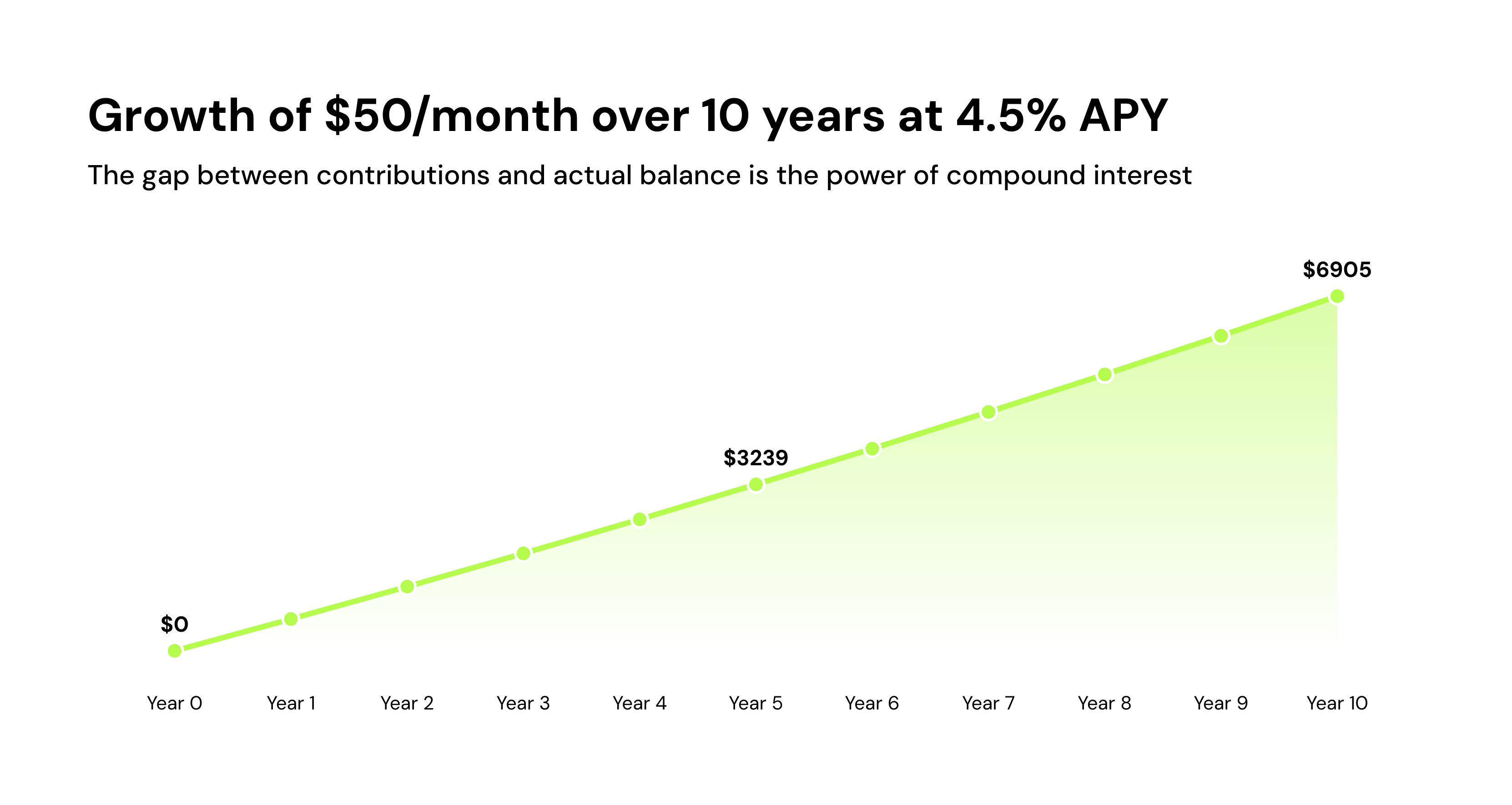
The math doesn't support that logic. Saving $50 a month for ten years at a 4.5% APY grows to over $7,500 without any additional effort. Starting small and starting now will almost always outperform waiting until the amount feels significant.
Not revisiting the strategy
A savings strategy that made sense a year ago may no longer fit your current income, expenses, or goals.
Review your savings plan at least once every six months, or any time your financial situation changes meaningfully, like after a raise, a move, or a major purchase. Adjust your savings rate, your target amounts, and your timeline as needed. A strategy that evolves with you is one you'll actually stick to.
How savings and credit work together
A savings strategy and a credit-building strategy aren't separate things. They're two sides of the same financial foundation.
Strong savings reduce your reliance on credit for unexpected expenses, which means fewer situations where you're forced to carry a high balance or miss a payment. Keeping your credit card utilization low, which is calculated as your balance divided by your total credit limit, is one of the biggest factors in your credit score, making up roughly 30%. The more financial cushion your savings provide, the easier it is to maintain low utilization and consistent on-time payments.
Building that positive payment history over time is exactly what apps like Kikoff are designed to help with. Kikoff reports your monthly payments to all three credit bureaus, making it a simple way to build credit history alongside the savings habits you're already developing.
Conclusion
A savings strategy doesn't need to be complicated to be effective.
Start by defining your goals, understanding your numbers, and picking a budgeting framework that fits how you actually live. Automate what you can, build your emergency fund first, and put your savings in the right accounts for each goal. From there, staying consistent matters far more than getting every detail perfect from the start.
And as your savings grow, so does your financial stability, which makes it easier to keep your credit in good shape along the way. If you're also working on building your credit profile, Kikoff can help you add positive payment history with no hard credit check required.
Frequently Asked Questions
About the editor

Disclaimer: The information provided in this blog post is meant for informational purposes only and does not constitute financial advice.