



When you take out a mortgage, your lender doesn't just hand over money and wish you well. They have a direct financial stake in your home, and that stake gives them significant power over the insurance you're required to carry.
Understanding how lenders influence insurance requirements can save you from surprises at closing, help you avoid costly force-placed insurance, and give you a clearer picture of what you're actually agreeing to when you sign a mortgage.
Let's jump in.
How mortgage lenders influence your insurance requirements
Mortgage lenders effectively function as a co-stakeholder in your home until your loan is paid off.
Because the lender has a financial interest in the property, they set minimum insurance standards to protect that interest. If your home burns down or gets destroyed by a storm, the lender wants to know the collateral backing their loan can be repaired or rebuilt. This means they have both the contractual right and the practical motivation to dictate certain terms of your homeowners insurance policy.
Here's a breakdown of the main ways lenders shape what you're required to carry.
They set minimum coverage amounts
Lenders generally require your dwelling coverage to be at least equal to the loan amount or the home's replacement cost, whichever is greater.
Replacement cost is what it would take to rebuild the home from scratch using current materials and labor costs. This is often higher than the market value of the home, and lenders know that, so they push for replacement cost coverage to ensure there's enough to rebuild if the worst happens. Some lenders will require 100% replacement cost coverage as a baseline condition of the loan.
This matters for you as a buyer because it can rule out cheaper, lower-coverage policies that might technically still meet state minimums. You may be required to purchase more coverage than you would have chosen on your own.
They require you to be named on the policy correctly
It's not just about coverage amounts. Lenders typically require that they be listed as a "mortgagee" or "loss payee" on your homeowners insurance policy.
This means that in the event of a major claim, insurance payouts are made jointly to you and the lender, not just to you. The lender can then ensure the funds are used to repair the property rather than being spent elsewhere. Every individual who has a mortgage should confirm this is set up correctly before closing, because a missing mortgagee listing can create real problems if a claim is filed.
They dictate which perils must be covered
Standard homeowners insurance covers a lot, but lenders in certain areas go further and require coverage for specific perils that a standard policy might exclude.
Flood insurance is the most common example. If your home is in a designated Special Flood Hazard Area, your lender is required by federal law to mandate flood insurance. This is mainly because standard homeowners policies do not cover flood damage at all.
Similarly, lenders in earthquake-prone states like California may strongly encourage or require earthquake coverage, though this is less universally enforced than flood requirements.
They can reject your chosen insurer
Lenders have the right to approve or reject the insurance company you choose.
Basically, if an insurer is financially unstable or not licensed in your state, a lender can refuse to accept that company's policy. Most major national insurers pass this test with no issue, but it's worth being aware of if you're shopping with smaller or regional providers. Just make sure any policy you're considering is from a company your lender will actually accept before you finalize anything.
They can force-place insurance on your behalf
This is the part that surprises lots of homeowners. If you let your policy lapse, fail to renew it, or carry coverage that falls below the lender's minimums, the lender can purchase insurance on your behalf and charge you for it.
This is called "force-placed" or "lender-placed" insurance.
Force-placed policies are generally much more expensive than what you'd find on the open market and usually only cover the lender's interest, not your personal belongings or liability. It's a no-brainer to keep your policy active and compliant to avoid this outcome. Lenders are required to notify you before force-placing coverage, but if you don't respond and correct the issue, they will move forward.
They review your policy at closing and annually
Your lender will request proof of insurance before finalizing your mortgage, and in lots of cases, they'll review it on an ongoing basis.
Your insurance information is usually held in an escrow account, where your monthly mortgage payment includes a portion for insurance premiums. The lender pays your premium directly from that escrow account, which is one way they stay in the loop on whether your coverage remains active and compliant.
If your premium increases and your escrow doesn't cover it, expect your monthly payment to go up accordingly.
Why lenders have this authority
The short answer is that until you pay off your mortgage, the lender technically has a lien on your home.
This lien gives them a legally recognized financial interest in the property. Your mortgage contract, which you sign at closing, spells out the insurance obligations in detail.
This isn't a gray area. It's a contractual requirement, and failing to comply can technically put you in default on your mortgage. The good news is that most of these requirements are reasonable and exist to protect both parties, not just the lender.
What you can and can't negotiate
You have more flexibility than you might think, but within limits.
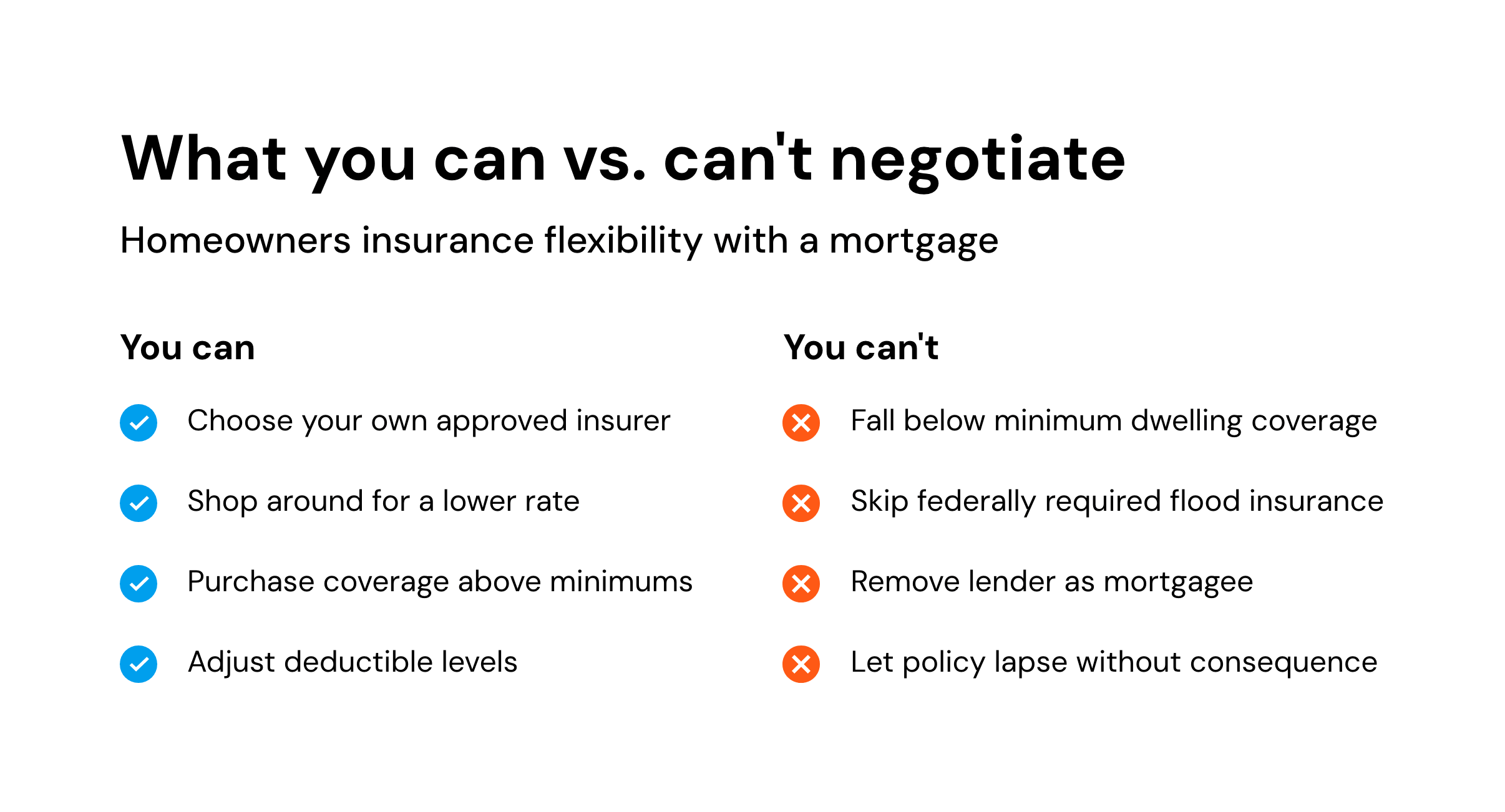
Lenders set floor requirements, not ceilings. You're free to purchase more coverage than the minimum, choose your own insurer from an approved list, and shop around for the best rate on a policy that meets the lender's standards. What you can't do is fall below those minimums or try to skip required coverages like flood insurance in a designated flood zone.
This said, if you think a lender's requirements are unusually strict, it's worth asking for written documentation of exactly what's required so you can shop precisely.
How your credit score connects to all of this
Your credit score plays a larger role in the insurance picture than most people realize.
Insurers in most states use a "credit-based insurance score" to help set your premium. A stronger credit profile generally means lower monthly premiums on your homeowners policy. This means building your credit before applying for a mortgage can effectively lower your insurance costs at the same time it lowers your mortgage rate.
Kikoff helps you build a positive credit history through on-time payment reporting, which is one of the single most impactful factors in your credit profile. Starting before your home search puts you in a better position on both the loan and the insurance side.
Conclusion
Mortgage lenders have broad authority over your homeowners insurance requirements, from minimum coverage amounts to which insurers they'll accept.
The best way to navigate this is to understand what's required before you shop for a policy, keep your coverage active to avoid force-placed insurance, and make sure your lender is listed correctly on your policy from day one. And because your credit score affects what you'll pay for that required insurance, building strong credit ahead of your home purchase is a step worth taking early.
Start building a positive credit history with Kikoff before you ever get to the closing table.
Frequently Asked Questions
About the editor

Disclaimer: The information provided in this blog post is meant for informational purposes only and does not constitute financial advice.