.jpg)



As living expenses continue to rise, many people are turning to credit cards to help them meet basic needs. Credit card debt is higher than ever, but it’s been on the rise for years. Here’s a closer look at credit card debt in the U.S. by year.
Credit card debt in the U.S. by year
| Year | Total U.S. Credit Card Debt (Q4) |
|---|---|
| 2000 | $680 billion |
| 2001 | $703 billion |
| 2002 | $706 billion |
| 2003 | $717 billion |
| 2004 | $740 billion |
| 2005 | $768 billion |
| 2006 | $808 billion |
| 2007 | $850 billion |
| 2008 | $866 billion |
| 2009 | $811 billion |
| 2010 | $733 billion |
| 2011 | $694 billion |
| 2012 | $672 billion |
| 2013 | $683 billion |
| 2014 | $700 billion |
| 2015 | $733 billion |
| 2016 | $779 billion |
| 2017 | $829 billion |
| 2018 | $868 billion |
| 2019 | $927 billion |
| 2020 | $820 billion |
| 2021 | $856 billion |
| 2022 | $986 billion |
| 2023 | $1.129 trillion |
| 2024 | $1.211 trillion |
| 2025 | $1.277 trillion |
How credit card debt has grown over time
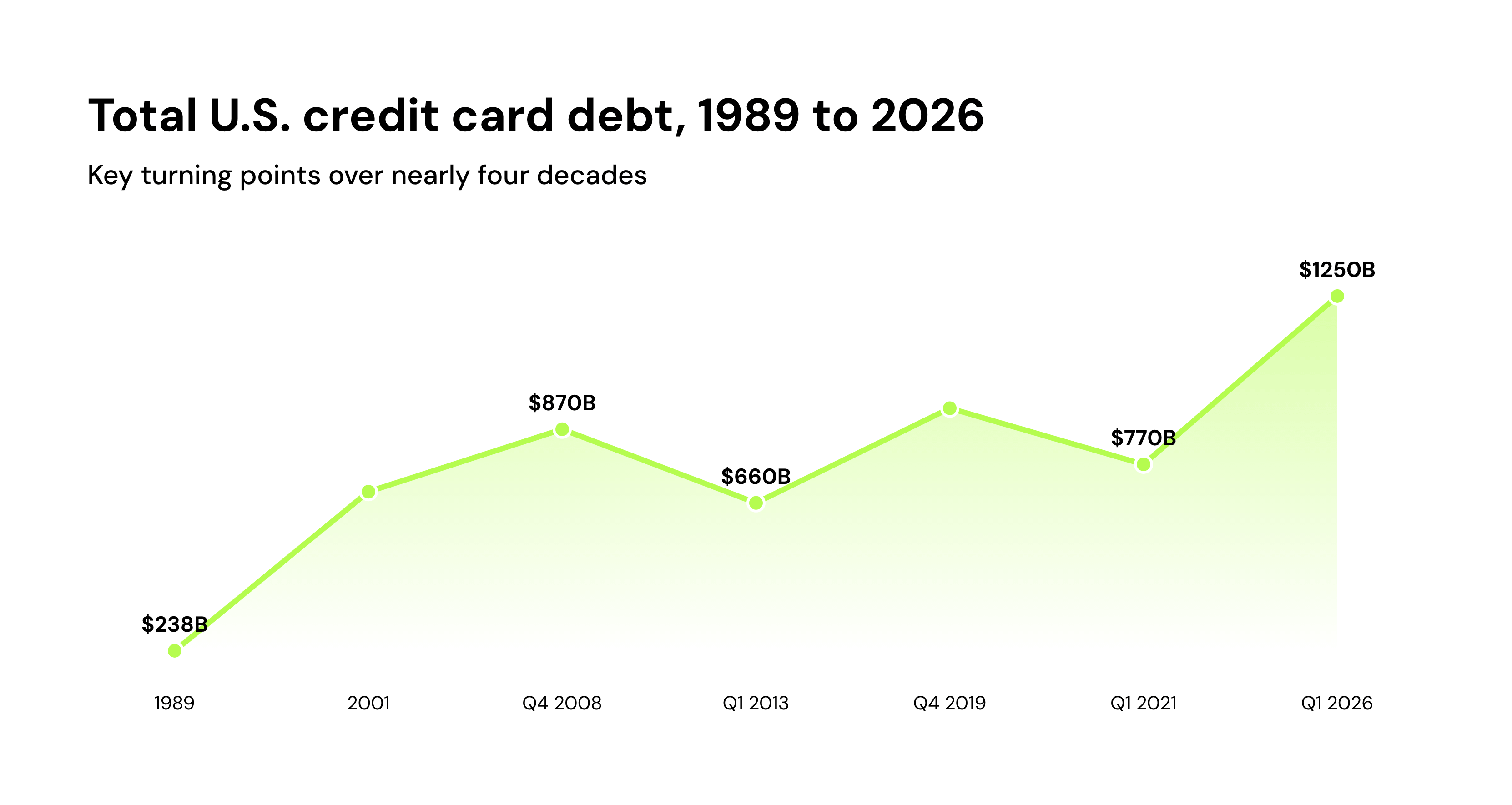
In the first quarter of 2026, credit card debt reached an all-time high of $1.25 trillion.[1] How did we get here? To understand, it’s necessary to go back to the beginning and examine credit card debt in the U.S. by year.
The early years of revolving credit and debt accumulation
The first modern credit card, the Diners Club Card, emerged in 1950. Technically, it was a charge card, meaning the cardholder had until the end of the month to pay off the balance. In 1958, Bank of America launched its BankAmericard, the first revolving credit card.[2]
Unlike charge cards, revolving credit cards allow borrowers to repeatedly borrow and repay money up to a limit. That meant borrowers could carry a balance from month to month.
However, it took time for revolving credit cards to become mainstream. When Bank of America introduced BankAmericard, it was a California bank.
BankAmericard was so popular that it became its own business entity separate from Bank of America, and it began licensing the card to a network of other banks. In 1976, that coalition rebranded as Visa. Another collection of banks had previously formed Interbank (now known as Mastercard) in 1966.[3]
For the first time, millions of consumers had access to credit. Regulators were concerned about predatory practices, and for good reason.
When Bank of America first released BankAmericard, it used a method now called the “Fresno drop”: The company sent ready-to-use credit cards to 60,000 consumers in Fresno, California.[4] These consumers hadn’t applied for or shown interest in the cards previously.
In 1970, legislators passed an amendment to the Truth in Lending Act that explicitly banned the practice.[5] Sending cards to consumers (many of whom were unqualified) led to defaults, but it also led to rampant fraud.
Over the course of the 1970s, many states also passed usury laws capping credit card interest rates at around 18% or less.[6]
Deregulation in the 1980s and the surge in credit card issuance
In the late 1970s and early 1980s, a major Supreme Court decision and a new law stripped away key consumer protections and prompted a significant increase in the total number of credit cards issued.
In 1978, the Supreme Court heard Marquette National Bank of Minneapolis v. First of Omaha Service Corp. First of Omaha Service Corp., the defendant in the case, was a Nebraska-based bank offering a credit card to Minnesota residents.
While the credit card’s interest rates were legal in Nebraska, they exceeded usury limits in Minnesota. Marquette National Bank filed the lawsuit in an effort to force First of Omaha to follow Minnesota’s limits on interest rates.
In what’s now referred to as the “Marquette decision,” the court unanimously ruled that banks may charge interest rates that are legal where they are located. For national banks, “located” meant where the charter was registered.[7]
The decision effectively gutted state usury laws, and many national banks began to relocate to states with relaxed or nonexistent regulations.
The Depository Institutions Deregulation and Monetary Control Act (DIDMCA) of 1980 codified that court decision into law.[8] It gave banks the power to “export” higher interest rates. This meant that if a bank was chartered in a state with minimal usury laws, it could charge that state’s interest rates to consumers in states with tighter regulations.
Deregulation had a profound impact on consumer debt in the decade between 1980 and 1990. Consider the following U.S. credit card debt statistics from that period:[9]
- The number of credit cards issued more than doubled
- Credit card spending increased more than 5x
- The average household’s credit card balance went from a low of $518 to almost $2,700
Bank profits soared, and consumers had more purchasing power than before. However, this sequence of events was laying the groundwork for rapidly increasing consumer debt across the country.
Debt trends through the 1990s and 2000s
The 1990s were a time of unprecedented credit card debt accumulation. From 1989 to 2001, total credit card debt almost tripled:[10]
- 1989: Average family credit card debt $2,697; total credit card debt $238 billion
- 2001: Average family credit card debt $4,126; total credit card debt $692 billion
At the same time, many Americans dealt with declining or stagnating wages and increasing healthcare and housing costs. For some, credit cards were a lifeline to help bridge the gap between income and cost of living.
Because the demand for credit was so high, credit card companies were able to increase interest rates. Many individuals and families couldn’t keep up. During this 12-year period, bankruptcy filings increased by an astounding 125%.[10]
Although increases in credit card debt were seen across income lines, individuals and families with lower incomes predictably saw the most new debt. Here’s a look at the percentage increase in credit card debt from 1989 to 2001 by household income:[10]
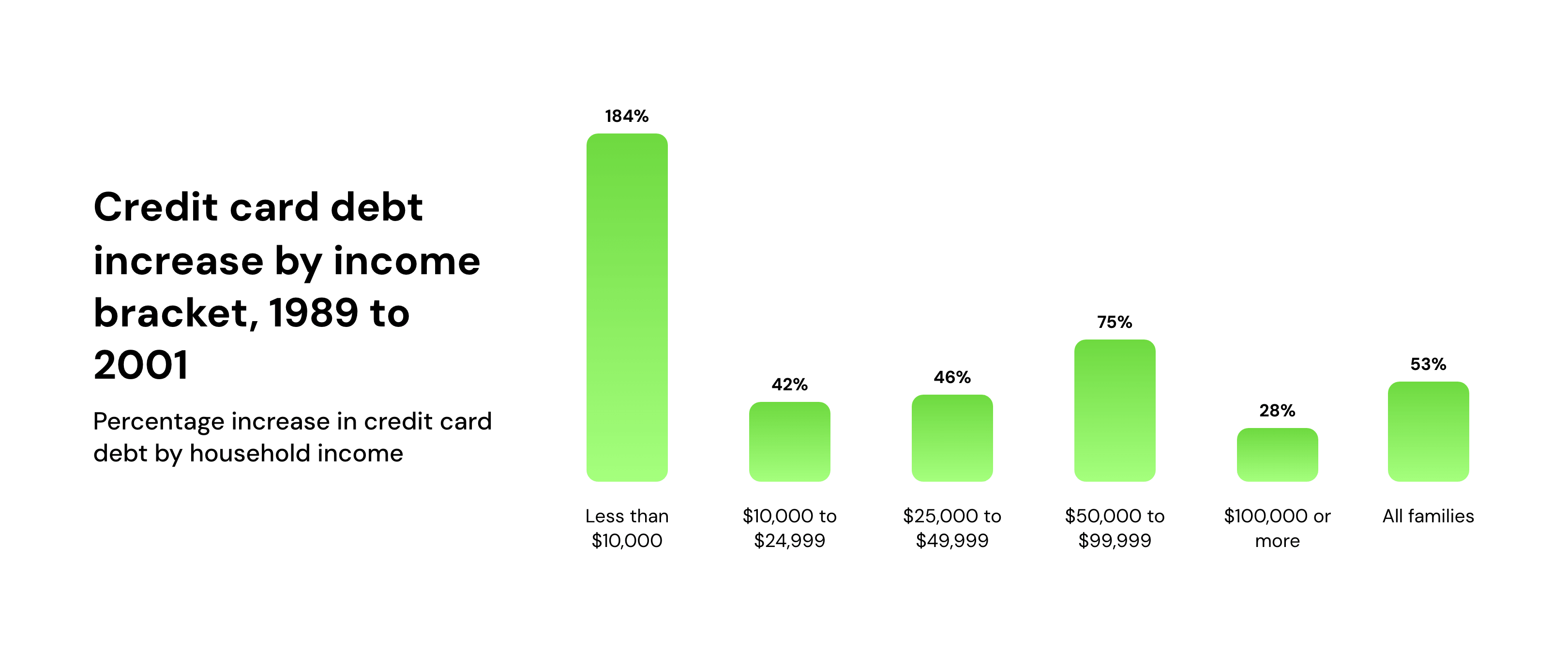
- Less Than $10,000: 184%
- $10,000–$24,999: 42%
- $25,000–$49,999: 46%
- $50,000–$99,999: 75%
- $100,000 or More: 28%
- All Families: 53%
It seemed like the credit card debt in the U.S. by year would only continue its sharp upward trajectory. Total debt began to climb until the 2008 financial crisis.
Key turning points in the credit card debt story
In recent decades, there have been a few major shake-ups in the story of credit card debt.
The 2008 financial crisis and the first major deleveraging
In the fourth quarter of 2008, total credit card debt was about $870 billion.[1] However, that number soon dropped precipitously. During the recession, countless borrowers defaulted. Banks greatly reduced the number of promotional offers they sent out, and consumers who had the means paid down debt.
By the first quarter of 2013, total consumer credit card debt had contracted to about $660 billion.[1] It was the first major consumer deleveraging since the advent of the credit card, and it proved that credit card debt wasn’t necessarily going to increase every year.
The Credit CARD Act of 2009 and its effect on balances
It takes time for consumer protections to catch up to new financial innovations. The Credit Card Accountability Responsibility and Disclosure Act of 2009 (commonly called the CARD Act) introduced a new set of protections for borrowers, including the following:
- Double-cycle billing (which charged interest on already-paid amounts) was banned
- Card issuers were prohibited from raising interest rates in the first 12 months after an account opened
- Before raising rates after 12 months, issuers had to send a notice at least 45 days in advance and provide a reason
- Late, over-limit, and other fees were restricted
- Issuers were required to give cardholders at least 21 days to pay their bill
- Issuers were required to apply payments in a way that favored cardholders
- Issuers were required to add new disclosures (like how long it would take to repay the balance)
The law also introduced new protections for borrowers under 21 and required card issuers to consider a borrower’s ability to pay before approving them.
The CARD Act made it easier for many borrowers to pay down their balances, and it may have contributed to the decrease in credit card balances in the wake of the 2008 recession.
The COVID-19 pandemic and the temporary debt paydown
In the fourth quarter of 2019, total outstanding credit card debt was at $930 billion.[1] However, the response to the COVID-19 pandemic meant consumers were reducing spending. Thanks in part to stimulus payments, many consumers were able to pay down the balances on revolving accounts.[12]
By the first quarter of 2021, credit card balances had shrunk again, this time to about $770 billion.[1]
The post-pandemic surge to record highs
Credit card balances started climbing again after the pandemic and into the present day. These increases are driven partly by inflation. In particular, the drastic changes in the cost of essential items are also causing more people to rely on credit cards.
Consider the following overview of the estimated price increases of some essentials from 2019 to 2025:[13]
- Groceries: 25.1%
- Housing and Utilities: 33.9%
- Car Insurance: 41.2%
During this time, credit card balances fluctuated somewhat but largely stayed on an upward trajectory. Here’s the credit card debt in the U.S. by year (divided into quarters) immediately after the pandemic:[1]
- Q1 2023: $990 billion
- Q2 2023: $1.03 trillion
- Q3 2023: $1.08 trillion
- Q4 2023: $1.13 trillion
- Q1 2024: $1.11 trillion
- Q2 2024: $1.14 trillion
- Q3 2024: $1.17 trillion
- Q4 2024: $1.21 trillion
- Q1 2025: $1.18 trillion
- Q2 2025: $1.21 trillion
- Q3 2025: $1.23 trillion
- Q4 2025: $1.28 trillion
By the first quarter of 2026, total credit card balances stood at $1.25 trillion.
Who carries credit card debt in America?
Credit card debt is an issue for America as a whole. However, some households and individuals are more likely to be in debt than others.
Debt by income level and the concentration among lower earners
Here’s a look at average credit card debt by income percentile:[14]
- Less Than 20% (Median Income $20,540): $3,630
- 20%–39% (Median Income $43,240): $3,840
- 40%–59% (Median Income $70,260): $5,950
- 60%–79% (Median Income $115,660): $7,440
- 80%–89% (Median Income $189,160): $8,900
- 90%–100% (Median Income $390,210): $11,210
That information alone might make it look like credit card debt is more of a problem for those with high incomes. To get a complete picture, however, it’s helpful to look at the approximate ratio of credit card debt to monthly income for each income decile. (The first decile is the lowest-income group, and the 10th is the highest):[15]
- 1st Decile: 85%
- 2nd Decile: 62%
- 3rd Decile: 58%
- 4th Decile: 42%
- 5th Decile: 65%
- 6th Decile: 48%
- 7th Decile: 46%
- 8th Decile: 35%
- 9th Decile: 28%
- 10th Decile: 8%
The higher a person’s total credit card debt is in relation to their income, the more likely they are to have trouble paying it off. Even if individual low-income consumers don’t usually have tens of thousands of dollars in debt, they’re more likely to get trapped in a debt cycle.
Debt by age group and generation
Here’s a breakdown of average credit card debt in America by generation as of 2025:[14]
- Silent Generation (Age 80+): $3,445
- Baby Boomers (Age 61–79): $6,795
- Generation X (Age 45–60): $9,600
- Millennials (29–44): $6,961
- Generation Z (18–28): $3,493
It’s worth noting that, on average, younger people have lower credit limits, so there’s a good chance that younger generations’ credit card balances will increase in the coming years.
Debt by race and the role of unequal credit access
The following is a breakdown of average credit card debt and percentage holding credit card debt by race:[14]
- White: $6,930; 42.20% holding credit card debt
- Black: $4,360; 56.30% holding credit card debt
- Hispanic: $4,150; 55.80% holding credit card debt
- Other: $5,910; 43.30% holding credit card debt
White Americans have higher balances on average, but members of other racial groups more commonly carry a balance on their credit cards.
It’s important to remember that credit card debt is just part of the picture. If someone is unable to access traditional credit when they need it, they may turn to alternative types of credit, like payday or title loans. These loans often have extremely high interest rates, making it much harder to achieve financial stability.
The real cost of carrying a balance
Credit cards help millions of Americans cover unexpected expenses and deal with cash-flow problems. However, if you’re carrying a balance from month to month, it can be costly in the long run.
How interest compounds on revolving balances
Credit card companies calculate interest using something called a “daily periodic rate,” or DPR. The DPR is calculated by dividing your annual percentage rate (APR) by 365 or 360.[16] Card issuers will multiply your DPR by the amount you owe each day.
When you carry a balance from one month to the next, interest compounds, and you end up paying interest on that interest.
Average APR over time and what rising rates mean for borrowers
Before the Marquette decision of 1978, many states capped credit card interest rates at 12%–18%. Since then, interest rates have risen steadily. For major bank credit cards, the average interest rate now sits at more than 25%.[17]
Higher interest rates always mean borrowers pay more over time. However, because credit cards usually compound interest daily, it also means credit card balances are growing faster than before.
The minimum payment trap and how long debt actually lasts
It’s easy to fall into the trap of making only the minimum payment on a credit card. Sometimes, that might be all you can afford. However, if you can manage to pay even a little more, you might be able to save yourself hundreds or even thousands in the long run.
Here’s an example: Imagine you have a credit card with a 25% interest rate and a balance of $5,000. Your card issuer calculates your monthly payment by adding your interest charges and 1% of your balance.
In this situation, your monthly payment would be $154.17. That might sound doable, but assuming you make only the minimum payment (and don’t make additional purchases), it would take you 287 months (almost 24 years) to pay off the balance.
Over that period, you’d pay $9,735.87 in interest alone. This means the total amount you’d pay to the credit card company would be $14,735.87.
FAQ
When did credit card debt start?
Although the first credit card was released in 1950, revolving credit cards (the kind that let you carry a balance) didn’t come out until 1958.
Why does credit card debt keep increasing?
There are several reasons. They include the increasing cost of living, rising interest rates, inflation, and higher credit limits.
What’s the best way to deal with credit card debt?
If you qualify for a lower-interest debt-consolidation loan, that may be a good way forward. If not, you might start by paying extra toward the card with the highest interest rate (the avalanche method) or the card with the smallest balance (the snowball method).
Where credit card debt stands today
Today’s credit card debt figure, $1.25 trillion, is a sobering one. It’s easy to dismiss credit card debt as the result of frivolous spending, but as we’re now seeing, the skyrocketing prices of daily necessities have pushed many people to rely on credit cards to fill in the gaps.
If you’re struggling with credit card debt yourself, it’s easy to feel hopeless. However, by taking the time to educate yourself (like you’re doing now!) and create a debt-repayment strategy that works for you, you can get closer to financial freedom.
Frequently Asked Questions
About the editor

Article Sources
Disclaimer: The information provided in this blog post is meant for informational purposes only and does not constitute financial advice.